The Signal
Researchers report 2.57-fold signal-to-noise gain in hBN magnetometry
A double-quantum protocol produced a 2.57-fold signal-to-noise improvement over a single-quantum measurement under identical conditions, researchers report. The experiment used spin defects in hexagonal boron nitride to detect alternating magnetic fields at room temperature.
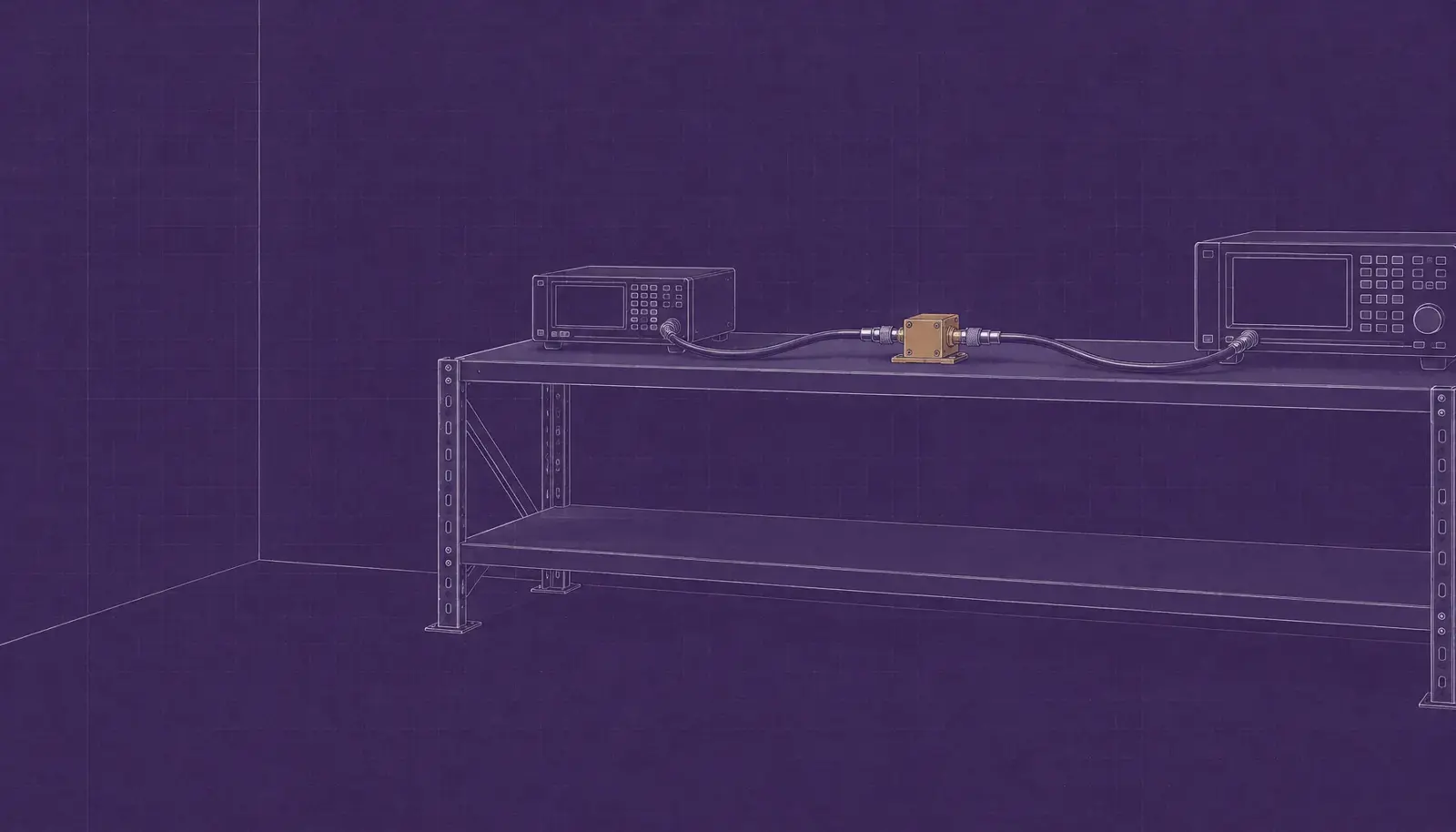
A double-quantum control method produced a 2.6-fold improvement in signal-to-noise ratio for alternating-current magnetometry using spin defects in hexagonal boron nitride, researchers report. The result comes from a preprint posted on November 10 and accepted by Physical Review Applied.
Source arxiv.org
The paper reports a 2.57-fold improvement in a quantum heterodyne measurement compared with a single-quantum spin-echo protocol under identical experimental conditions. The team also reports that optical readout contrast was approximately twice as large with the double-quantum method in its spin ensemble.
Controlling the defects
The experiment centers on negatively charged boron vacancies in hexagonal boron nitride, or hBN. These defects have a spin-triplet ground state that can be initialized and read out optically at room temperature.
The researchers placed an hBN flake several micrometers thick on a coplanar waveguide patterned on a 200-nanometer-thick gold film. Microwave signals delivered through the waveguide generated a local alternating magnetic field at the flake, while a green laser pulse initialized the spin state and fluorescence provided the readout.
Earlier hBN experiments had mainly used the ground-state single-quantum transitions separately. The double-quantum method applies resonant microwave excitation to both transitions at the same time, allowing coherent control of the double-quantum spin manifold.
Comparing magnetic signals
For the comparison, the team applied an external radio-frequency field at 20 MHz and used quantum heterodyne readout to sample the signal phase against a stable classical clock. The double-quantum measurement produced a signal-to-noise ratio of 257, the paper reports.
A single-quantum spin-echo benchmark under the same conditions produced a ratio of 100. The comparison did not require an absolute calibration of the radio-frequency coil.
In another test, the researchers applied a reference signal and a target signal simultaneously. The resulting spectrum resolved components separated by 0.8 MHz, which the team says showed detection of both signals.
Before the heterodyne measurements, the researchers also used spin-echo correlation spectroscopy to detect external alternating magnetic fields at room temperature. With an external radio-frequency signal applied, the Fourier transform of the correlation signal showed a sharp peak at 20 MHz.
Tracing relaxation noise
The researchers also measured double- and single-quantum relaxation rates under different magnetic fields. They used the double-quantum relaxation channel as a probe of electric-field and strain noise affecting the defect spins.
The double-quantum rate decreased as the out-of-plane magnetic field increased and eventually saturated. The single-quantum rate showed no significant variation over the same field range, according to the paper.
The data are compatible with correlated surface fluctuations or fluctuations distributed through the volume, the researchers say. Their analysis disfavors short-range uncorrelated surface-noise models, within its assumptions.
The single-sample measurement constrains the noise channel but does not uniquely establish the microscopic origin or location of the fluctuators. The researchers say controlled studies of thickness, density, temperature or surface treatment will be needed to determine the origin.