The Signal
Antwerp Team Reads Carbon-Nanotube Spins at Room Temperature
A University of Antwerp team reports room-temperature optical readout of triplet spin states in chemically modified carbon nanotubes. The researchers also detect a paramagnetic molecule, but low signal contrast and a noisy antenna demonstra
Quantum.world Team · Written with AI · fact-checked ·
A University of Antwerp team says it can read spin states in chemically modified carbon nanotubes at room temperature, but the signal is faint enough to complicate the path from laboratory result to sensor. In a paper submitted on October 21, the researchers report optical readout and a test detecting a paramagnetic molecule. Their compact antenna demonstration, however, produced a low signal-to-noise ratio and required about an hour of data collection.
Halogen defects trap triplet excitons
The team functionalized chirality-sorted (6,5) single-wall carbon nanotubes with para-halophenyl defects containing chlorine, bromine or iodine. The chemical modifications create sites that trap triplet excitons—excited states with spin—and emit near-infrared light. The defects sit on the nanotube surface, putting them close to molecules around the tube, a useful geometry for sensing.
The researchers used optically detected magnetic resonance, or ODMR, to read the spin states. Laser light prepares a spin-polarized population; applied microwaves drive transitions between spin levels, changing the emitted light. The team observed the effect in room-temperature samples under ambient pressure, using a helium flow in the measurement cavity to limit laser heating. The modified nanotubes showed an emission feature around 1,150 nanometers.
“Here, we demonstrate optical initialization and readout of these triplet states at room temperature, provide proof-of-principle sensing of paramagnetic molecules, and highlight potential for on-chip detection.”
J. Alejandro de Sousa et al., University of Antwerp
TEMPO changes the spin signal
To test sensing, the researchers added TEMPO, a stable free radical, to a dispersion of chlorine-functionalized nanotubes. As TEMPO concentration increased, the ODMR contrast fell: the reported response ranged from a 10% signal decrease at 0.1 millimolar to a 90% decrease at 28.5 millimolar. A chemically similar closed-shell reference, called TEMP, did not change the contrast.
The team attributes the response to interactions between TEMPO’s unpaired electron and the nanotube triplet spins, which alter their spin polarization. Dissolved oxygen did not affect the ODMR contrast in the tests, and the authors say the measurement operates in the near-infrared. The experiment establishes a response to a model radical, not a validated sensor for biological samples or other real-world targets.
Antenna test exposes the engineering gap
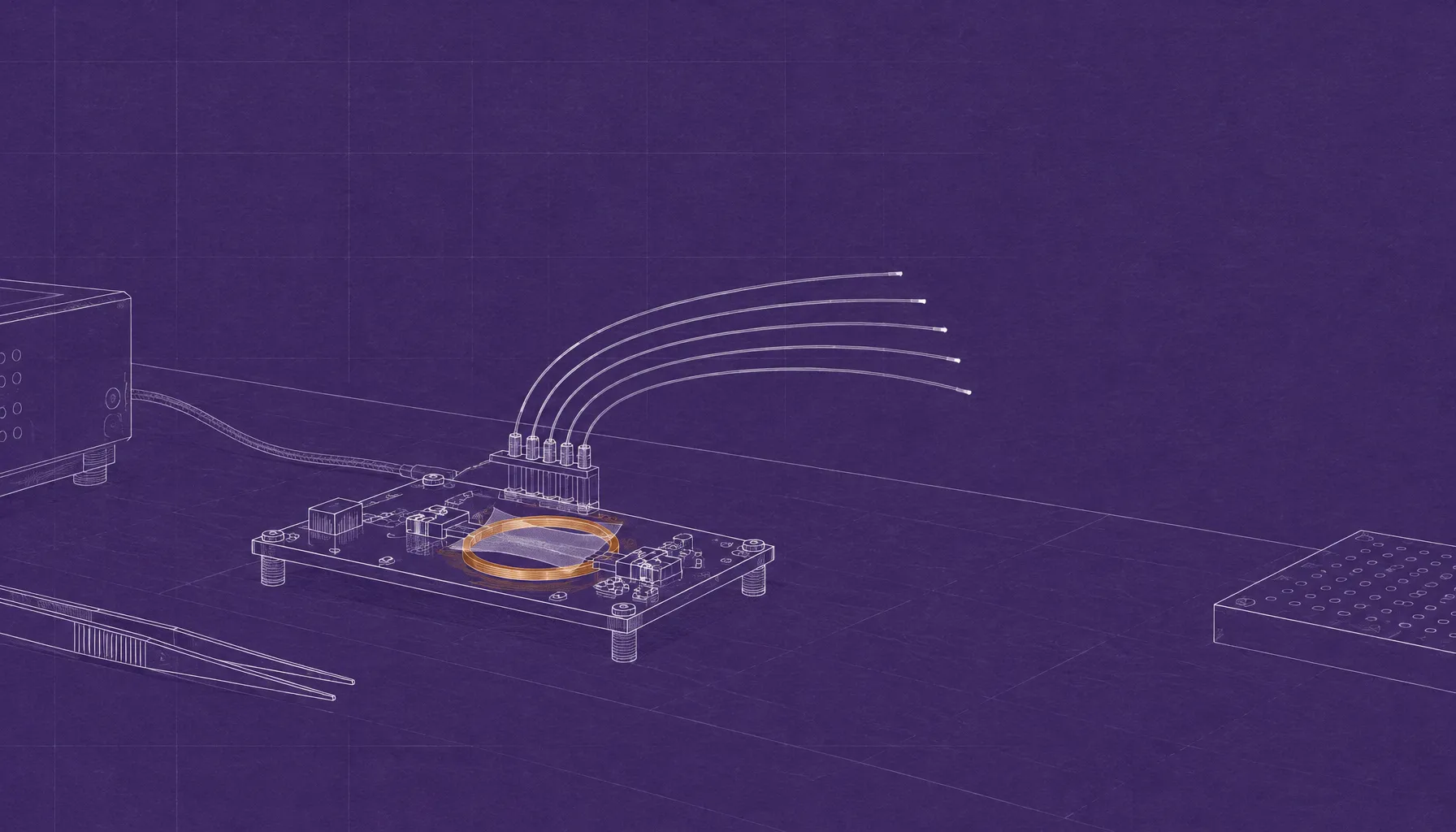
For a more compact setup, the researchers placed a bromine-functionalized nanotube film over a one-millimeter microwave antenna and used optical fibers to deliver excitation and collect emission. The antenna operated across 2.8 to 3.2 gigahertz. After roughly 60 minutes of integration, the team resolved two ODMR features, but the signal-to-noise ratio remained low.
The authors point to heat near the antenna and limits on available microwave and laser power as possible contributors. Their measurements in the standard setup also produced small ODMR contrasts, around 10−4 to 10−3, although the best signal-to-noise ratios reached about 100 before processing. They say improving that contrast is necessary before the approach can become a technology.
The spin mechanism is still unsettled
The signal’s sign and strength vary with the orientation of the nanotubes relative to the magnetic field. One component grows with temperature toward about 150 kelvin and persists at room temperature. The authors propose that thermally activated interactions between dark and bright exciton states may affect how triplet spins become populated, but they say the current data do not establish the mechanism.
The work therefore pairs a clear laboratory demonstration with two concrete constraints: weak optical contrast and a spin-polarization process that is not yet fully explained. The next technical test is whether improved antenna and optical arrangements can strengthen the room-temperature readout without losing the nanotubes’ near-infrared response.