The Signal
hBN Defects Hold Nuclear-Spin Coherence for Up to 1.44 Milliseconds
Researchers report shell-selective control of boron nuclei around defects in hexagonal boron nitride, with Hahn-echo coherence times ranging from 0.33 to 1.44 milliseconds. The findings describe a layered spin system, not a demonstrated qua
Quantum.world Team · Written with AI · fact-checked ·
The longest measured nuclear-spin echo in the study lasts 1.44 milliseconds—about 48 times the 30-microsecond upper end of the electron-spin coherence range cited by the researchers. In a paper published October 26 in Physical Review Letters, a team reports that boron nuclei around defects in hexagonal boron nitride (hBN) form distinct, controllable two-dimensional shells. The shortest measured shell coherence is 0.33 milliseconds.
The result is not a quantum memory demonstration. It is a measurement of nuclear-spin coherence in a material whose layered structure makes nearby groups of nuclei spectroscopically distinguishable, a step toward studying and controlling those groups as a system.
Five shells, five coherence times
The researchers examined negatively charged boron vacancies, defects where a boron atom is missing from the hBN lattice. At a 3-tesla magnetic field, they focused on boron-11 nuclei and used electron-nuclear double resonance spectroscopy to identify groups in successive shells around the vacancy. The reported Hahn-echo coherence times are 1.44 milliseconds for B1, 0.93 for B2a, 0.91 for B2b, 0.73 for B3 and 0.33 for B4′.
Those differences show that coherence depends on a shell’s location and its interactions with the surrounding spins. The innermost B1 group, made up of six nuclei, lasts longest despite having the shortest boron-to-boron distances and stronger direct interactions within the shell. The authors suggest its spectral separation from neighboring nuclei may outweigh sources of dephasing.
“Notably, the six-site B1 shell shows the longest coherence despite having the shortest B-B distances and, hence, the strongest direct intrashell nuclear dipolar interactions.”
G. V. Mamin et al., authors of the paper
A layered crystal sorts the nuclear bath
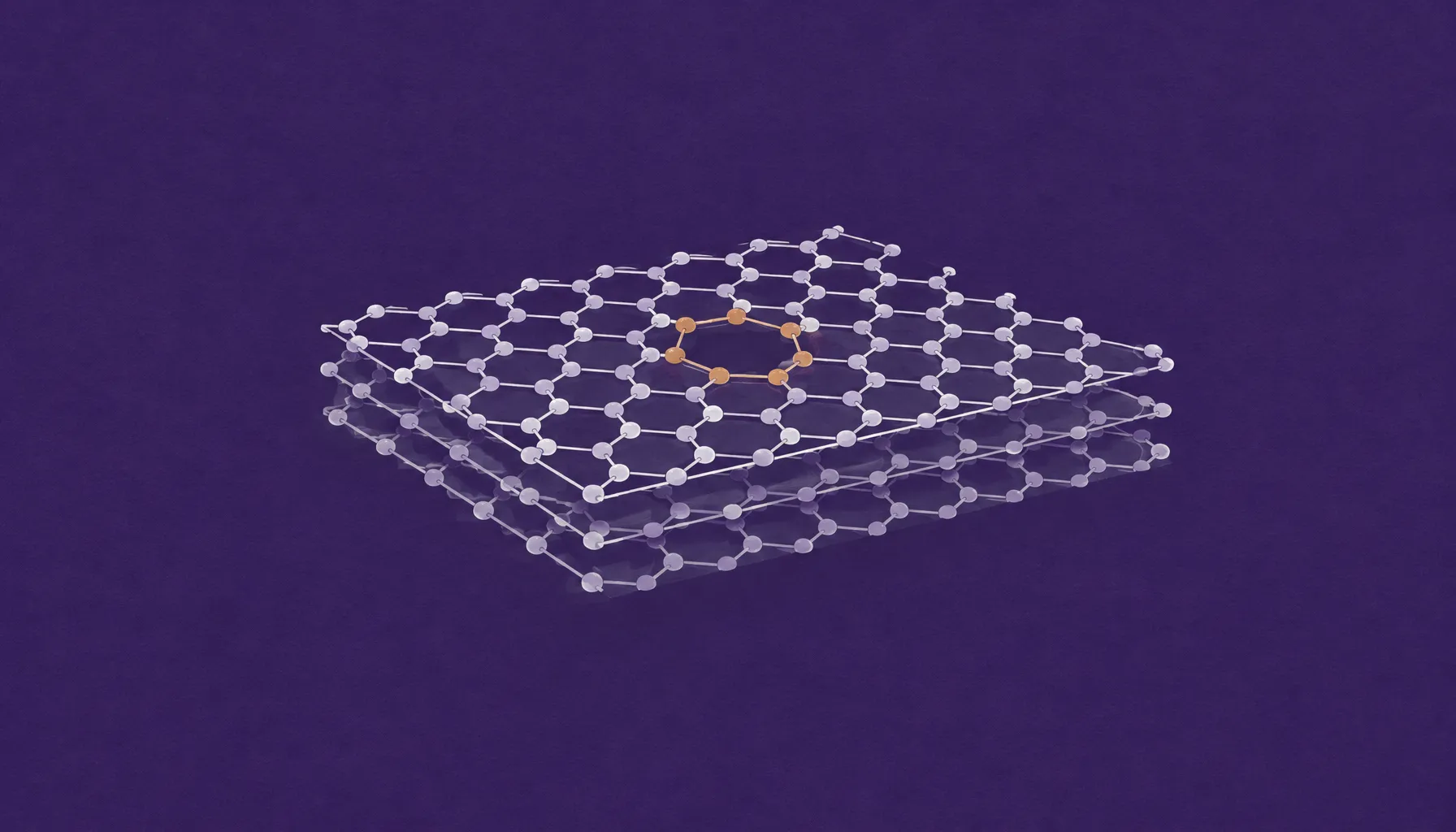
In many solid-state systems, a defect’s electron spin interacts with a surrounding collection of nuclear spins. The hBN structure offers a different arrangement: its boron and nitrogen atoms sit in weakly coupled planes. The team’s spectroscopy and calculations indicate that the defect’s electron spin density stays within the defective layer, so the dominant interactions sort nuclei into discrete planar shells rather than blending them into a broad background.
The evidence also extends across the layers. Boron nuclei in the adjacent layer show quadrupole coupling close to that of pristine hBN, indicating that the defect’s perturbation drops sharply across the gap between planes. A calculation of the ideal two-dimensional lattice finds that the first three in-plane boron shells account for 71.6% of the total ideal in-plane electron-nuclear dipolar hyperfine weight.
Control at 25 kelvin, with a comparison to other platforms
The team created defects in roughly 150-micrometer-thick hBN crystals by irradiating them with 2-million-electron-volt electrons. It collected electron-spin-resonance and double-resonance measurements at 25 kelvin, using a magnetic field of 3 tesla. Radio-frequency pulses drove nuclear-spin oscillations, while a nuclear spin-echo sequence measured how long the shell spins retained coherence.
The measured inhomogeneous dephasing time, T2n*, clusters near 100 microseconds; the longer Hahn-echo values are obtained by refocusing some of that dephasing. The authors say the echo times are comparable to those in III–V quantum dots, but shorter than nuclear-spin memory times in dilute silicon, diamond and silicon carbide systems. They also exceed the microsecond-scale defect-core dynamics previously reported at room temperature, though the current measurements were made at 25 kelvin.
What the measurements establish—and leave open
The work establishes shell-selective coherent control in this hBN defect system, not a complete memory or processor. The authors propose extending the shell framework to other hBN isotopes and identify dynamic nuclear polarization and correlated nuclear-cluster states as possible directions. Those remain prospects; the reported experiments demonstrate resolved shells and millisecond-scale echo coherence.
The paper’s data-availability statement says no research data or software supporting the manuscript are publicly available, and directs requests to the authors. For now, the reported benchmark is five resolved boron shells, with measured Hahn-echo times ranging from 0.33 to 1.44 milliseconds.