The Signal
Adelaide Team Reworks SQUID Arrays to Detect Zero Field
Adelaide University researchers report that bare superconducting loops can give SQUID arrays an absolute magnetic-field response without varying the physical areas of their loops. The design addresses a sensitivity trade-off in existing arr
Quantum.world Team · Written with AI · fact-checked ·
Absolute readings, with a sensitivity trade-off
For SQUID arrays, reading a magnetic field all the way down to zero has come with a design cost: making the loops different areas can compromise the performance of each individual loop. A team at Adelaide University reports a different route, inserting superconducting loops without Josephson junctions into an array whose SQUID loops share the same physical area. The paper appeared in Physical Review Applied on October 26, 2026; the university announced the result the following day.
The work concerns two-dimensional superconducting quantum interference filter arrays, or SQIFs, built from SQUID loops. A conventional SQUID uses superconducting material and Josephson junctions to produce a voltage response that changes with magnetic flux. Arrays can produce sensitive radio-frequency responses, but the researchers say existing designs used as absolute magnetometers require loop areas that are incommensurate—areas that do not share simple whole-number ratios. That spread helps identify an absolute field, but the paper says it conflicts with optimizing the performance of each loop.
Bare loops create a “synthetic area spread”
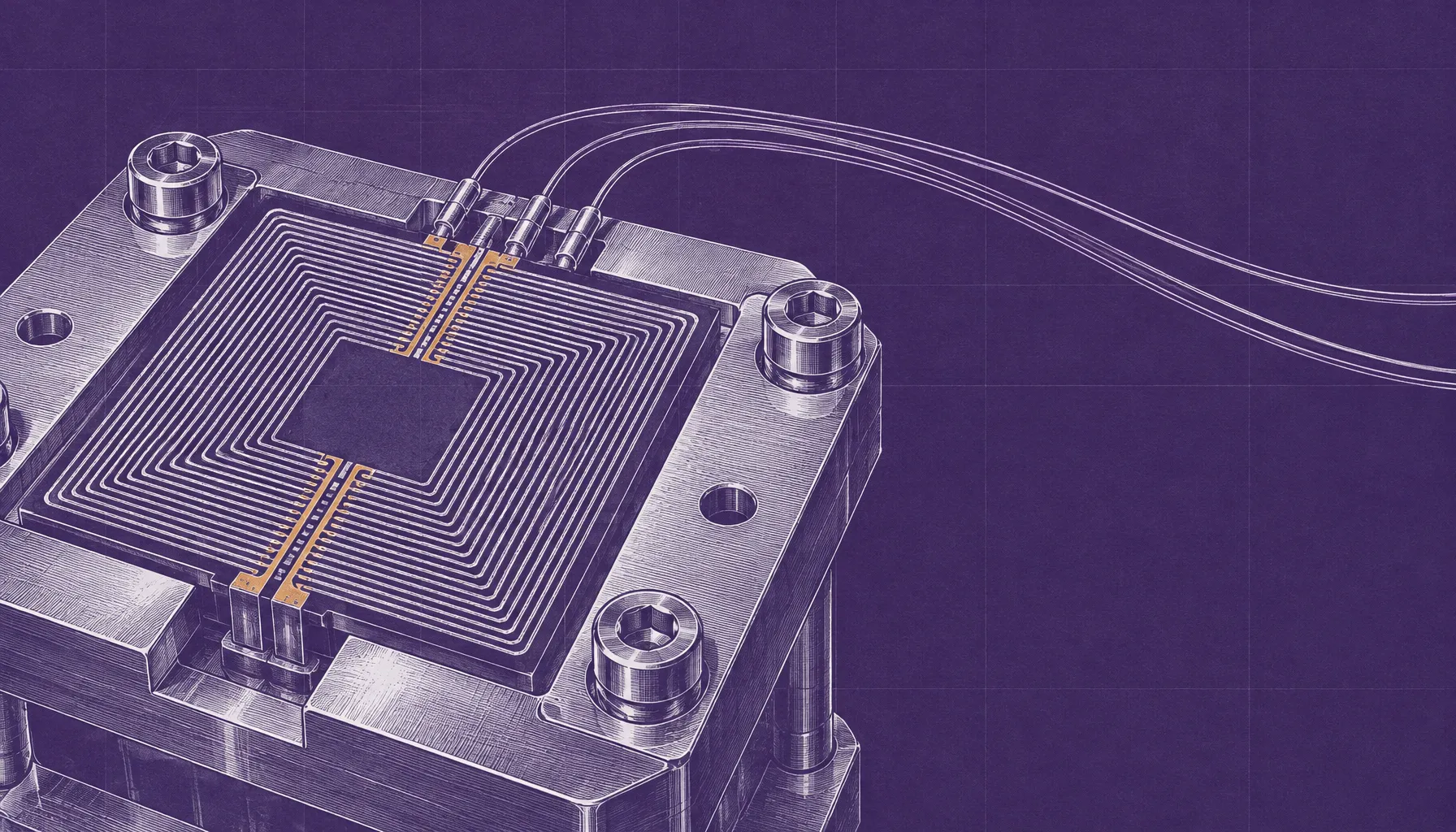
Instead of varying the size of the loops, Ross D. Monaghan, Jonathan L. Marenkovic and Giuseppe C. Tettamanzi place “bare” sections—loops with no Josephson junctions—at selected positions in the circuit. Their arrangement changes how signals move through the array, producing what they call a synthetic area spread: the circuit behaves as though its loops had different areas even though no physical area spread has been introduced.
“In this work, we report that by selectively inserting ‘bare’ sections of a superconducting circuit with no Josephson junctions, 2D SQUID arrays can operate as an absolute magnetometer even when no physical area spread is applied.”
Ross D. Monaghan, Jonathan L. Marenkovic and Giuseppe C. Tettamanzi, Physical Review Applied
The researchers set out an analytical relationship between where the bare loops sit and the equivalent spread of loop areas. That gives designers a way to calculate how a particular pattern of junction-free loops should affect the array’s voltage–magnetic-flux response, rather than relying on differently sized physical loops to generate it.
Fabricated arrays match the theory
The paper reports that the team fabricated several two-dimensional arrays containing bare loops and measured their response. The arrays behaved in line with the theoretical predictions. Adelaide University says the fabricated superconducting circuits operated at very low temperatures, as required for the superconducting devices.
The result supports the design principle in hardware, but it does not establish a finished sensor’s performance in a medical scanner or communications system. The paper describes a route to absolute magnetometry and says the method could support high-performance quantum sensors; it does not report a deployed product or a field-ready brain-imaging device.
Applications remain a next step
Adelaide University points to brain monitoring, radio-frequency receivers, low-noise communications and electromagnetic sensing as possible applications. Those remain prospective uses. The university says further testing is needed before commercialization, while additional studies examine device performance and applications.
The design is also the subject of an international patent application, according to Adelaide University. Its near-term contribution is narrower and concrete: fabricated SQIF arrays with equal physical loop areas can use strategically placed loops without Josephson junctions to reproduce the response associated with an area spread.