The Signal
Paper reports diamond maser gain above 30 dB at 13 mK
A diamond maser using nitrogen impurity spins produced microwave gain exceeding 30 dB at 13 mK, according to a Nature Communications paper. The paper reports about 2.55 quanta of added noise above the standard quantum limit and describes limits on the device’s measured noise.
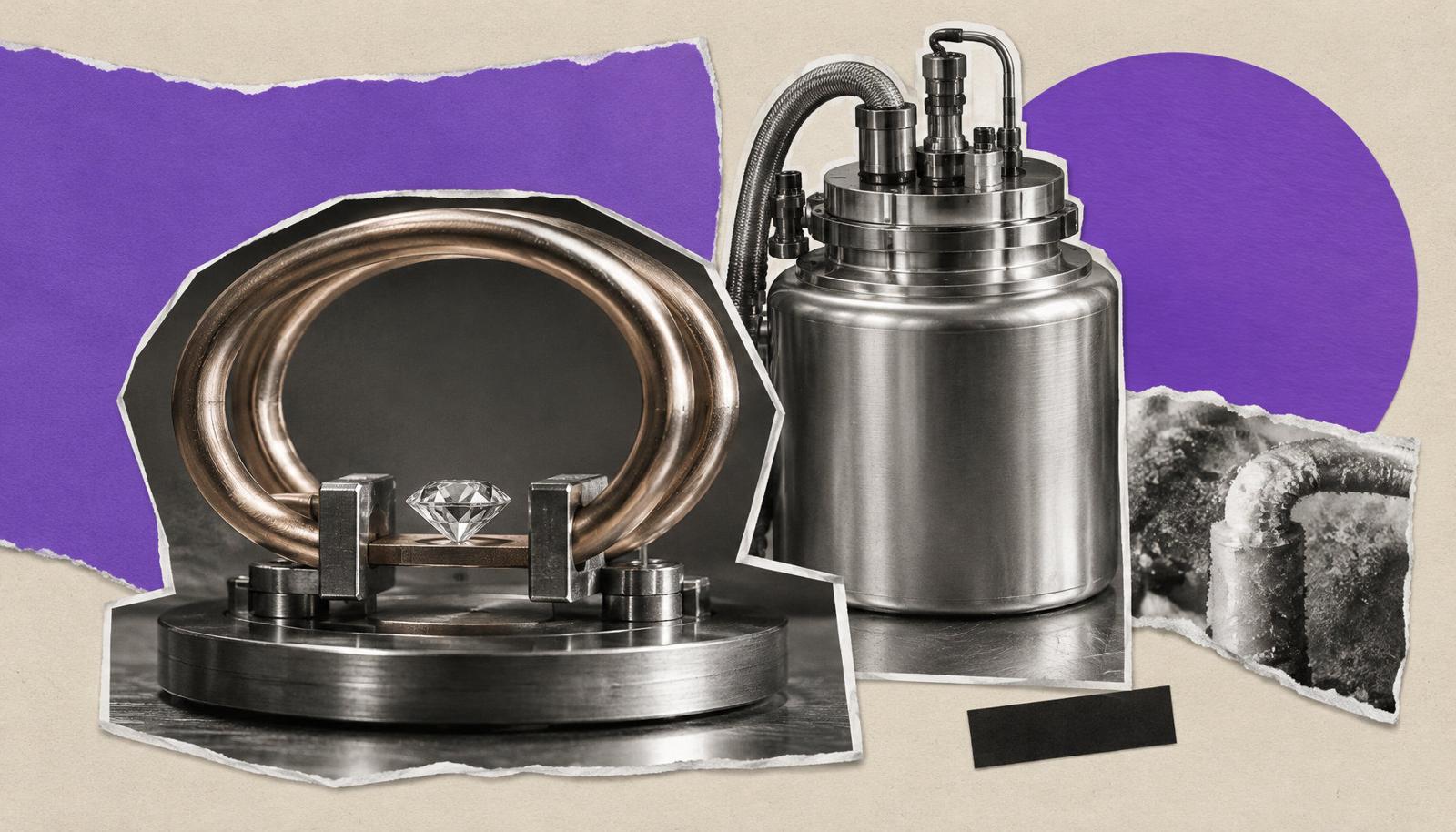
A diamond maser amplifies at millikelvin temperatures
An impurity-spin maser in diamond delivered microwave gain exceeding 30 dB while adding about 2.55 quanta of noise above the standard quantum limit at millikelvin temperatures, according to a Nature Communications paper published November 16, 2026. The device operated at 13 mK and used microwave-pumped P1 centres in diamond; the paper describes it as a non-superconducting amplifier.
Spin-based amplification
The amplifier consists of a diamond crystal inside a loop-gap microwave resonator. The crystal contained approximately 16 ppm of P1 centres, nitrogen impurities whose electron spins act as the amplifying medium. The resonator frequency was approximately 6.595 GHz, with internal and external quality factors of approximately 2600 and 250, respectively. The device was thermalised to the mixing chamber plate at 13 mK in a dilution refrigerator.
The team produced population inversion by pumping the P1 centres with microwaves and using a four-spin cross-relaxation mechanism. The P1 centres were pumped at 6.501 GHz, while the resonator operated at 6.595 GHz. The paper says amplification comes from stimulated emission rather than wave-mixing processes.
Gain, bandwidth and noise
At a pump power of −39 dBm, the measured gain exceeded 30 dB, with a bandwidth of approximately 70 kHz and a gain-bandwidth product of 2.8 MHz. The paper reports a maximum 1 dB output compression point of −63 dBm at 6.595 GHz. It also reports that changing the static magnetic field tuned the gain profile over 10 MHz in central gain and about 6 MHz in full-width at half-maximum.
To assess noise, the researchers compared measurements with the maser switched on and off. They measured a pump-on/off signal-to-noise ratio change of approximately 6 dB. After accounting for measured insertion loss of 1.6 dB, the paper gives an SNR improvement of approximately 4.4 dB.
Limits and possible improvements
The reported noise is constrained, the paper says, by slow relaxation of the P1− spins, at approximately 0.95 × 10⁻³ s−1. That rate limits the effective pumping of P1+ spins. With a slightly faster P1− relaxation rate of 1.2 × 10⁻³ s−1, the paper estimates noise could fall to 1.94 quanta.
The paper estimates that increasing the resonator’s internal quality factor to approximately 105 could further reduce loss-related noise, bringing the estimate to 1.70 quanta. It also discusses other spin systems and pumping schemes as possible ways to improve population inversion. The study was published in Nature Communications on November 16, 2026.