The Signal
PRX Quantum paper reports erbium memory storing 70 temporal modes
A spin-state memory using an erbium-doped crystal stored 70 temporal modes and reached classical efficiencies up to 81%. The PRX Quantum paper also reports quantum storage and entanglement, while identifying limits on storage time and efficiency.
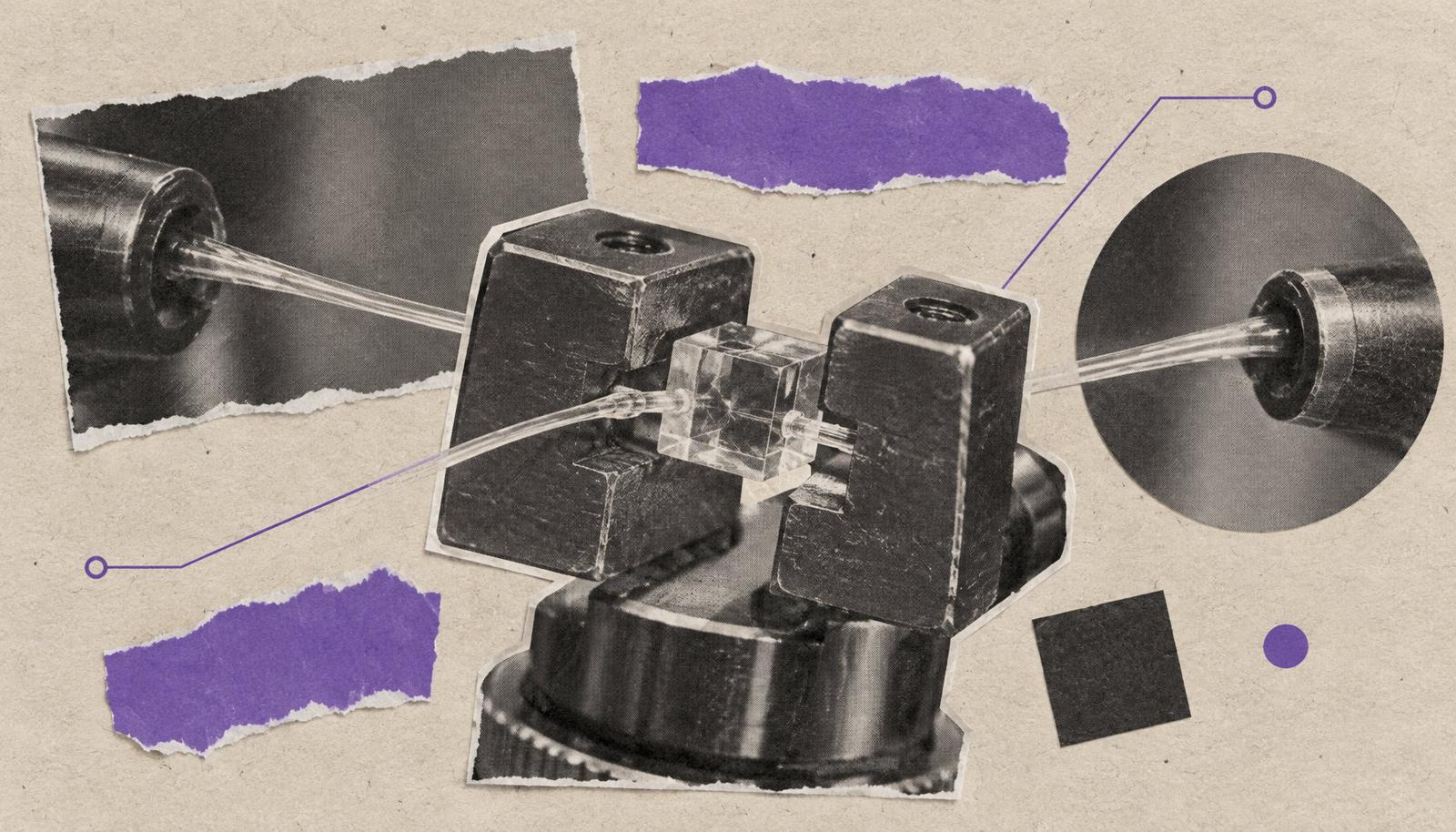
An erbium-based spin-state memory stored 70 temporal modes, with classical storage efficiency reaching up to 81%, according to a paper published in PRX Quantum on November 13. The experiment also demonstrated quantum storage and entanglement between an output optical state and the state retained in the memory. The work was by James Stuart, Kieran Smith, Morgan Hedges, Rose Ahlefeldt and Matthew Sellars of the Australian National University.
Source journals.aps.org
A telecom-compatible crystal
The researchers used a crystal of yttrium orthosilicate doped with erbium-167. Its optical transition was at 1538 nanometers, in the telecom C-band. The crystal was cooled to 1.5 kelvin in a pumped liquid-helium cryostat, with a magnetic field of 6 tesla applied during the experiments.
The team used the rephased amplified spontaneous emission protocol, which stores information in the erbium ions’ spin states before recalling it as light. The paper describes a spin-state storage time of 25.1 microseconds and a write-time of 157.8 microseconds. Write-time is the period available to encode information before it must be transferred to the spin transition.
Efficiency and quantum correlations
In classical measurements, the authors report a peak efficiency of 81% at 36 decibels of gain. They also demonstrated 70 temporal modes, using time-separated optical fields. The paper reports that the entanglement between an output state and the state in memory violated an inseparability criterion by 3.7 standard deviations.
The quantum-level measurements used a lower gain of 7 decibels, corresponding to an efficiency of 17%, which the researchers selected to avoid classical noise. The reported 81% efficiency therefore applies to the classical measurements, not those quantum-level measurements.
Limits and proposed changes
The paper says the measured 25-microsecond storage time was limited by dephasing on the hyperfine transition; microwave rephasing pulses were not applied. The authors describe longer storage as a possible next step, saying rephasing pulses could extend it toward the material’s coherence times. They also estimate that changes to the pulse sequence could raise efficiency above 90% in the quantum regime. Those improvements are proposals, not results demonstrated in this experiment.
In the preprint version, the authors describe the 81% result, obtained in the classical regime, as the highest storage efficiency seen with any rare-earth quantum-memory protocol. They note that the demonstrated 70 temporal modes were within the material’s limits and discuss spectral multiplexing as a way to increase capacity; the paper gives a calculated capacity of up to 10⁴ spectro-temporal modes per spatial mode.
Sources
Related stories
- Preprint finds quantum memory can evade every pairwise test
- Nanjing Researchers Design a Bosonic Memory That Can Sense Force
- Nature Paper Reports a Carbene Molecule With Optical Spin Readout and Millisecond Coherence
- Oxford Stores Remote Ion Entanglement in Calcium for 10 Seconds
- Single-Ion Error Correction Extends Qubit Lifetime 12.9-Fold