The Signal
Oxford Stores Remote Ion Entanglement in Calcium for 10 Seconds
An Oxford quantum-network experiment transferred entanglement between remote strontium ions to calcium memory qubits and stored it for about 10 seconds. The study also created mixed-species entangled states involving as many as four matter
Quantum.world Team · Written with AI · fact-checked ·
Calcium memory qubits retained 69(4)% entanglement fidelity after 10 seconds in an Oxford quantum-network experiment, while a fitted decay time constant reached 14(4) seconds. The result, published October 13 in Physical Review Letters, stores entanglement between matter qubits in separate network modules for more than 100 times the average time needed to create it.
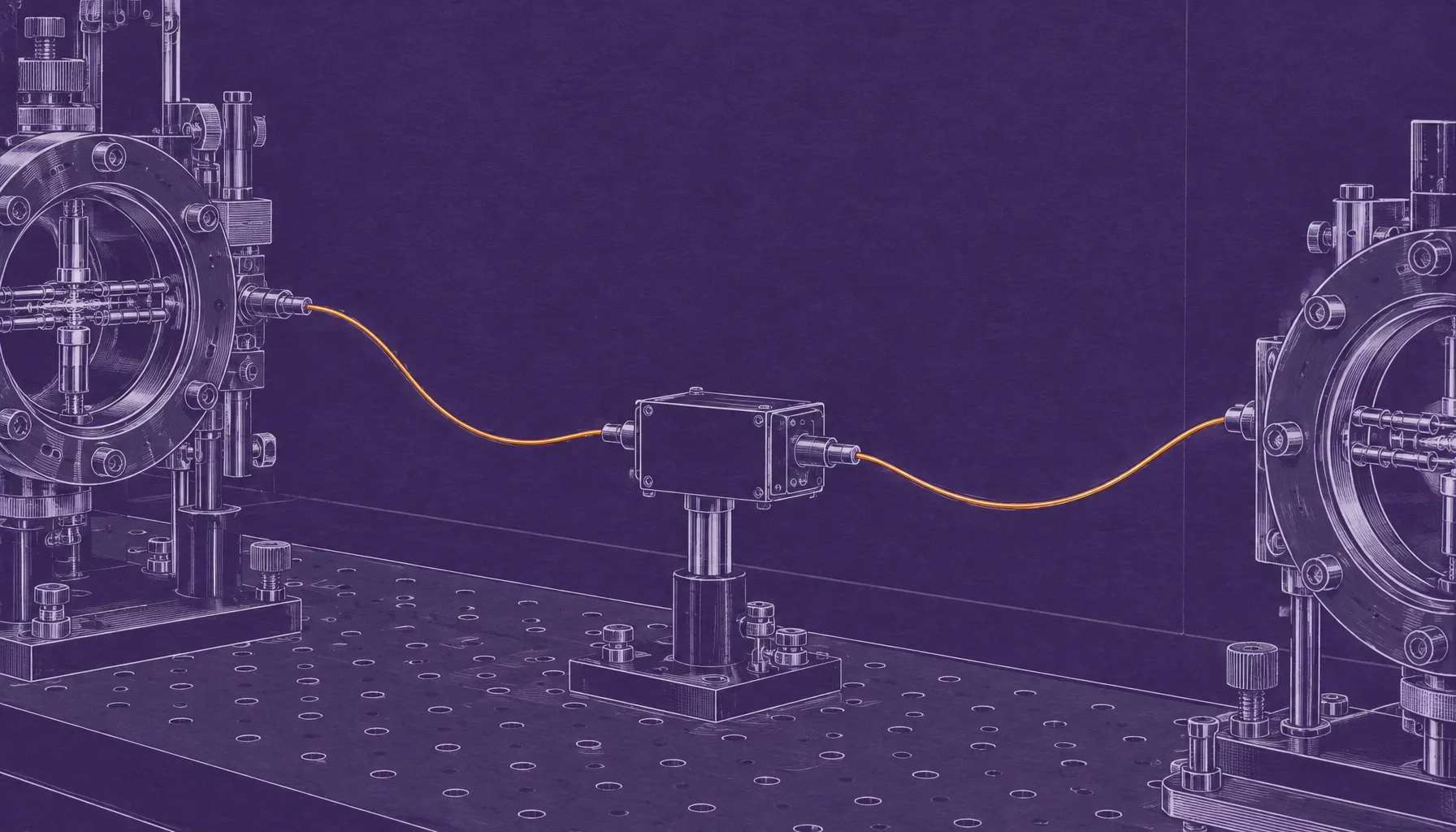
The team used two trapped-ion modules linked by an optical fiber. Strontium ions generated the remote link; local operations then transferred the shared quantum state to calcium ions, which held it longer. The experiment also produced entangled states involving up to four matter qubits.
Calcium holds 69% fidelity after 10 seconds
The 14-second figure is an exponential decay time constant, not a promise that every stored state stays intact for exactly that long. At the directly measured 10-second mark, the researchers report 69(4)% fidelity for the remote entanglement stored in calcium. The distinction matters: the measured point describes the state at a chosen storage duration, while the fitted constant summarizes how fidelity falls over time.
The comparison with the strontium network qubits shows why the group split networking and storage between two ion species. The paper reports a 44(3)-millisecond decay time constant for remote entanglement held in the network qubits, compared with 14(4) seconds for the calcium memories. The authors say the memory result exceeds the average entanglement-generation time by more than a factor of 100.
“We demonstrate storage of the remotely entangled memory qubits for ∼10 s, more than 100× the state creation time.”
D. Main and co-authors, authors of the paper
Strontium carries the link; calcium keeps the state
Each module contains a strontium-88 ion and a calcium-43 ion. Photons emitted by the strontium ions travel through the fiber link and meet at a central station; a particular detection outcome signals entanglement between the distant strontium ions. Local mixed-species logic gates then extend or transfer that entanglement to calcium memory qubits held alongside the strontium ions.
The arrangement assigns different tasks to the two species. Strontium supplies the optical connection between modules, while the selected calcium states are less sensitive to magnetic-field noise and serve as longer-lived storage. The researchers used local gates and measurements to create remotely entangled strontium-calcium and calcium-calcium pairs, as well as mixed-species Greenberger-Horne-Zeilinger states.
Four-qubit states extend the network’s entanglement
The network produced states involving two, three and four matter qubits. The paper reports mixed-species Greenberger-Horne-Zeilinger states of up to four qubits. Those results show the team combined remote photon-mediated entanglement with local operations on different atomic species, rather than demonstrating storage alone.
The work remains a two-module trapped-ion experiment, not a deployed quantum repeater or a demonstration of a multi-node network. Its reported measurements establish a specific capability: calcium can store remote entanglement for seconds in this setup, while the measured fidelity falls to 69(4)% at 10 seconds. How that performance carries over to longer links and larger networks remains an open technical question.