The Signal
Researchers Demonstrate a Single-Molecule Spin–Photon Interface
Researchers report a carbene molecule that combines optical spin readout with millisecond-scale coherence at 4.5 K. The work demonstrates single-molecule addressability, while photon emission efficiency remains a limitation.
Quantum.world Team · Written with AI · fact-checked ·
A molecular spin can hold quantum information, but linking that spin to light is a demanding test for a quantum-network node. In a paper published by Nature on October 28, 2026, researchers report a single carbene molecule that combines optical spin readout with millisecond-scale coherence at 4.5 K. Its estimated net emission efficiency into the zero-phonon line is about 2.1%, leaving photon output as a limitation.
A carbene in a matched crystal
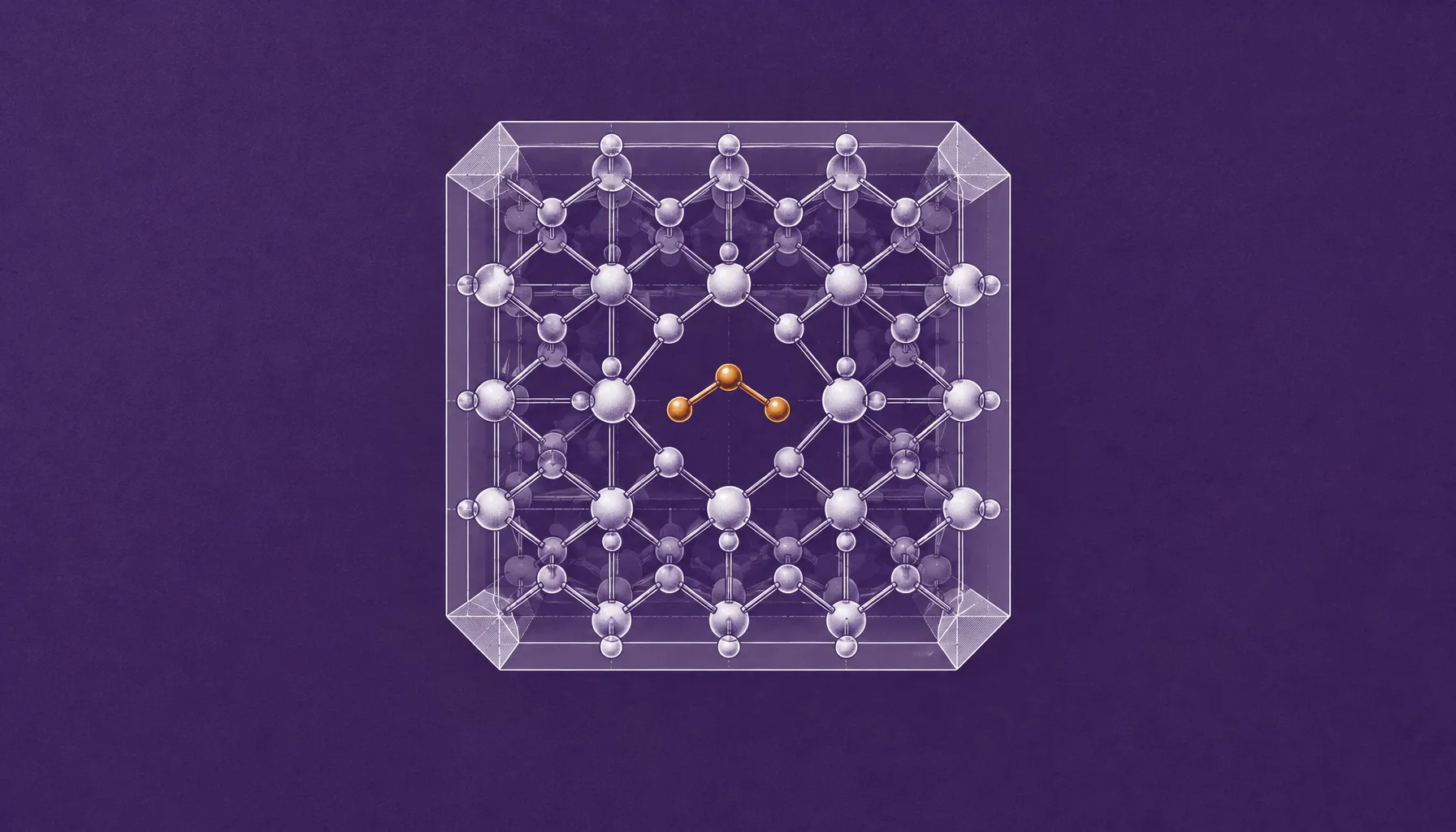
The team embedded a triplet-ground-state carbene, di([1,1′-biphenyl]-4-yl)carbene, in a crystalline host made from a structurally similar ketone. This matched host let the researchers address individual molecules rather than relying only on measurements averaged across a bulk ensemble. The authors describe the system as combining single-molecule addressability with narrow zero-phonon lines, stable emission and optical transitions that depend on spin state.
The molecule’s spin comes from two unpaired electrons associated with the central carbon and nearby aryl units. The researchers chose a rigid crystal structure to limit changes in molecular geometry when the molecule is optically excited. The paper explains that this can direct more emission into the zero-phonon line, the optical transition without accompanying vibrational excitation.
“Here we show that a triplet ground-state carbene molecule, embedded within a structurally matched host crystal, functions as a robust spin–photon interface with single-molecule addressability.”
Simon Roggors and co-authors write in the Nature paper.
Optical readout and spin control
The paper reports spectral stability lasting more than an hour and a 38 MHz optical linewidth. Spin-selective optical transitions are separated by more than 1.5 GHz, allowing the researchers to distinguish spin states through their optical response. They also demonstrate single-molecule optically detected magnetic resonance, a technique in which changes in fluorescence reveal the spin’s response to microwave control.
Microwave pulse sequences let the team manipulate the molecule’s electron spin. Under an XY8 dynamical-decoupling sequence, the measured coherence time was 2.2(3) milliseconds, while the spin-lattice relaxation time was 21(2) milliseconds. The ordinary Hahn-echo coherence time was 12.2(6) microseconds. The contrast shows that the longer coherence result was obtained with repeated control pulses, rather than with a simple echo sequence.
A photon-efficiency limitation
The paper reports a photoluminescence quantum yield of 10.8% and a Debye–Waller factor of 19%. The latter describes the fraction of fluorescence in the zero-phonon lines; combining it with the quantum yield gives an estimated net zero-phonon-line emission efficiency of about 2.1%. The authors compare that net efficiency with the nitrogen-vacancy centre in diamond. It is not the fraction of all emitted fluorescence in the zero-phonon lines.
The measurements establish an individually addressable molecular spin with optical readout at 4.5 K. They do not demonstrate entanglement between remote nodes or a deployed quantum link. The paper presents the work as a molecular platform for single-emitter quantum optics, with photonic integration and conversion of visible photons to telecom wavelengths identified as steps toward networking applications.