The Signal
Laser-Controlled Ytterbium Atoms Reject Magnetic Noise More Than 30,000-Fold
Researchers co-trapped two ytterbium isotopes in an optical lattice and used their spin precession to suppress magnetic-field noise. The comagnetometer also measured the ratio of the isotopes’ nuclear magnetic moments to 4 ppm precision.
“We achieve a magnetic noise suppression factor exceeding 3×10⁴, and determine the ratio of nuclear magnetic moments to 4 ppm precision.”
J.-L. Zhang, W.-T. Luo, Y. A. Yang, Y.-Q. Wang, T. Xia and Z.-T. Lu, study authors
That result from a team at the University of Science and Technology of China anchors a Nature Photonics News & Views published October 30. The underlying research, published in Nature Photonics on August 17, pairs two ytterbium isotopes in one optical lattice and compares their nuclear-spin precession. The technique aims to cancel magnetic-field fluctuations while retaining sensitivity to other shifts in the atoms’ energy levels.
Two ytterbium isotopes share one trap
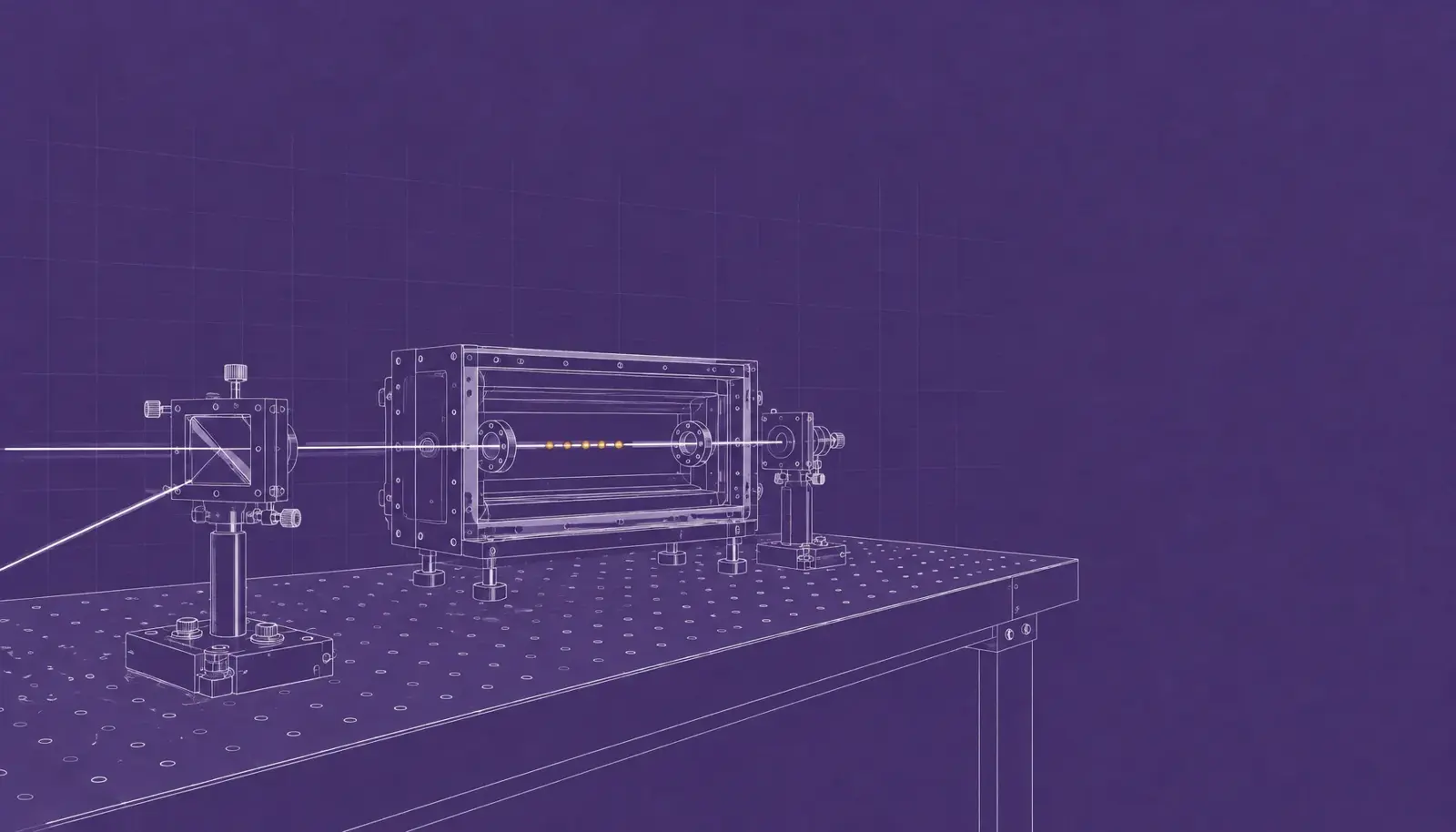
The instrument confines ytterbium-171 and ytterbium-173 together in a one-dimensional optical lattice. Their nuclear spins differ: 171 has spin 1/2, while 173 has spin 5/2. The researchers report about 20,000 atoms of each isotope, held across roughly 160 lattice sites in a cloud about 40 micrometres wide and 80 micrometres long.
A comagnetometer measures both species at the same time and place, then compares their Larmor frequencies—the rates at which their spins precess in a magnetic field. Because the isotopes respond differently to magnetic and nonmagnetic effects, taking the frequency ratio can suppress shared magnetic noise while leaving a route to detect shifts that do not come from magnetism. That makes the arrangement relevant to searches for new spin-dependent interactions, not just measurements of magnetic fields.
Laser control tackles light shifts
The lattice light itself can disturb the spins, so the team had to limit those shifts as well as environmental magnetic noise. Linear polarization suppresses vector light shifts in the lattice; for the higher-spin 173 isotope, the researchers use a Schrödinger-cat spin state to reduce sensitivity to tensor light shifts. A separate 556-nanometre Rabi beam drives the transitions used to prepare that state.
The control does not remove every light-related effect. The authors found that a small misalignment between the magnetic field and lattice polarization lets tensor light shifts couple to the Zeeman effect, changing the 173 isotope’s precession. They characterized that systematic shift and adjusted the operating conditions; their measurements also show that the cat-state coherence is limited to 60 seconds by collisions between the two isotopes, despite a much longer coherence time for 173 ytterbium without those collisions.
What the 30,000-fold figure measures
The reported suppression factor comes from testing the comagnetometer at magnetic fields of 50 and 100 milligauss. Although doubling the field doubles each isotope’s Larmor frequency, the measured frequency ratio stays constant to about 10 parts per million. From the two measurements and their uncertainties, the team calculates a magnetic-noise suppression factor greater than 30,000 at 95% confidence.
That figure describes rejection of magnetic-field fluctuations in the comagnetometer ratio; it is not a general claim that every source of sensor noise falls by the same amount. The experiment also determines the ratio of the isotopes’ nuclear magnetic moments to 4 ppm precision. Its final value, −0.726076(3), agrees with the previously recommended value and improves the measurement precision by an order of magnitude.
A sensor with micrometre-scale reach
The atoms occupy a cloud only tens of micrometres across, giving the platform a smaller sensing region than gas-cell comagnetometers. The paper identifies searches for exotic interactions at ranges of 1 to 100 micrometres as a potential application. Those searches are a prospective use of the apparatus, not a result of this experiment.
For now, the demonstrated result is a shared optical trap, 60 seconds of measured spin coherence, and a frequency ratio that stays stable as the applied field doubles from 50 to 100 milligauss.
Sources
Related stories
- Researchers report 2.57-fold signal-to-noise gain in hBN magnetometry
- Adelaide Team Reworks SQUID Arrays to Detect Zero Field
- PRL paper uses cavity photon loss to sense qubit noise
- Jin, Ye and Ma Propose Faster Quantum Noise Spectroscopy
- Ott and Colleagues Use Logical Qubits to Find Rare Signals in Noise