The Signal
Researchers Observe a Room-Temperature Quantum Supersolid
Researchers report observing a supersolid phase in an exciton-polariton condensate operating at room temperature. The experiment used a liquid-crystal microcavity, and laser pulses revealed a repeating pattern whose position changed from one pulse to the next.
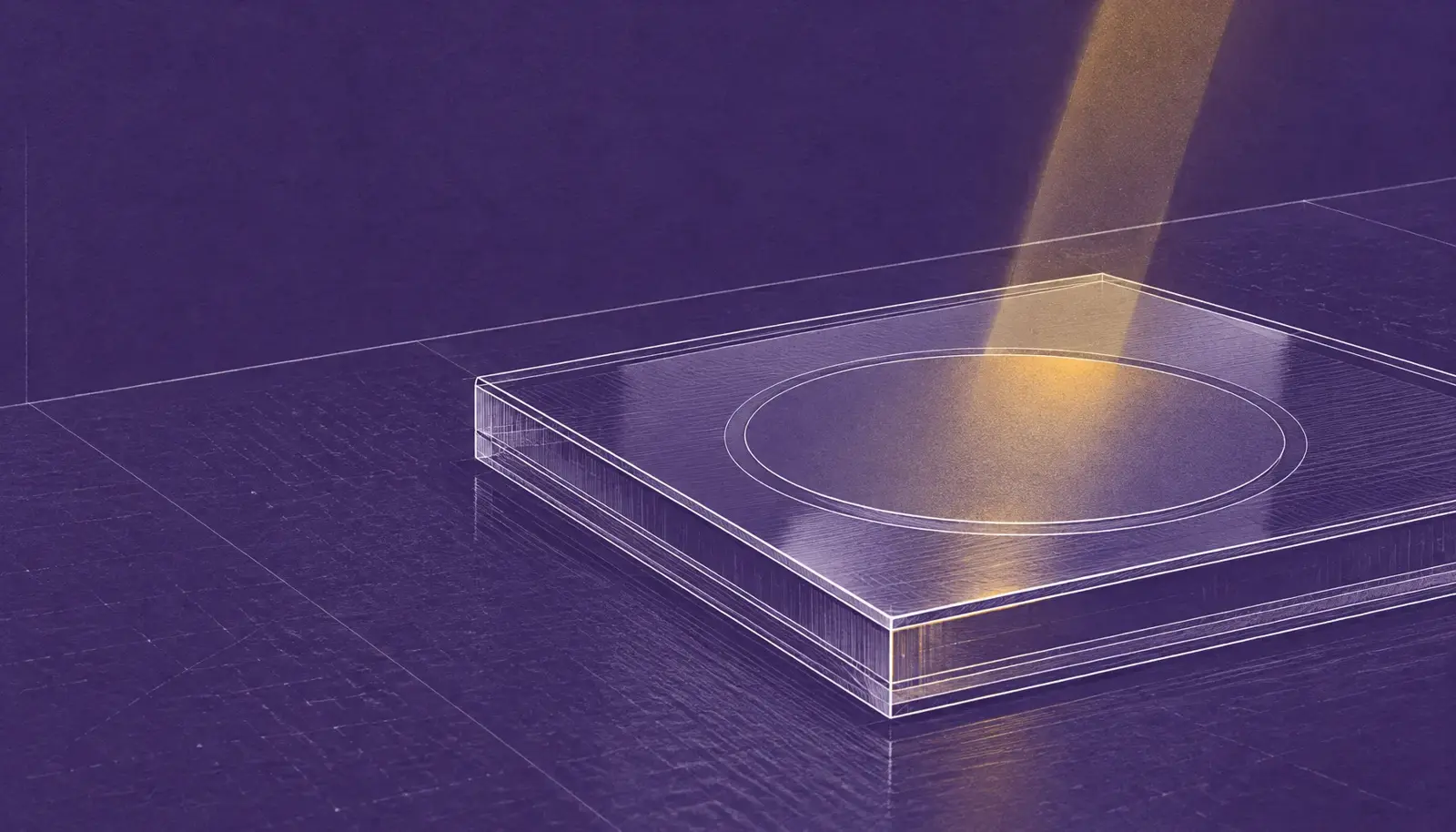
Researchers from the University of Warsaw, the Military University of Technology, IBM Research in Zurich and France’s CNRS report observing a quantum supersolid in an exciton-polariton condensate at room temperature. The results were published in Science Advances. Most research into exotic quantum phases has required cryogenic equipment and temperatures near absolute zero; a supersolid was observed in ultracold atomic gases in 2017.
When a quantum liquid forms a pattern
A supersolid combines two properties that usually seem at odds: superfluidity, in which a liquid flows without viscosity, and a regular density pattern resembling a crystal. Physicists proposed in the 1960s that superfluidity could coexist with a periodic structure. The resulting state would flow without resistance while also displaying an ordered, crystal-like density pattern. For decades, the idea remained theoretical, until experiments with ultracold atomic gases observed the phenomenon in 2017.
Light and matter in a liquid-crystal cavity
The experiment used exciton-polaritons, quasiparticles formed by coupling light and matter inside an optical microcavity. Although they exist for only a few picoseconds, they can form a Bose-Einstein condensate and behave as a quantum fluid during that time. Researchers filled the microcavity with a specially prepared liquid crystal and coated it with an organic semiconductor, enabling strong light-matter coupling at room temperature.
The Military University of Technology prepared the liquid-crystal structures. The main experiments took place at IBM Research in Zurich, where researchers coated photonic structures made at the Military University of Technology with a thin layer of organic semiconductor. Prof. Wiktor Piecek of the Military University of Technology says the optical microcavities can operate at temperatures of about 60°C.
Laser pulses reveal spontaneous ordering
The researchers identified the supersolid phase through regular fringes in the intensity of light emitted by the sample. The fringes indicated that the condensate had formed a periodic structure. After each laser pulse used to excite the sample, the fringes appeared in a different position, showing that the system selected its configuration anew. The university describes this as spontaneous symmetry breaking: the theory predicted that the supersolid could take different, equivalent configurations, and the experiment observed that behavior.
„Teoria przewidywała, że nadstała faza będzie mogła przyjmować różne równoważne konfiguracje.”
Prof. Guillaume Malpuech of Institut Pascal CNRS said this was what the researchers had observed.
A periodic spin helix also persisted in the sample, appearing as a repeating change in the polarization of the light. The researchers could therefore observe two ordered patterns at once: one in polarization and another in the intensity of emitted light. The paper is titled “Observation of a supersolid phase in a spin-orbit coupled exciton-polariton Bose-Einstein condensate.”
A short-lived sample and an adjustable platform
The organic semiconductor gradually reacted with the liquid crystal, so all measurements had to be completed within a dozen or so hours of preparing the sample. Repeating the measurements required making a new sample. Dr. Marcin Muszyński, the paper’s first author, said the team had to plan the experiment sequence carefully. He is now working at City College of New York.
The liquid-crystal microcavities are electrically tunable: an external voltage can dynamically control their optical properties. The university describes them as the first electrically tunable platform for studying exciton-polariton supersolid condensates. It says the findings could support research into ultrafast optical components, neuromorphic computing accelerators and sensitive sensors that use the supersolid phase’s sensitivity to light polarization. The reported result is an observation of the phase in a system operating at room temperature.
Source
Related stories
- Researchers Find Room-Temperature Quantum Emitters in Boron Nitride Nanotubes
- Researchers Model Quantum Gates in a Recoiled Free Electron
- Researchers Model Entanglement Across Multiple Bright Frequency Combs
- Optica researchers report counting more than 9,000 photons
- PRX Quantum paper demonstrates phase-controlled photon routing