The Signal
Optica researchers report counting more than 9,000 photons
A multiplexed detector system counted laser pulses containing more than 9,000 photons, with uncertainty below one photon for counts up to 276. The researchers combined eight superconducting nanowire detectors with 128 time-separated modes to create 1,024 detection bins.
A wider counting range
A multiplexed detector system counted laser pulses containing more than 9,000 photons, with uncertainty below one photon for counts up to 276, according to an Optica research release. The approach combines superconducting nanowire detectors that can resolve photon number with a system for distributing each pulse across many detection bins.
The release, dated November 12, describes a study published in Optica by researchers including Timon Schapeler and Tim Bartley of Paderborn University. The paper, “Macroscopic photon counting beating the Poisson noise limit,” appeared in volume 13, pages 2371–2378, in 2026.
Splitting each pulse
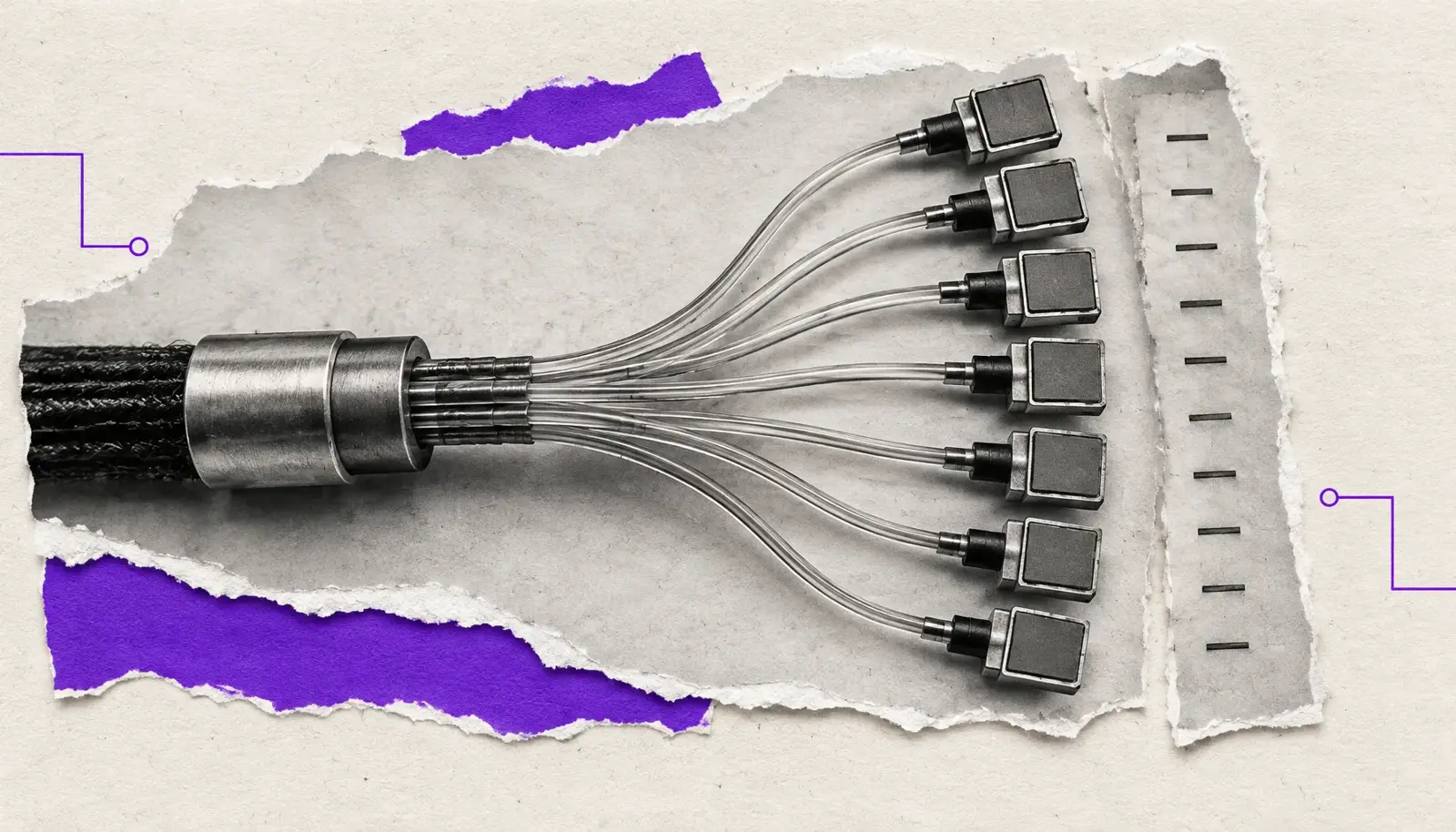
The apparatus combines superconducting nanowire single-photon detectors, or SNSPDs, with multiplexing to form 1,024 detection bins. The system divides an incoming pulse into 128 time-separated smaller pulses, then routes them across eight detectors. The resulting bins each receive part of the original light pulse, while the detectors’ timing response carries information about how many photons arrived in each bin.
To interpret those signals, the researchers used a model-informed characterization of the individual bins. Their analysis combines the photon-number information from the bins to estimate the total count and its measurement uncertainty for an individual pulse. Optica’s release says a conventional multiplexed system would require about 37,000 detector elements to reach the same precision reported for counts up to 276.
Testing precision and limits
In the study, the researchers tested 125 input states with mean photon numbers from zero to 15,393 per pulse. For each input state, they recorded 3.2 million samples. The Optica release describes the tested laser pulses as having average photon numbers between 1 and 15,000.
The paper reports a range extending to more than 9,000 counted photons and measurement uncertainty below one photon through 276 photons. Across the tested range, the authors report average detector noise 6.7 decibels below the Poisson noise limit. They report a maximum noise level 4.1 decibels below that limit above 6,800 photons.
The paper also reports that ensemble variance rises above the Poisson limit at measured means above about 1,000 photons, which the researchers attribute to probabilistic blinding of detector bins. This ensemble behavior is distinct from the paper’s shot-by-shot measurement-uncertainty result, which the authors report remained below the Poisson noise limit across the measured photon counts.
Characterization and next tests
The authors reconstructed the detector’s response using quantum detector tomography, producing a description with 1.38 × 10⁸ matrix elements. At the experiment’s repetition rate of 80 kilohertz, the paper says the photon counts correspond to optical power of approximately 71 picowatts.
The release says the team plans to apply the detectors to bright quantum states of light, rather than only laser pulses, to investigate quantum effects at larger scales. It also says that improvements in SNSPD technology could enable precise measurements for sensing applications.
Sources
Related stories
- Researchers Find Room-Temperature Quantum Emitters in Boron Nitride Nanotubes
- Researchers Model Entanglement Across Multiple Bright Frequency Combs
- Researchers Observe a Room-Temperature Quantum Supersolid
- Researchers Model Quantum Gates in a Recoiled Free Electron
- PRX Quantum paper demonstrates phase-controlled photon routing