The Signal
Researchers Model Entanglement Across Multiple Bright Frequency Combs
A study models quantum correlations across bright, coupled optical frequency combs linked by a shared idler comb. Its calculations examine discrete combs and ultrafast pulses, including routes to squeezing and cluster states.
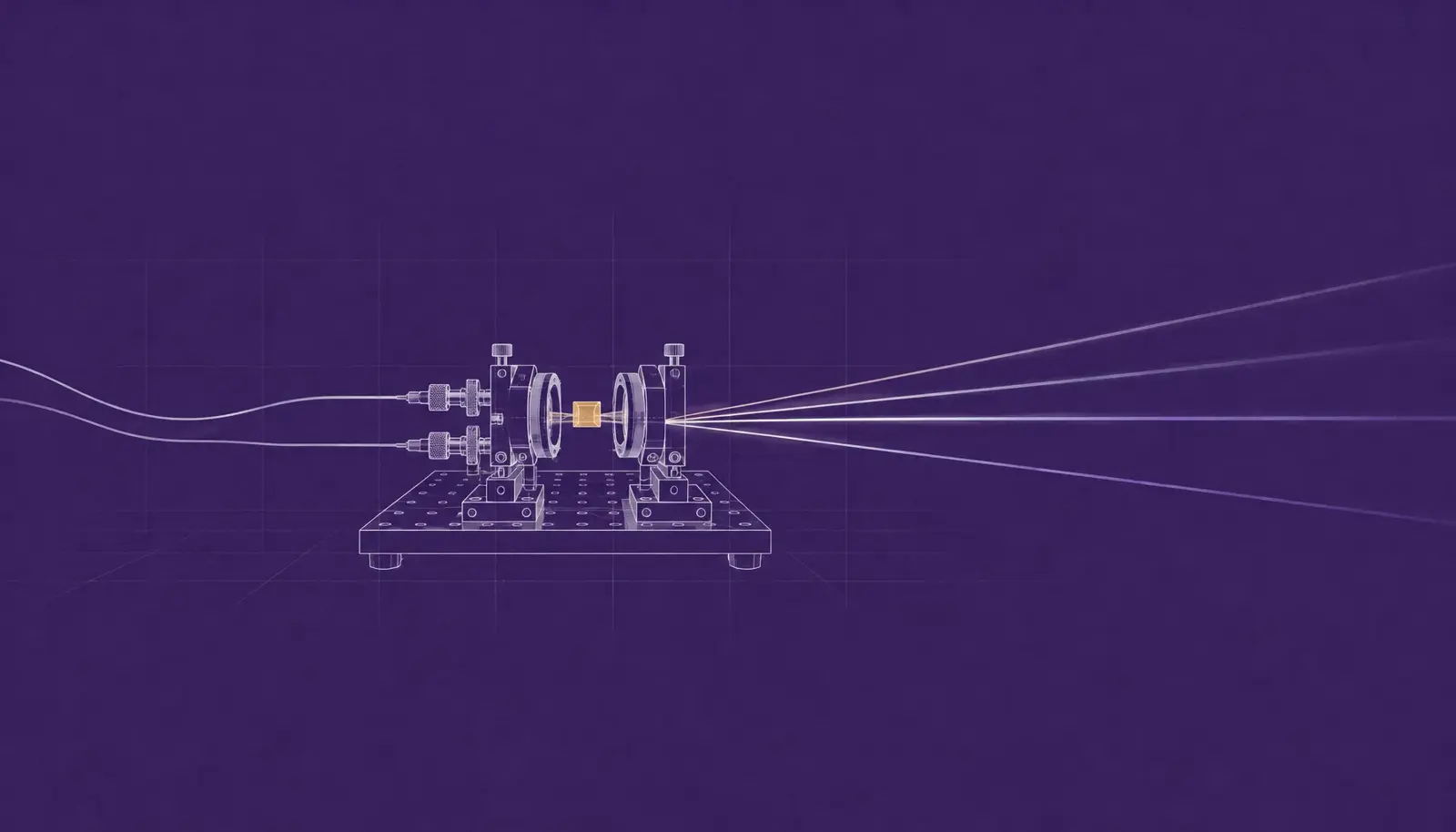
Researchers model a system in which a shared idler comb links several distinct optical combs, generating spectrally distributed quantum correlations in bright light. Published on 5 November 2026 in Light: Science & Applications, the study analyzes how cascaded nonlinear interactions could produce entanglement both within individual combs and between them. The authors also examine broadband ultrafast pulses and ways to tailor the resulting quantum states.
In the model, one idler comb connects separate combs
In the general case, the proposed system begins with a pump comb and a seed comb. Difference-frequency generation between them creates a lower-frequency idler comb, which is recycled through the nonlinear cavity to drive further sum- and difference-frequency processes. Those cascaded interactions generate additional combs on either side of the pump spectrum.
The resulting structure is a “comb of combs”: a set of subcombs with closely spaced modes inside each one and a larger separation between their central frequencies. The shared idler mediates interactions among the subcombs, so the calculated correlations can span both frequency dimensions. The researchers find correlations extending even to modes that are not directly coupled by the nonlinear interaction.
Researchers model a seven-subcomb system
One modeled configuration contains seven subcombs, each with seven modes. In that example, the pump wavelength is 465 nm, the idler wavelength is 4.07 μm and the spacing between modes within a subcomb is 3.00 GHz, matching the free spectral range of a 10 cm free-space cavity.
The authors calculate the system’s steady-state fields and quantum fluctuations, then derive output intensity noise and two-mode photon-flux noise. Their analysis compares weak seeding relative to the pump with strong seeding. Most modes in the five-subcomb example have individual intensity noise above the shot-noise limit, while a stronger seed tends to reduce that single-mode noise.
Researchers calculate two-mode quantum correlations and squeezing
The researchers calculate two-mode photon-flux noise using separate normalizations for shot noise and for uncorrelated fluctuations. They also describe collective quadratures involving modes from multiple combs.
A second modeled case uses five subcombs with five modes apiece. For this configuration, the calculations assume 1% intrinsic loss and 50% outcoupling roundtrip loss for optical modes; idler modes have 1% intrinsic loss and 2.5% outcoupling roundtrip loss. The authors select high outcoupling relative to intrinsic loss because escape efficiency limits observable squeezing.
Researchers explore pulse shaping to tailor quantum states
The study extends its analysis beyond discrete comb lines to ultrafast systems containing multiple broadband, nondegenerate pulses. The researchers identify correlations between pulses as a possible resource for quantum-enhanced pump-probe measurements, alongside the inter- and intracomb correlations calculated for the discrete systems.
The authors also use covariance-matrix optimization to examine target cluster states and concentrated two-mode squeezing. They explore the potential of pulse shaping and dissipation engineering—the use of loss as a resource—to tailor the covariance matrix, including to strengthen squeezing between a selected pair of wavelengths. The researchers identify entanglement-assisted spectroscopy, squeezing-enhanced pump-probe measurements, quantum spectral multiplexing and spectrally addressable cluster-state generation as potential applications for the architecture.
Source
Related stories
- Nature paper reports synchronized microwave-optical superradiant combs
- Researchers introduce a framework to upper-bound entanglement from a state's spectrum
- Fudan Researchers Find Hidden Entanglement Transitions in SYK Models
- PRX paper bounds entanglement growth and its spectrum
- Mixed Initial States Trigger Sudden Entanglement Birth