The Signal
Nature paper reports synchronized microwave-optical superradiant combs
A Nature paper reports periodic superradiant pulses and matching frequency combs in microwave and optical signals from an ytterbium-doped crystal. The researchers tuned the pulse repetition by changing the optical pump detuning and observed the two signals in step.
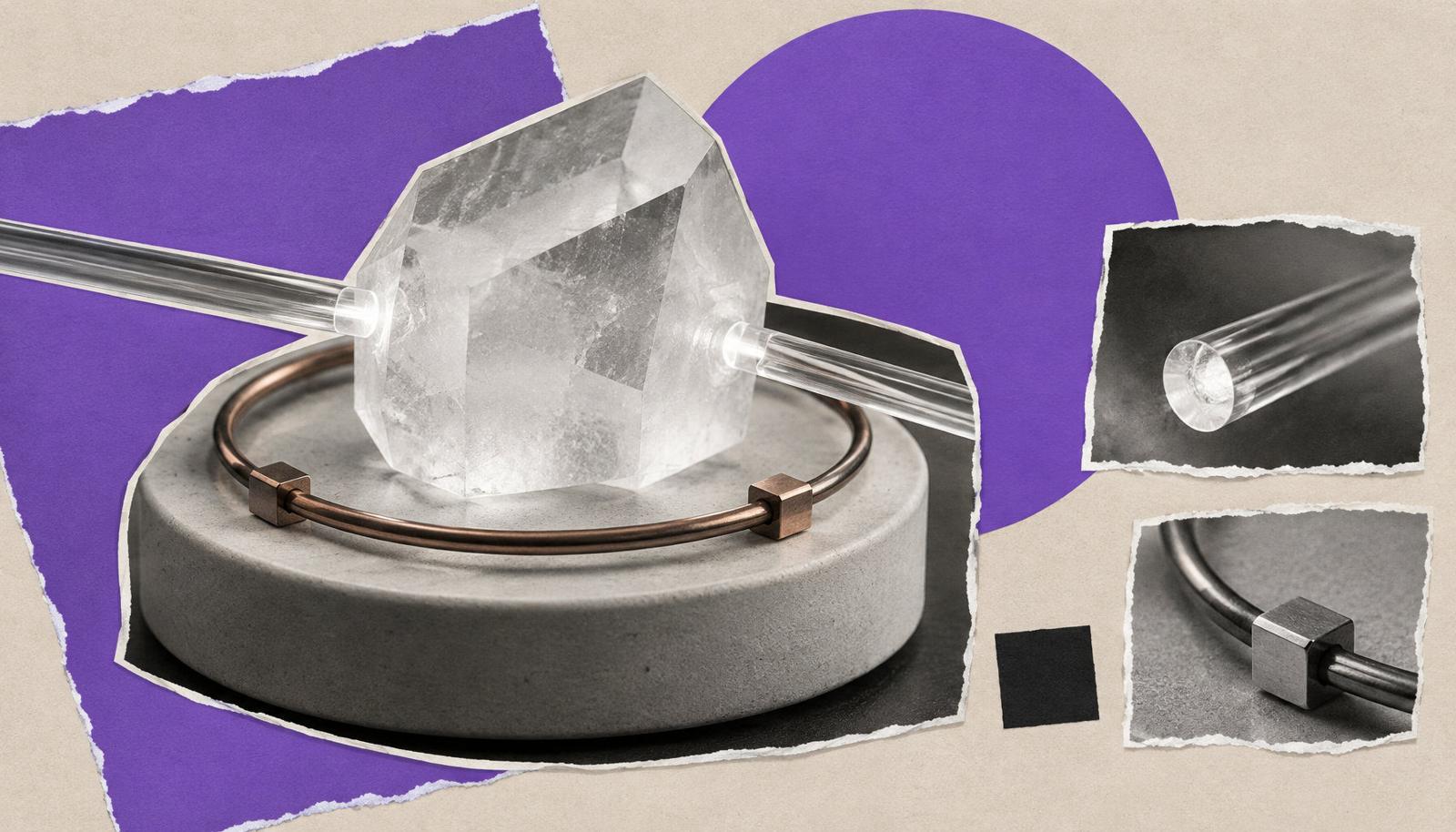
A crystal-based system produced periodic bursts of superradiant emission and matching frequency combs in microwave and optical signals, according to a paper published in Nature on November 18, 2026. The researchers also varied the pulse repetition by changing the optical pump detuning, and reported that the microwave and optical bursts stayed synchronized.
From steady emission to pulses
The team used ytterbium-171 ions doped into a yttrium orthovanadate crystal, coupled to an on-chip superconducting microwave resonator. The ions’ microwave transition was at 3.4 GHz, with an inhomogeneously broadened linewidth of 160 kHz; the resonator was fabricated on the crystal and had a cavity linewidth of 3.6 MHz.
The paper describes superradiance as collective emission from an ensemble of emitters. The researchers varied the continuous-wave optical pump power to adjust how many ions participated, and observed three regimes: no superradiant emission, continuous-wave superradiance, and periodic pulses.
In the continuous-wave regime, the measured emission linewidth was about 30 Hz. At higher pump power, the steady emission became unstable and the system produced a repeating train of bursts; the paper reports a comb linewidth of about 50 Hz in this pulsed regime.
Detuning tunes the pulse train
The researchers also changed the pump’s frequency relative to the centre of the ions’ optical inhomogeneous linewidth, selecting different subsets of ions while keeping the pump Rabi frequency unchanged. They report that the burst periodicity increased as the pump detuning moved farther from zero.
The study’s model links the periodicity to the ensemble cooperativity, which depends on the number of participating emitters. The authors say their measurements and simulations showed periodicity scaling inversely with ensemble size, while pulse amplitude scaled quadratically with it.
Two frequency ranges, one rhythm
The ytterbium system supports both microwave and optical transitions. The researchers report observing optical superradiance at 304 THz, alongside microwave emission at 3.4 GHz, with both channels producing synchronized pulse sequences.
Analysis of the signals showed a zero-phase offset between the optical and microwave bursts, according to the paper. Their spectra contained matching frequency-comb structures with the same repetition rate. The researchers describe the periodic pulsed phase as connected to a continuous time crystal, a non-equilibrium phase characterized in the paper by spontaneously emerging temporal order.
Limits and proposed next steps
The paper says the repetition rate and pulse structure are currently limited by the optical pumping rate needed to rebuild population inversion. The researchers propose that adding a high-cooperativity optical cavity could enhance repumping and enable higher repetition rates, faster control of ensemble participation and direct generation of a tunable optical superradiant comb.
They also identify dynamic control of cavity-mediated interactions as a direction for future work. The paper says that combined control of ensemble coupling, dissipation and detuning could support programmable quantum light sources.
Sources
Related stories
- Researchers Model Entanglement Across Multiple Bright Frequency Combs
- PRX Quantum paper reports homodyne readout of spin information
- PRX Quantum paper demonstrates phase-controlled photon routing
- Optical Experiment Recovers 10.3% of Lost State Purity
- Paderborn sampler compares Gaussian and non-Gaussian inputs