The Signal
Researchers Model Quantum Gates in a Recoiled Free Electron
A paper published November 2 in Physical Review Research proposes using photon recoil to create a controllable energy ladder in a kiloelectron-volt free electron. Its simulated gates and quantum simulations rely on idealized models, with electron dispersion and optical-control errors still unresolved.
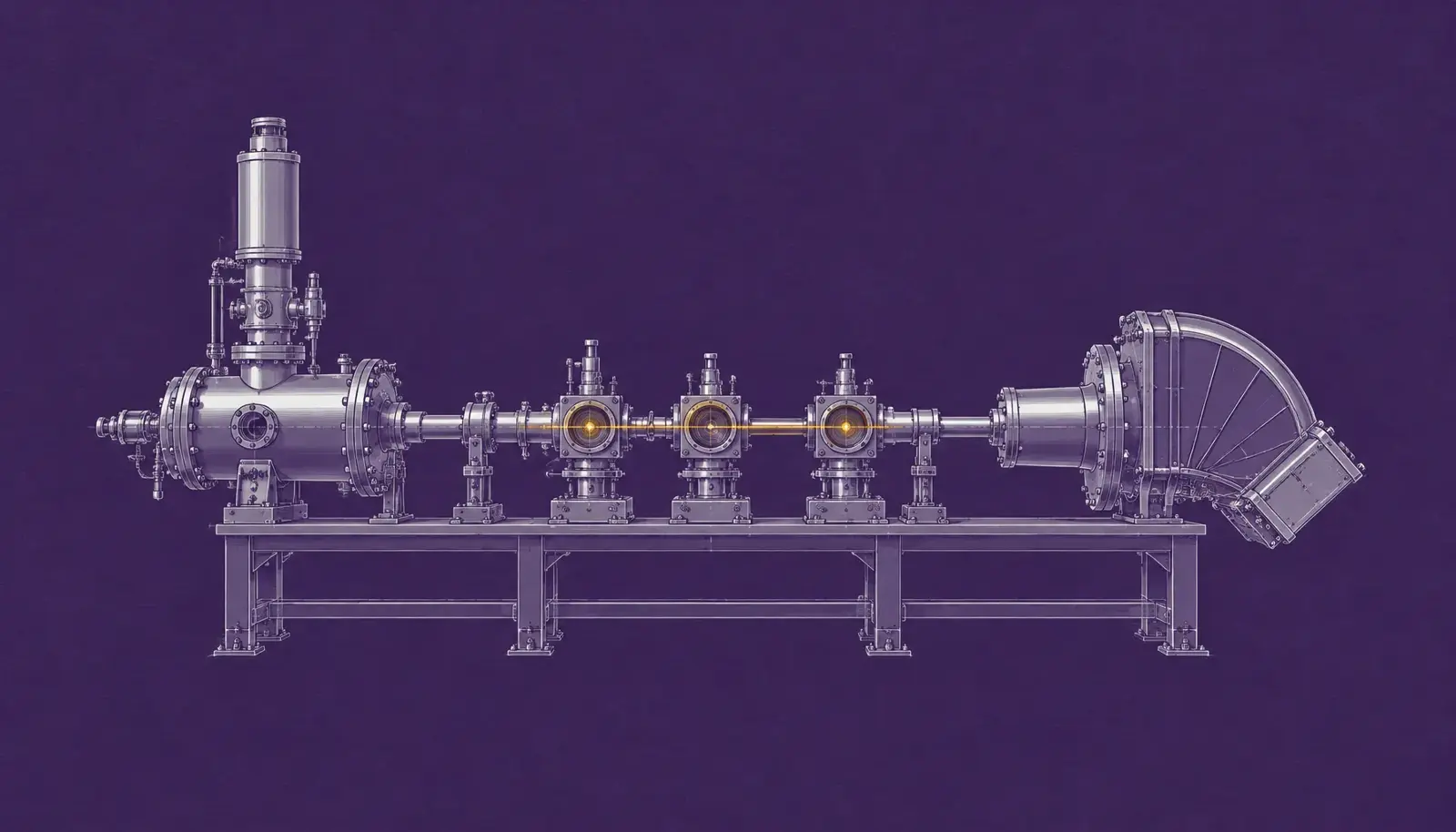
A kiloelectron-volt electron could carry several logical qubits in its own energy states, according to a theoretical study published November 2 in Physical Review Research. The proposal turns photon recoil—the energy and momentum change when an electron absorbs or emits light—into a way to build and control a ladder of discrete electron states. The authors model quantum gates and simulations on that ladder; they do not report an operating free-electron quantum computer.
“The resulting recoil ladder forms a high-dimensional qudit with programmable couplings and sufficient controllability for universal quantum computation.”
Maxim Sirotin et al., Physical Review Research
Photon recoil creates an addressable energy ladder
Free-electron optics often works with electrons energetic enough that recoil can be neglected. At energies in the kiloelectron-volt range, the recoil from optical photons becomes appreciable, separating the electron’s possible energies into sidebands that can be addressed as individual rungs. The study derives an interaction Hamiltonian from relativistic quantum electrodynamics to describe how those states couple to optical fields.
In the proposed setup, external laser tones set the amplitudes and phases of interactions between neighboring rungs. Their frequencies and momentum matching determine which transitions are driven, allowing the researchers to model a programmable, anharmonic ladder rather than a simple evenly spaced set of levels. Scanning electron microscopes are one possible setting: they offer optical access and space to integrate nanophotonic or cavity structures.
Four energy levels encode two logical qubits
The paper models an example in which four consecutive rungs represent two logical qubits. A nearest-neighbor transition supplies a basic operation, while sequences of interactions across multiple zones can implement more complex gates, including a controlled-phase operation. The authors also simulate composite sequences designed to reduce errors from population leaking outside the encoded states.
That encoding is virtual: the qubits are not separate physical objects, but information represented across spectrally resolved energy levels of one electron. The paper says an effective register of N qubits requires 2N ladder states. That can reduce the need to couple separate qubits, but it does not remove the requirements for controlling, measuring and protecting the growing set of states.
A synthetic horizon, not a black hole
The same ladder could also act as a quantum simulator. By varying the optical couplings from rung to rung, the model reproduces wave propagation in a one-dimensional curved-spacetime analogue, including a synthetic horizon that traps some simulated wave packets. The horizon exists in the engineered dynamics of the energy ladder; the proposal does not create or study an astrophysical black hole.
After the sequence of optical interactions, the electron’s state would be encoded in its energy spectrum. The paper describes reading it with an electron energy spectrometer and a single-electron-sensitive detector. In a separate set of calculations, it also models how controlled recoil can create nonclassical light and correlated electron-photon states.
Electron coherence sets the practical limit
The calculations assume an ideal coherent ladder and leave out several experimental imperfections. The authors identify finite electron energy spread, fluctuations in optical phase, imperfect overlap between the electron and optical modes, and longitudinal wave-packet dispersion as effects that could lower gate fidelity and restrict how many rungs remain coherent.
Repeated interactions pose a particular challenge: recoil changes the electron’s speed, so different energy components can drift apart as they travel. For a modeled 1-keV electron on a 10-centimeter-diameter orbit, the paper estimates about 16 picoseconds of arrival-time separation, or 0.3 millimeters of longitudinal walk-off, per revolution and per photon recoil. The paper’s gate fidelities therefore describe an ideal coherent model, not measured performance from a free-electron processor.
Source
Related stories
- Researchers Observe a Room-Temperature Quantum Supersolid
- Researchers Model Entanglement Across Multiple Bright Frequency Combs
- Researchers Find Room-Temperature Quantum Emitters in Boron Nitride Nanotubes
- Optica researchers report counting more than 9,000 photons
- PRX Quantum paper demonstrates phase-controlled photon routing