The Signal
Researchers Control Quantum-Geometric Nonlinear Hall State With Electric Current for First Time
Researchers at Tohoku University and the Japan Atomic Energy Agency demonstrated electrical control of a quantum-geometric nonlinear Hall state in Mn3Sn for the first time. Opposite-polarity current pulses switched the sign of its third-order nonlinear Hall response.
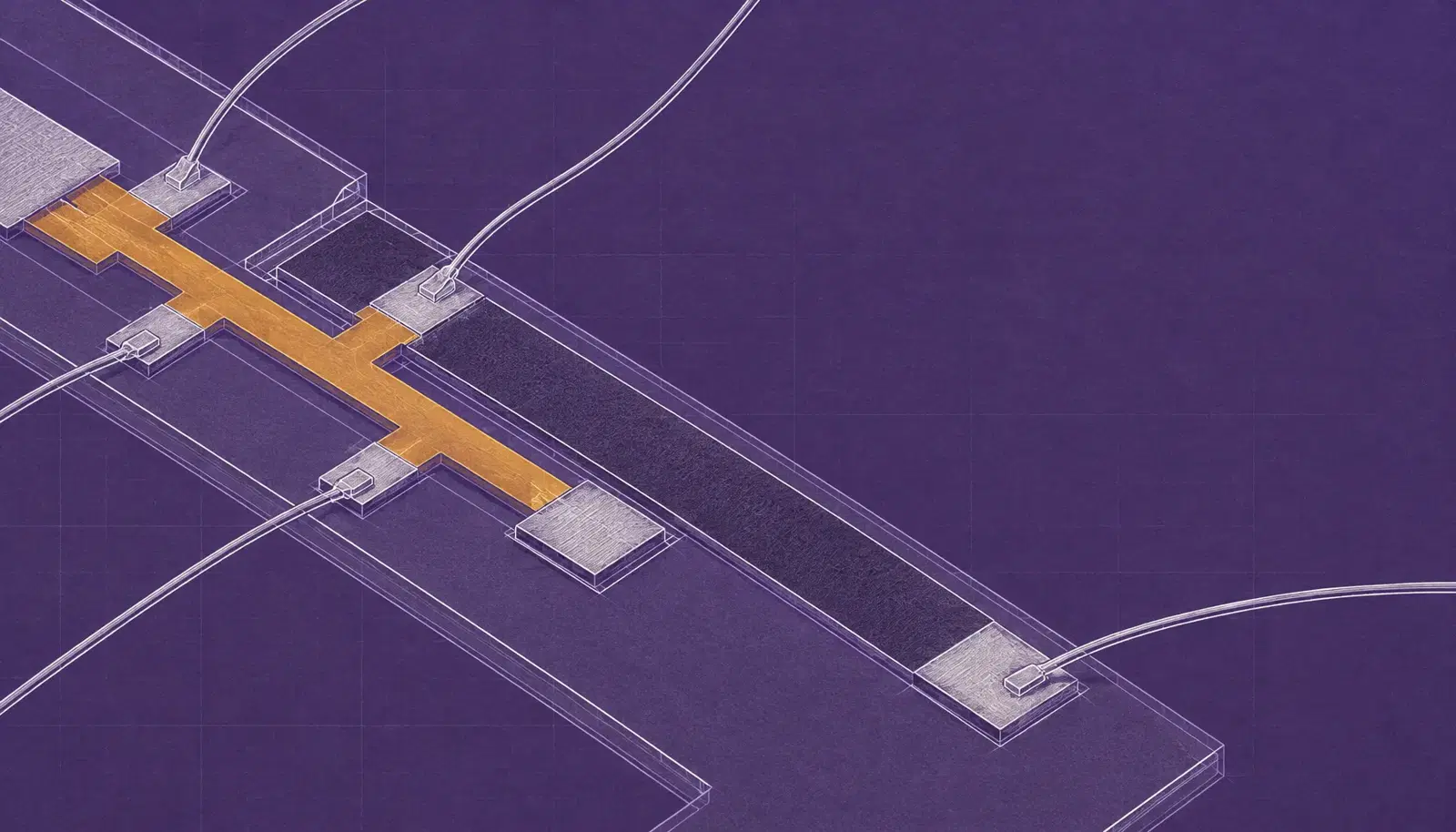
On Nov. 5, Tohoku University reported that researchers at the university and the Japan Atomic Energy Agency had controlled a quantum-geometric nonlinear Hall state with electric current. They did so by switching the spin structure of a chiral antiferromagnet, demonstrating electrical control of the state for the first time. The study’s findings appeared in the Cell Press journal Newton on Nov. 4, 2026.
Researchers observe a third-order nonlinear Hall response in Mn3Sn at room temperature
The researchers studied epitaxial thin films of Mn3Sn, a chiral antiferromagnet whose spin structure is closely connected to its electronic states. They first observed a third-order nonlinear Hall effect at room temperature: the nonlinear voltage was proportional to the cube of the current. The team combined experiments with theoretical calculations to verify that the response had a quantum-geometric origin. Switching Mn3Sn’s spin structure reversibly changed the observed effect.
The quantum-geometric nonlinear Hall (QgNLH) state corresponds to an unconventional voltage-current response associated with the geometry of electronic quantum states. In an ordinary conductor, voltage and current follow the proportional relationship described by Ohm’s law, while the Hall effect produces a transverse voltage. In the nonlinear Hall effect, that transverse Hall voltage no longer follows the usual linear relationship with current. The university says the QgNLH state is of interest both for studying quantum properties of solids and as a basis for nonlinear signal processing.
Opposite-polarity pulses switch the sign of the nonlinear Hall response
To control the state, the researchers used a spintronic approach. Current flowing through a heavy-metal layer adjacent to Mn3Sn produces spin-orbit torque, which acts on Mn3Sn’s spin structure and can switch it. Applying current pulses with opposite polarities switched the sign of the third-order nonlinear Hall response. The experiment demonstrated control of the QgNLH state through current-induced magnetic dynamics.
"We are able to realize on-demand electrical manipulation of the QgNLH state under different external conditions", said Tomohiro Uchimura, identified by the university as the paper’s leading author. He added: "Deterministic switching and fluctuation of the QgNLH state can be achieved under finite and zero bias magnetic fields, respectively."
Potential applications in nonlinear electronics
The paper’s corresponding authors, Jiahao Han and Shunsuke Fukami, describe the work as a way to manipulate quantum-geometric electronic responses by electrically controlling magnetic order. They said the approach may help develop current-tunable nonlinear devices, including frequency multiplexers and rectifiers. They also said those devices could benefit from the energy-efficiency and speed advantages of magnetoresistive random access memory (MRAM), through the use of spintronic methods.
The paper is titled “Electric-current manipulation of quantum-geometric nonlinear Hall state in a chiral antiferromagnet”. Its authors are Tomohiro Uchimura, Jiahao Han, Yasufumi Araki, Yuta Yamane, Shun Kanai, Jun'ichi Ieda, Hideo Ohno and Shunsuke Fukami. It was published in Newton with the DOI 10.1016/j.newton.2026.100722.
Source
Related stories
- UChicago and Tohoku establish quantum materials research hub
- SLAC Team Finds Direct Evidence of Altermagnetism in MnTe
- Researchers Observe a Room-Temperature Quantum Supersolid
- Researchers Model Quantum Gates in a Recoiled Free Electron
- Researchers Model Entanglement Across Multiple Bright Frequency Combs