The Signal
Preprint reports 18.9-km urban free-space QKD link
A decoy-state BB84 system was tested over a single 18.9-kilometer free-space link between Castelldefels and Barcelona. The preprint estimates an average finite-size secret-key rate of 11.17 kbit/s from a 40-minute field test, while noting that the test emulated the protocol.
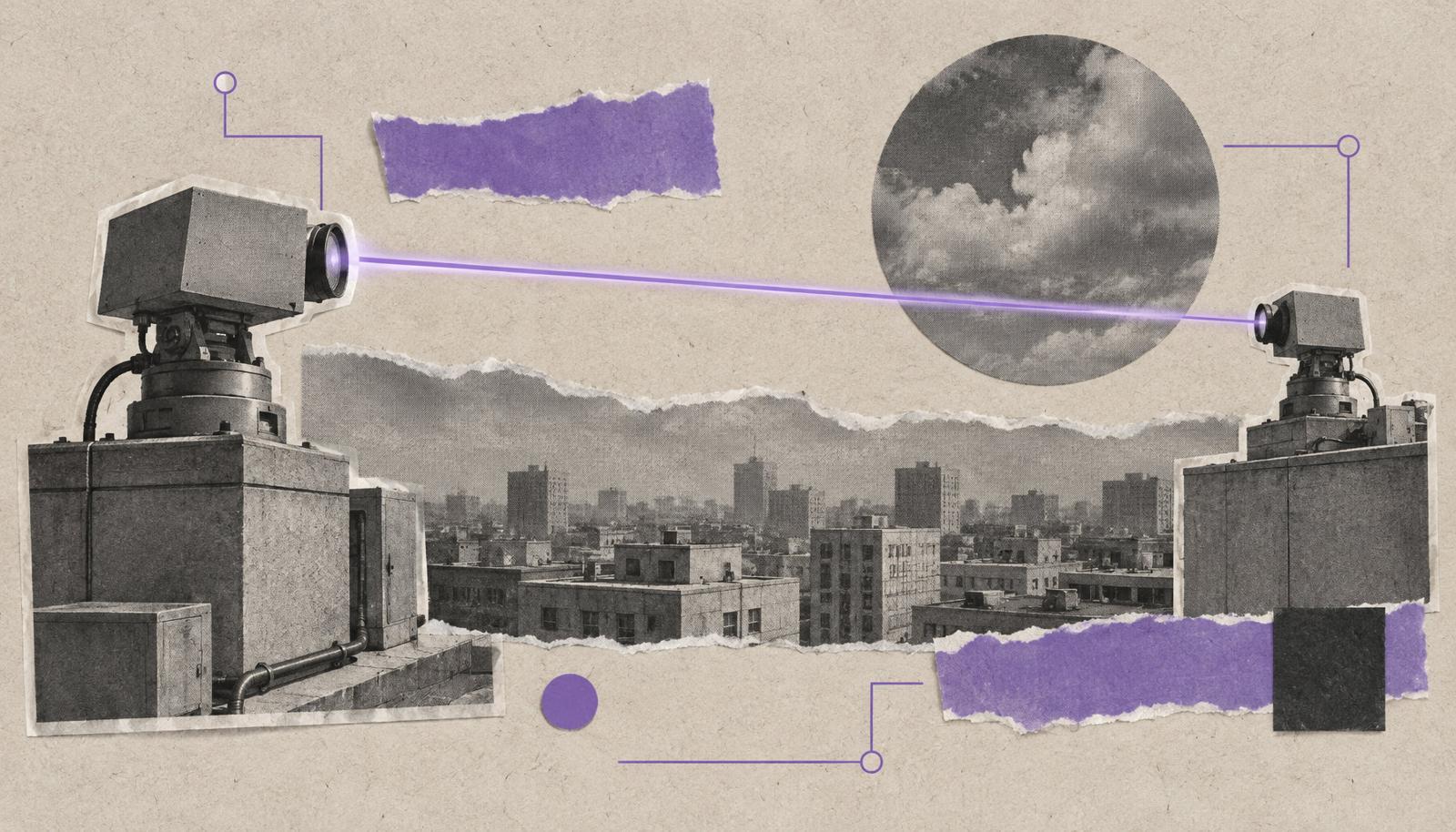
A decoy-state BB84 system was tested over a single 18.9-kilometer free-space link between Castelldefels and Barcelona, according to a preprint submitted November 12. The researchers estimate an average finite-size secret-key rate of 11.17 kbit/s from measured channel parameters.
Source arxiv.org
The 40-minute field run emulated the QKD protocol rather than demonstrating continuous, unattended key distribution. It measured the link’s behavior and the system’s error rate; those results were then used to calculate the estimated key rate.
A direct route across an urban corridor
The paper describes a transmitter in Castelldefels and a receiver in Barcelona, connected by a single free-space channel through the metropolitan area. The route crosses several municipalities, including Gavà, Sant Boi de Llobregat, Cornellà de Llobregat and Esplugues de Llobregat.
Both terminals and the path between them sit within Barcelona–El Prat Airport’s Laser-beam Critical Flight Zone, where the paper gives a maximum permitted irradiance of 5 µW/cm². The authors designed the auxiliary alignment and tracking channels around those restrictions, using low-power LED beacons instead of the high-power laser beacons often used in free-space optical systems.
Room-temperature detection and optical stabilization
The system used 785-nanometer quantum signals and room-temperature silicon single-photon detectors. At the receiver, a telescope collected the signal, while a fast steering mirror and a low-power reference beam corrected small pointing shifts. The setup used tip–tilt stabilization but did not require higher-order adaptive optics.
Timing came from independent GPS-disciplined rubidium clocks at the transmitter and receiver, avoiding a separate optical synchronization channel. The transmitter generated polarization-encoded decoy-state BB84 pulses, with signal, decoy and vacuum intensity settings.
What the field run measured
For the field test, the team repeatedly sent a 256-symbol pseudorandom sequence over 40 minutes. The paper reports a detection-weighted mean quantum bit error rate of 1.31% across the four polarization states. It also estimates an average channel attenuation of 19.7 dB during the session.
Using the measured detection gains and error rates, the researchers calculate an average finite-size secret-key rate of 11.17 kbit/s. That figure is an estimate from the emulated protocol and measured channel parameters, not a report of keys produced during a full, live QKD session.
Further operating tests remain
The paper says the infrastructure was operated over three months and across multiple measurement campaigns. Across those campaigns, reported attenuation ranged from 16 to 22 dB, while QBER ranged from 1% to 3%.
The authors identify longer-term channel measurements and continuous unattended QKD operation as work still to be done, including tests over days and during daytime. They also say the link’s long-term behavior across months and seasons has not yet been fully characterized.
Sources
Related stories
- Preprint reports 100-km fiber link carrying timing, data and quantum signals
- Preprint reports live keys from four-city Slovak QKD network
- Researchers report quantum-key packets routed through two hops
- Luxquanta and partners demonstrate 8,000-km hybrid quantum-safe network
- Preprint predicts repeaterless-bound gains for continuous-variable QKD