The Signal
Preprint reports 100-km fiber link carrying timing, data and quantum signals
A preprint reports an optical-frequency-comb system that carried 100 Mbit/s data and precision timing over a 100-km fiber link while sharing the link with continuous-variable quantum key distribution. The researchers also report quantum-key-protected timestamp transmission with 0.26 fs timing stability at 1 s.
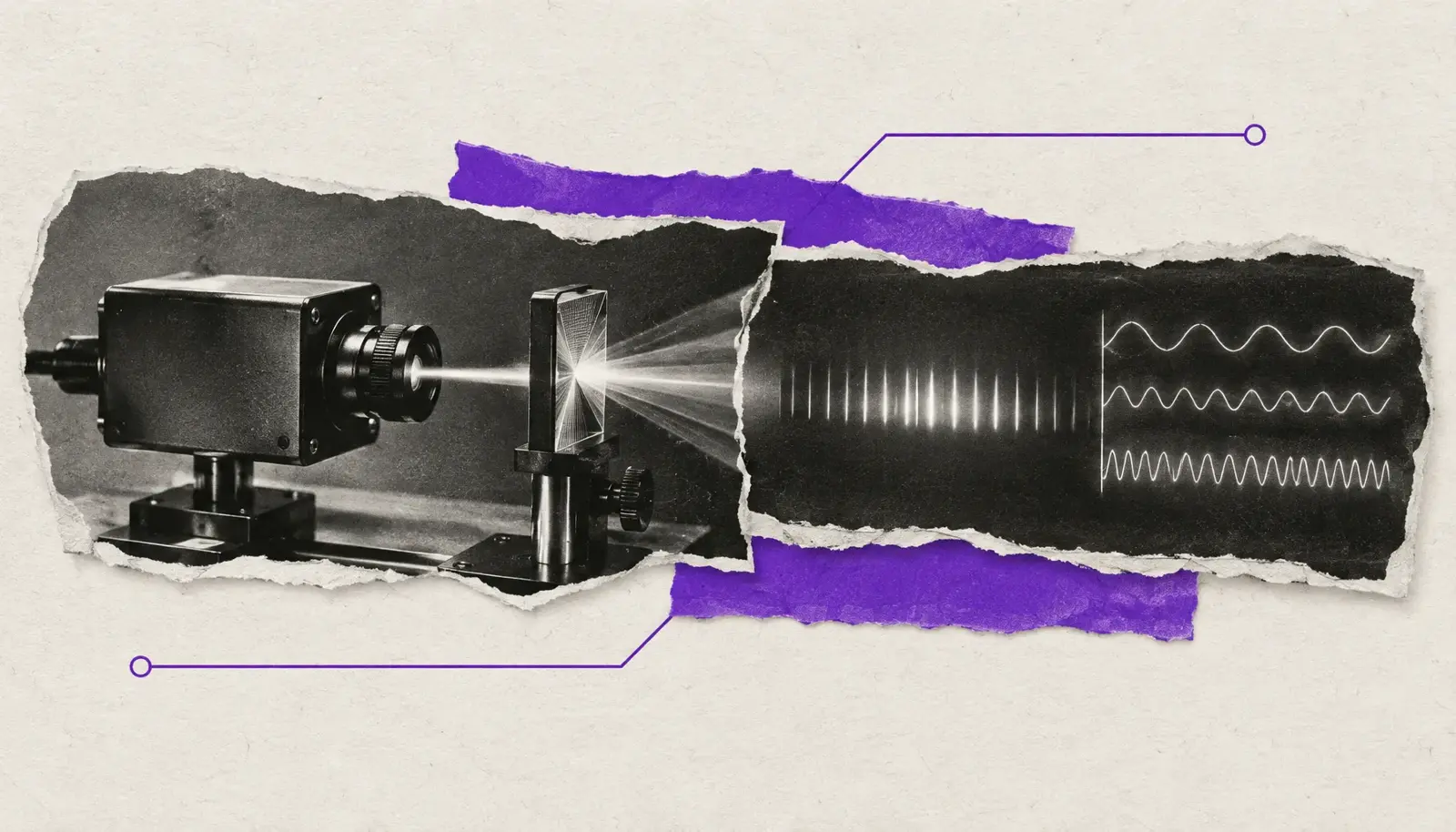
One link for three network functions
An optical frequency comb carried classical data and precision timing while sharing a 100-kilometer fiber link with quantum communication, according to a preprint submitted to arXiv on November 12. The researchers report transmitting data at 100 megabits per second alongside timing with a stability of 0.85 femtoseconds at 1 second, and integrating the link with continuous-variable quantum key distribution.
The work, by researchers including Yiting Lin, Zishuo Ren, Ziyang Chen and Hong Guo, uses the comb’s pulse timing as a reference and encodes classical data in the intensity of its light. The same fiber carries weak quantum signals on separate wavelength channels, using wavelength-division multiplexing. The paper describes the experiment as a way to bring timing, classical communication and quantum communication onto a shared optical infrastructure.
Separating data from timing
Encoding data onto a comb can create spectral sidebands that interfere with the signal used to recover timing. The team says it used a spectral-engineering strategy to manage that interaction, adjusting coding format, the share of unmodulated symbols, modulation depth and modulation rate. These settings affect both the overlap between data-related spectral components and timing information, and the communication link’s performance.
In the timing-and-data test, the researchers used non-return-to-zero coding and reported a bit-error-rate criterion of 10-6 at a received optical power of -46 dBm, without forward error correction. The 100-kilometer link was a spooled fiber, rather than a reported field deployment. For the quantum test, the researchers modeled excess noise as dependent on classical optical power, wavelength allocation and propagation direction.
Quantum channel and protected timestamps
Classical light can add noise to the quantum channel through effects including Raman scattering, nonlinear interactions and residual optical leakage, the paper says. After optimizing the channel configuration, the system added 0.0037 shot-noise units of excess noise. The authors report a secret key rate of 29.67 kilobits per second, a 6.7% reduction compared with the standalone quantum communication system.
The team also used quantum-generated keys to protect timestamps sent over the link. It reports absolute time synchronization with a time deviation of 0.26 femtoseconds at 1 second, while timestamp transmission left the timing stability consistent with the standalone system. The paper says the timestamp was sent once per second in a 76-bit packet, carried through intensity modulation at 100 megabits per second.
Limits noted in the paper
The researchers identify compact frequency-comb sources, network-level synchronization protocols and long-distance quantum communication as areas needing improvement before practical deployment at larger scale. They also say channel management and suppression of noise from nonlinear and scattering effects will matter for metropolitan and intercity networks. The paper describes integrated photonics as a possible route to smaller implementations.