The Signal
Preprint predicts repeaterless-bound gains for continuous-variable QKD
A proposed continuous-variable twin-field quantum key distribution protocol could exceed direct-channel bounds under specified apparatus conditions. The preprint presents theoretical rates and finite-key calculations, not an experimental demonstration.
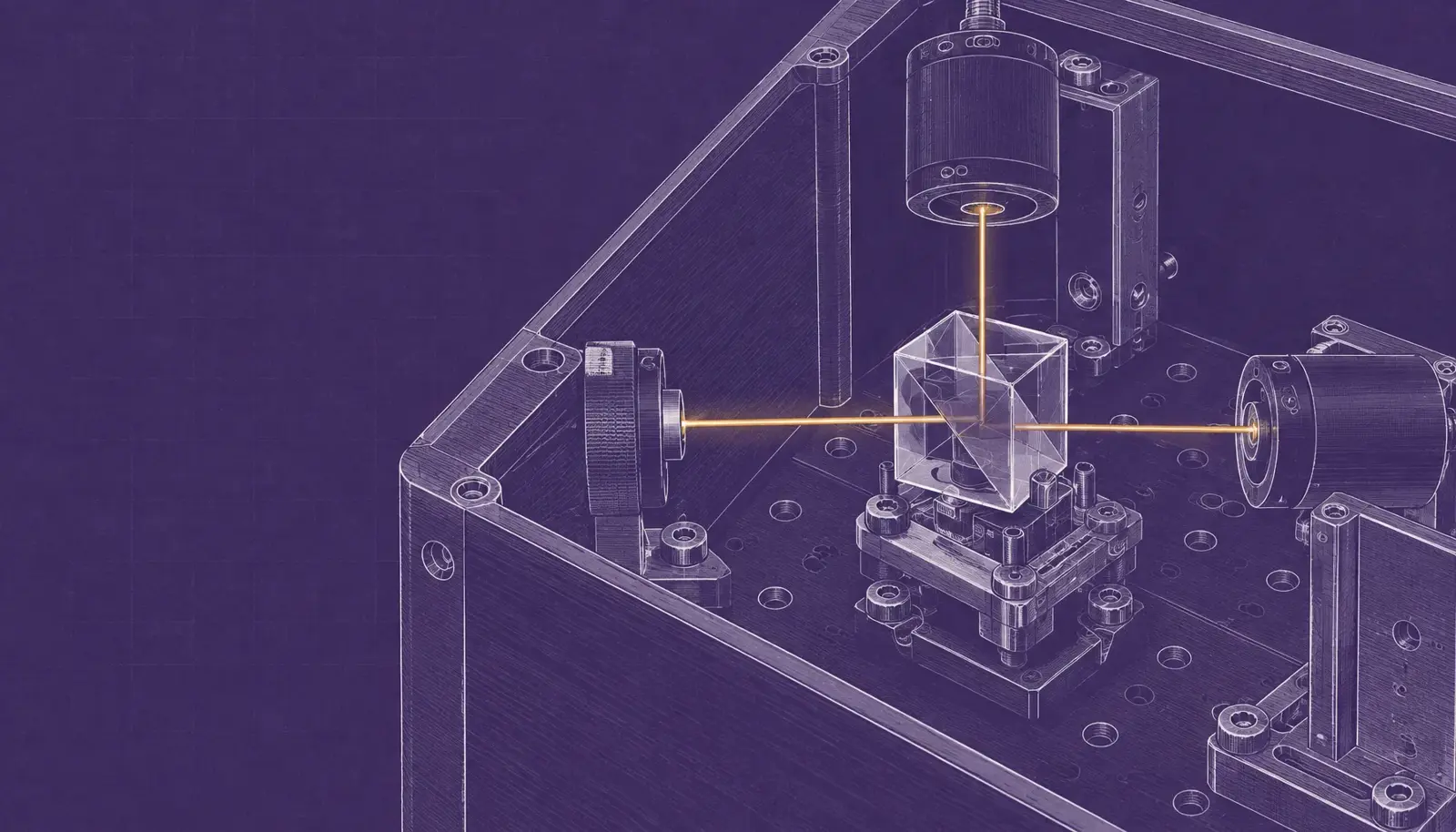
A proposed continuous-variable quantum key distribution protocol could exceed direct-channel repeaterless bounds under specified apparatus conditions, according to finite-key calculations in a new preprint. University of York researcher Stefano Pirandola combines Gaussian-modulated signals with a twin-field relay in a theoretical design, rather than reporting an experimental demonstration.
Source arxiv.org
The work was submitted to arXiv on November 10. Its calculated rates account for detector inefficiency, dark counts, phase fluctuations and reference overhead; the predictions depend on the apparatus and noise model used in the paper.
Signals meet at a relay
The design uses independent Gaussian-modulated coherent states sent by the communicating users to an untrusted relay. In the modeled optical operation, the relay accepts an event when one photon is detected in one output and the other output contains a vacuum.
The users keep their preparation records in trusted laboratories and communicate over an authenticated classical channel. The relay and both transmission channels are untrusted. The paper describes the relay apparatus as a model for honest performance, not a restriction on an adversary.
The non-Gaussian measurement is confined to the relay. The proposed users do not need local single-photon sources, squeezing or quantum memories.
Two ways to process records
The paper examines full-record reconciliation and a binary phase-disclosure method. In the first, the users retain their complete complex preparation records privately and use reconciliation data to reconstruct a shared block.
In the second approach, the key owner discloses signal intensity and a folded phase while retaining a binary sign as the key variable. The other user keeps the full preparation record private and uses it to reconstruct that sign. Reconciliation, verification and privacy amplification follow, with the public disclosures included in the security analysis.
The author calculates that the two approaches have nearly equal asymptotic rates against collective attacks. At fixed weak input-referred excess noise per arm, both rates per relay use scale with the square root of end-to-end transmissivity, the preprint says.
Calculated rates and conditions
The finite-key analysis concerns the phase-disclosure method and compares its expected rate with pure-loss and matched thermal-loss repeaterless bounds. At 85 decibels of total fiber loss, the two-day calculation reaches 2.31 times the pure-loss bound, according to the paper.
Those calculations use joint apparatus design targets, including ideal trusted sources and exact photon-number classification after the specified loss and dark events. The paper treats detector dark events separately from thermal excess noise and includes allowances for tests and for runs that do not complete.
The acquisition durations exclude decoder processing time. The author identifies calibrated source and detector responses, as well as a benchmarked reconciliation implementation, as requirements for realizing the quantitative predictions.
Security scope
For the phase-disclosure method, a bounded test of preparation intensities supports a composable security argument against general coherent attacks. Test positions are selected after the relay has committed its flags, and those positions are excluded from the key.
The security analysis relies on trusted sources and laboratories. It also accounts for information disclosed during reconciliation and verification before determining how much of the resulting block can be retained as a secret key.