The Signal
Preprint reports proton sensing with silicon-carbide nanopillar arrays
A silicon-carbide nanopillar device detected proton NMR signals from immersion oil, using a near-surface PL5 color center. The preprint reports fluorescence rates of about 1 Mcps for PL5 and 2 Mcps for PL6 across its arrays.
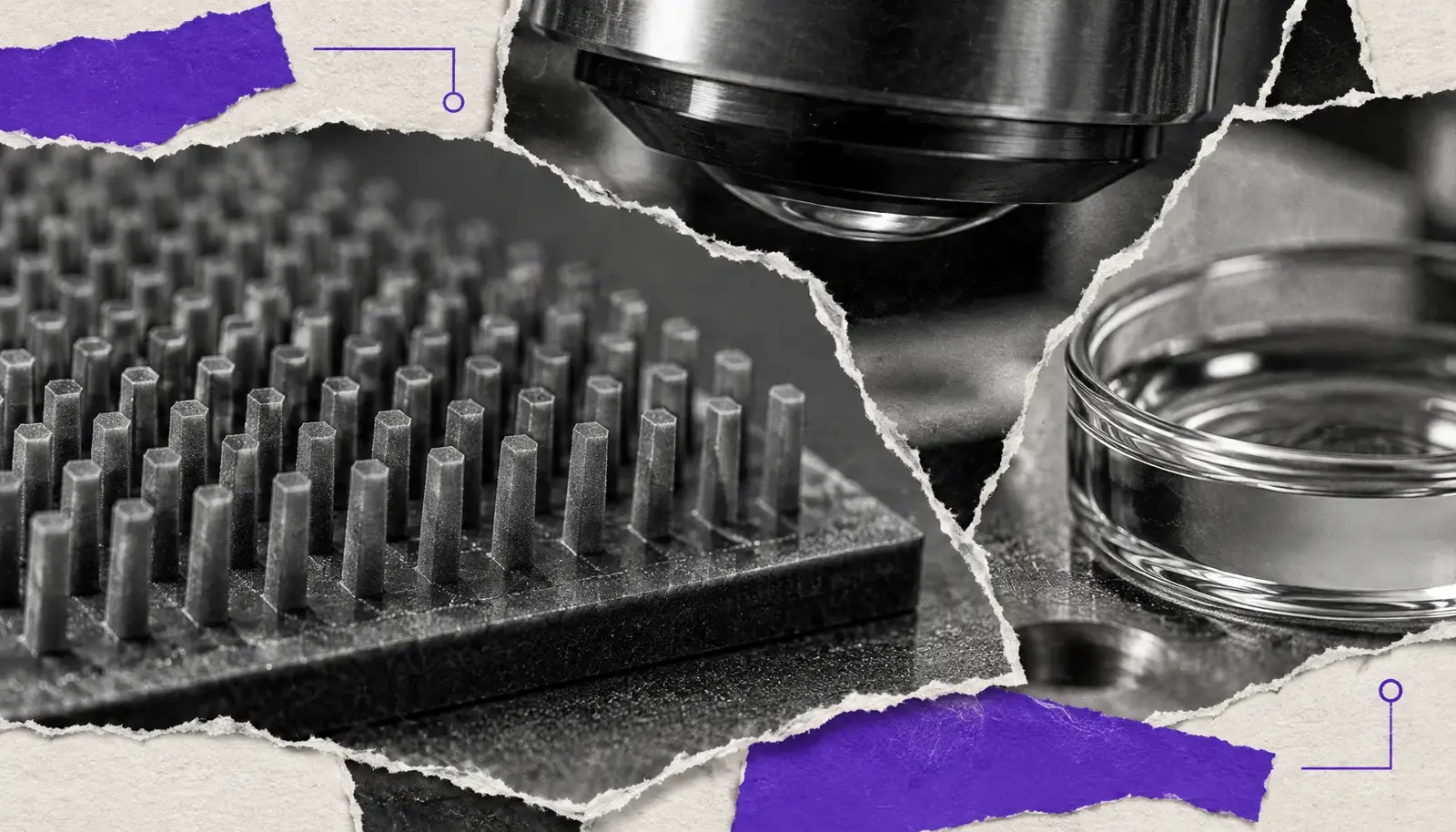
A silicon-carbide nanopillar sensor detected proton nuclear magnetic resonance signals from immersion oil, while related arrays produced fluorescence count rates around 1 to 2 million counts per second, according to a preprint on arXiv. The work combines precisely positioned spin defects with light-collecting nanostructures, and reports an NMR measurement using a near-surface PL5 center.
Positioning the spin centers
Posted on November 12, 2026, the preprint by Chenyang Liao and colleagues describes arrays made from 4H-silicon carbide. The researchers used a self-aligned fabrication process and localized oxygen-ion implantation to place PL5 and PL6 color centers near the centers of nanopillars. These defects serve as the spin sensors, while the pillars are designed to improve collection of the emitted light.
The fabrication process uses a patterned mask both to define the implantation area and to guide pillar etching. The resulting structures had a top radius of about 310 nanometers and a height of about 480 nanometers. The paper reports that the approach positioned the doped region at the center of each pillar and produced a uniform pillar array.
Brightness and uniformity
Measurements of representative PL5 and PL6 centers produced saturation fluorescence rates of 1.25 million and 2.20 million counts per second, respectively. In a statistical sample of 19 PL5 and 17 PL6 centers, the reported average rates were 1.03 million counts per second for PL5 and 1.92 million for PL6. The corresponding standard deviations were 0.07 million and 0.24 million counts per second.
The authors say the array’s brightness was similar across the sampled centers. They compare the measured rates with earlier silicon-carbide color-center work, where they report rates mostly around 100,000 counts per second. The preprint describes the new rates as a benchmark for these centers; that comparison is the authors’ assessment.
Proton NMR test
To test sensing, the researchers placed immersion oil on the nanopillar surface and used near-surface PL5 centers to detect its proton NMR signal. They applied an XY4-30 dynamical-decoupling sequence, which the preprint says was used to detect the proton signal in a nanoscale volume. At a magnetic field of 645.58 gauss, the measured signal was at 2.75 megahertz.
From the signal, the researchers estimated that the PL5 center was 6.5 nanometers below the device surface, with an uncertainty of 0.3 nanometers. For a representative PL5 center, the paper reports magnetic-field sensitivity below 100 nanotesla per square root hertz and describes this as a two- to threefold improvement over prior PL5/PL6 NMR detection. Those performance figures are the preprint’s reported results, not an independent comparison.
The work demonstrates external proton-spin detection with the silicon-carbide devices. The authors say the combination of brightness, uniformity and fabrication method could support parallel nanoscale NMR measurements and larger sensing arrays.
Sources
Related stories
- Researchers Find Room-Temperature Quantum Emitters in Boron Nitride Nanotubes
- Diamond spin spirals sustain collective dynamics, paper reports
- Adelaide Team Reworks SQUID Arrays to Detect Zero Field
- Nature Physics paper reports 18% longer autonomous qubit lifetime
- PRL paper uses cavity photon loss to sense qubit noise