The Signal
Neutral-atom simulator reveals long-lived dynamical regimes and a phase transition
A programmable neutral-atom quantum simulator was used to study quench dynamics in spin models with up to 180 qubits. The experiments found long-lived prethermal regimes, resonant breakdown of prethermalization and a first-order dynamical phase transition in two dimensions.
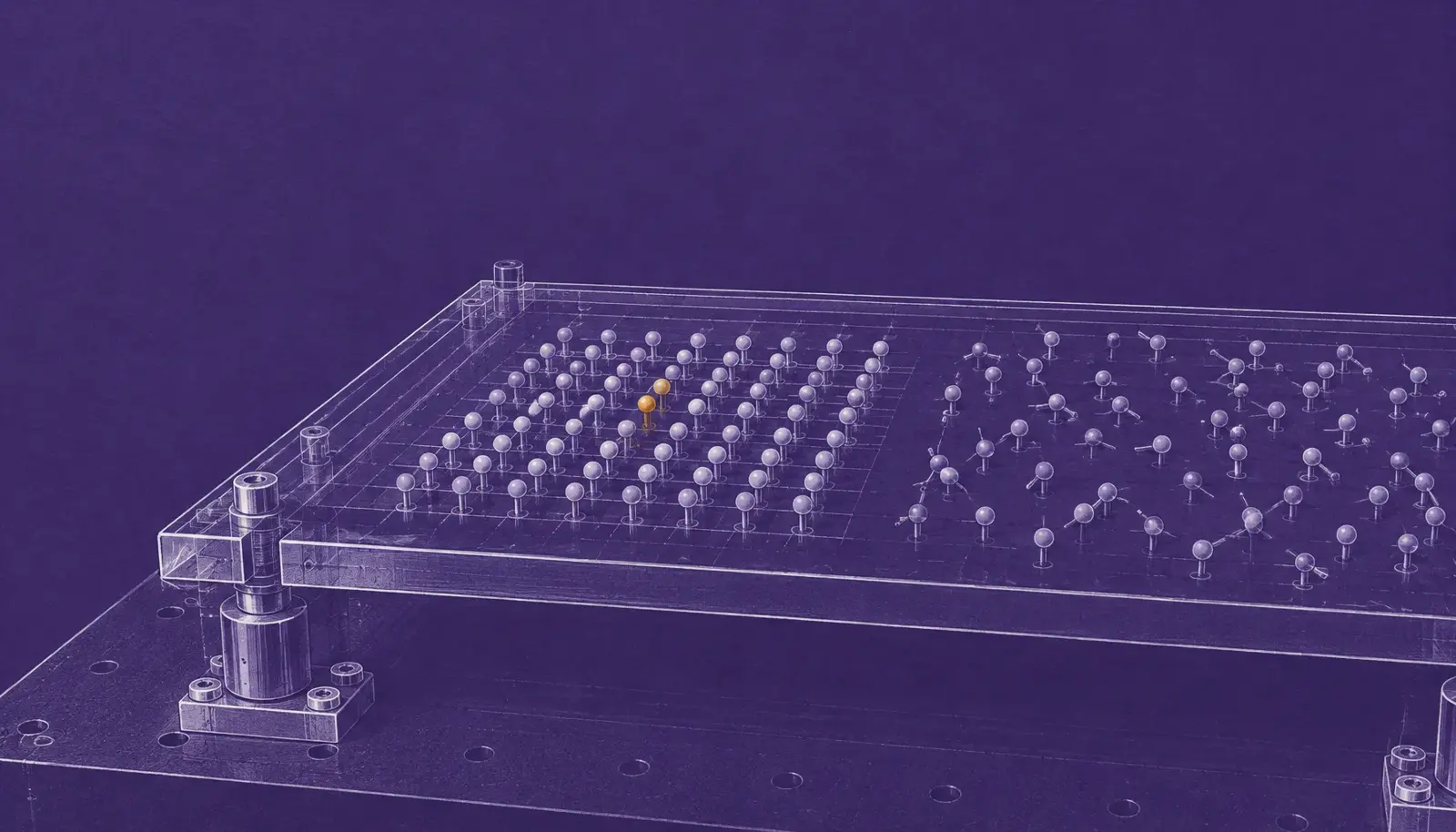
A programmable neutral-atom quantum simulator was used to study how isolated quantum systems evolve after a sudden quench. The experiments explored spin models with up to 180 qubits, finding several stable, qualitatively distinct dynamical regimes and, in two dimensions, a first-order dynamical phase transition. The Nature paper was published on 4 November 2026.
Distinct regimes after a sudden quench
A sudden quench takes a system away from its initial conditions and lets its subsequent dynamics unfold. Such dynamics are relevant to material science, high-energy physics and quantum chemistry, but are difficult to study numerically, especially for systems with many dimensions. The researchers used a programmable neutral-atom simulator to examine this problem experimentally across a broad parameter space.
They began by initializing the system in a product state, then performed quenches in spin models. Across the parameters studied, they found several stable regimes with qualitatively different behavior. The results map out a range of dynamical responses rather than a single pattern following every quench.
The researchers traced the regimes’ stability to Floquet-like prethermal steady states. Strong dynamical constraints stabilize these states over exponentially long emergent timescales. The paper identifies this long-lived prethermal behavior as the basis for the distinct regimes observed in the experiments.
Resonances and the melting of prethermalization
The study also reports sharp peaks in the dynamical response. The researchers quantitatively explain these peaks through the structured melting of prethermalization by resonances. In this account, resonances mark a way that the long-lived prethermal behavior can break down. The resonant response and its breakdown form a second part of the reported phase structure, alongside the stable regimes.
Together, the observations connect long-lived dynamics to their resonant destabilization. The study examined these behaviors in both one- and two-dimensional systems, and its figures describe the emergence of distinct regimes, the one-dimensional response and resonances, and the dynamical regimes of the two-dimensional lattice.
A two-dimensional dynamical transition
In two dimensions, the researchers found a prethermally driven, first-order dynamical phase transition linked to the proliferation of Néel-order defects. They probed the transition quantitatively using a generalized Clausius–Clapeyron test. The paper distinguishes this transition from an equilibrium phase transition: it is not inherited from the equilibrium phase boundaries.
The work therefore reports a connection between prethermal dynamics, defect proliferation and a first-order transition in the two-dimensional system. The authors describe the findings as a programmable route to studying high-energy prethermal phase structure, including long-lived dynamical phases, resonant breakdown and a transition that does not follow the equilibrium boundaries.
Experiment and data
The experiments were conducted on Aquila, a neutral-atom analogue quantum simulator built and operated by QuEra Computing. The authors also ran numerical simulations using Bloqade, software developed by QuEra, on the Perlmutter supercomputer at the National Energy Research Scientific Computing Center.
The paper states that data-processing and statistical-analysis procedures are described in the Methods and Supplementary Information, and that source data are provided. The full raw datasets are not included with the paper because of their volume; they are available from the corresponding authors upon request. The authors report that no custom code central to the study’s conclusions was developed, and that the software packages used for numerical simulations are described and cited in the Methods.
The author affiliations listed in the paper include the National Energy Research Scientific Computing Center at Lawrence Berkeley National Laboratory, QuEra Computing, Boston University and Harvard University. The funding acknowledgements name the US Department of Energy, NERSC, the Center for Ultracold Atoms and the National Science Foundation.
Source
Related stories
- Researchers couple atom array to fiber cavity in networking study
- Researchers propose fault-tolerant atom arrays with global control
- Princeton Team Uses Rydberg Blockade to Speed Ytterbium Loading
- Infleqtion reports 30 entangled logical qubits on Sqale
- Pasqal Finds Three Relaxation Regimes in a 256-Qubit Quantum Magnet