The Signal
Researchers propose fault-tolerant atom arrays with global control
A proposed neutral-atom architecture uses mobile rubidium atoms to select stationary caesium qubits under global control. Simulations predict a 1.43% quantum-memory error threshold under a hardware-inferred noise model.
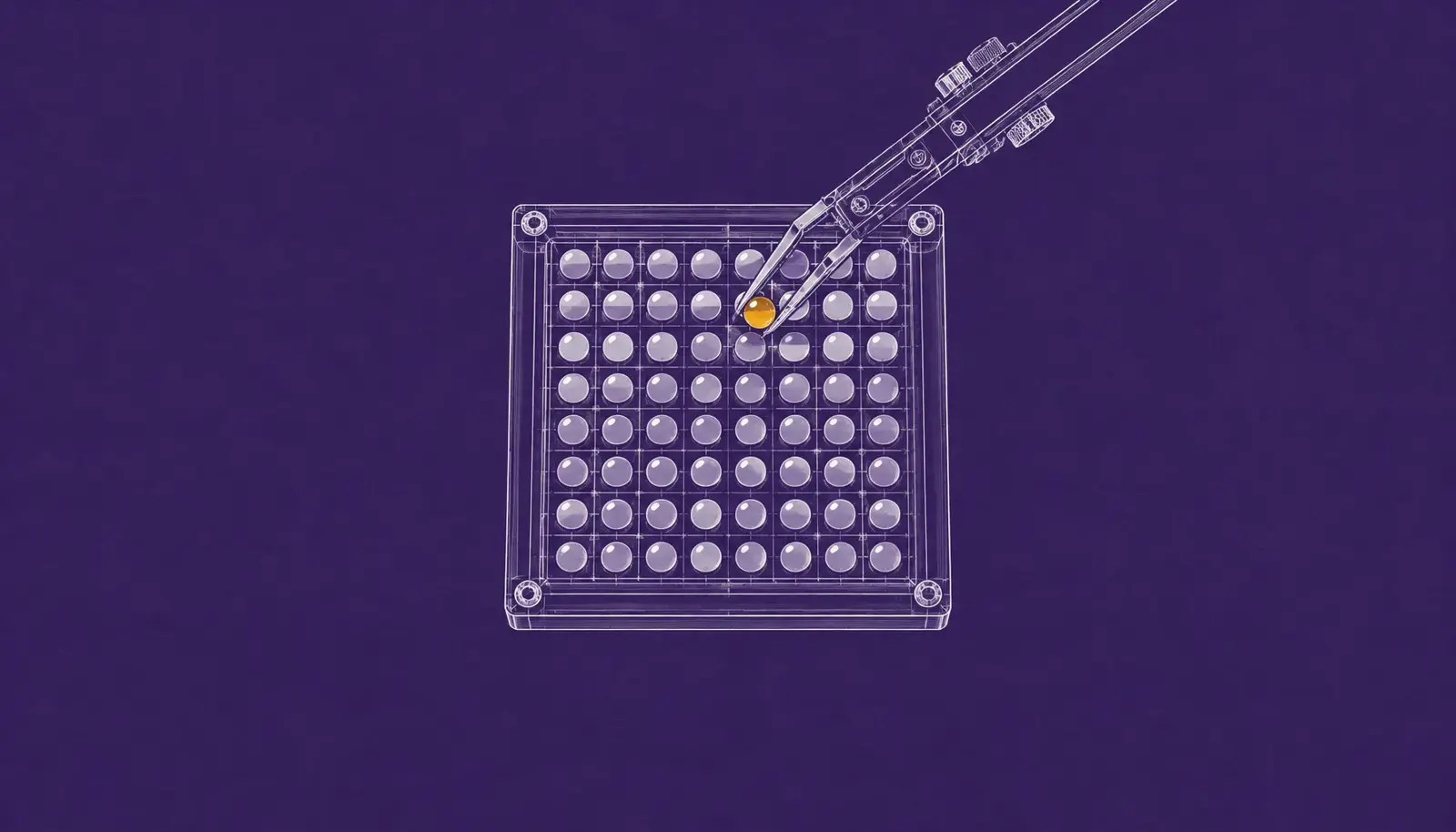
Mobile rubidium atoms could select individual caesium qubits for operations driven by global pulses, replacing locally focused gate beams in a proposed fault-tolerant quantum-computing architecture. The design and its simulated performance are described in an arXiv preprint by Zhihao Zhang, Shuaifan Cao and colleagues at Fudan University.
The work is a proposal and a set of modeled results, not a demonstration of a completed fault-tolerant computer. Under a hardware-inferred circuit-level noise model, the researchers report a 1.43% error-correction threshold for a quantum memory built around the design.
Selection by moving atoms
In the proposed array, stationary caesium atoms hold data qubits, while mobile rubidium atoms serve as addressors or measurement qubits for syndrome extraction. Optical tweezers would move the rubidium atoms while the caesium atoms remain in place.
Moving a rubidium addressor within the blockade radius of a selected caesium qubit provides spatial selection under global microwave and Rydberg pulses. The researchers say the arrangement removes the need to implement and calibrate focused gate beams at individual caesium sites.
The authors call the proposed native instruction set the Global Rydberg Atom Instruction Language, or GRAIL. Its instructions cover atom movement, global quantum control, reset and measurement; the authors use them to construct a physical gate set comprising H, T and controlled-Z operations.
Modeled gates and crosstalk
Using parameters they describe as accessible in current experiments, the authors predict fidelities above 99.5% for all compiled physical gates. Their gate simulations include Rydberg decay and finite blockade strength.
At a Rydberg Rabi frequency of 2.38 MHz, the modeled infidelities for addressed physical H, T and caesium–caesium controlled-Z gates are 2.05 × 10⁻³, 9.16 × 10⁻⁴ and 4.74 × 10⁻³, respectively. Global pulses also affect idling atoms, creating unwanted crosstalk. At 12 MHz, the researchers estimate crosstalk errors below 0.1% for the H, T and controlled-Z gates.
Memory and logical operations
For quantum memory, the researchers compiled the ZXXZ surface code into GRAIL and evaluated it with a noise model that includes gate errors and crosstalk. The reported 1.43% threshold uses the leakage probability of the native rubidium–caesium controlled-Z gate as the physical error rate.
In the simulation, the logical error rate per cycle decreased with code distance below that threshold. At 2.38 MHz, increasing the code distance by two suppressed the rate by a factor of 8.76 ± 0.04, the authors report. Extrapolating the fitted trend, they estimate that a distance-17 memory could reach a logical error rate below 10-9.
The work also compiles logical Clifford operations and adapts magic-state cultivation to the proposed instruction set. The authors developed a parallelized compilation intended to reduce the number of global pulses and the crosstalk from idling atoms.
In a cultivation benchmark at 11.9 MHz, the modeled logical error rate reached 1.98 × 10⁻¹⁰, with 2.43 expected attempts per accepted output. At 2.38 MHz, the corresponding estimate was 1.94 × 10⁻⁷, with 258 expected attempts.
The noise model combines numerical simulations of Rydberg pulses with effective error channels for global microwave rotations, reset and measurement. In the circuit simulations, leakage and crosstalk are approximated using depolarizing channels.
Sources
Related stories
- Researchers synthesize four-circuit fault-tolerant ancilla preparation
- Researchers couple atom array to fiber cavity in networking study
- Infleqtion reports 30 entangled logical qubits on Sqale
- Princeton Team Uses Rydberg Blockade to Speed Ytterbium Loading
- LLM-guided search produces fault-tolerant circuit designs