The Signal
Researchers couple atom array to fiber cavity in networking study
Researchers combined a 12-site rubidium atom array with a fiber Fabry–Pérot cavity and measured collective coupling for up to five atoms. The paper was accepted by PRX Quantum on November 10.
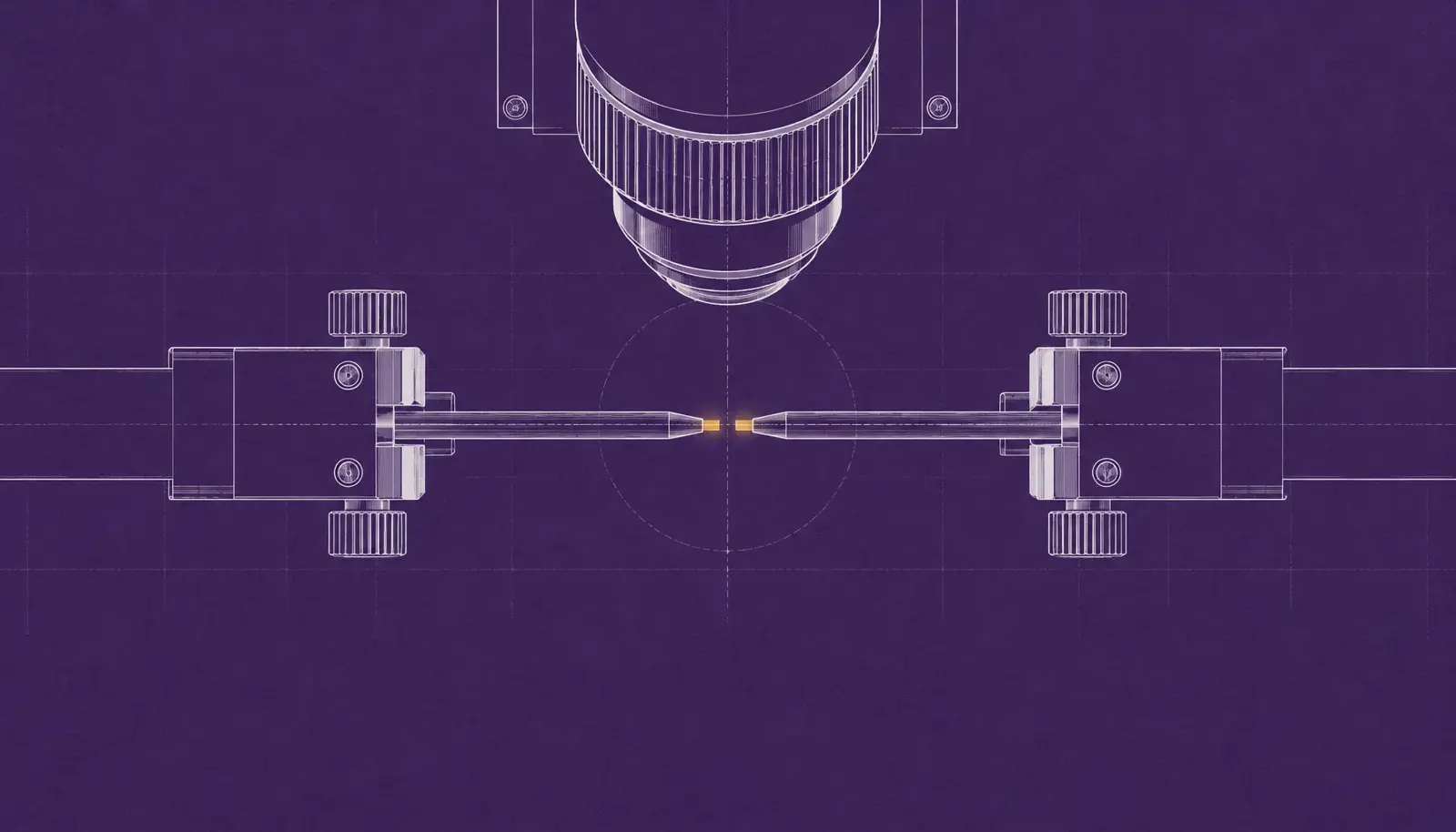
Researchers have coupled an array of individually controlled rubidium atoms to a fiber-based optical cavity, a configuration they describe as a possible building block for quantum networks. In a paper accepted by PRX Quantum on November 10, the team reports controlling how strongly atoms interact with the cavity and measuring a collective response from up to five atoms.
The experiment combines a 12-site optical tweezer array with a fiber Fabry–Pérot microcavity. Stephan Roschinski and Johannes Schabbauer contributed equally to the work, which was posted on arXiv in August.
Atoms between fiber mirrors
The researchers see the combination as a route toward network nodes that can process information locally while interfacing atoms with photons. Their paper identifies a geometric difficulty in that approach: the optical access needed to trap, control and image individual atoms competes with the small cavity dimensions used for high atom–photon cooperativity.
The experiment uses a one-dimensional array of rubidium-87 atoms. The cavity is 85 µm long and is formed by mirrors fabricated on the ends of optical fibers. A probe enters through one fiber mirror, and transmitted light is detected through the other.
The team projects up to 12 optical tweezers onto the cavity mode using a microscope objective. The tweezers are generated from a laser beam at 810 nm, and an acousto-optic deflector independently sets each trap’s position along the cavity axis.
The researchers load the traps from a cloud of laser-cooled atoms. A fluorescence image identifies occupied traps; after probing the cavity, a second image checks whether the traps remain occupied. They report an average imaging fidelity of 99.91(3)% for distinguishing empty and occupied tweezers.
Control by position
Moving a trapped atom along the cavity axis let the team change its coupling to the cavity’s standing-wave field. As the atom moved from an antinode toward a node, the measured vacuum Rabi splitting decreased continuously and the spectrum approached that of an empty cavity.
The paper attributes a residual splitting near the node to the finite spatial extent of the atom’s wavepacket. Unlike a scheme that pins atoms in an intracavity lattice, the experiment kept atoms confined by the optical tweezers, allowing continuous control of the coupling.
For the collective-coupling test, the researchers positioned a five-site array near antinodes of the standing wave. Measurements of the individual sites gave a mean coupling of 103(4) MHz, with variations below 4% across the sites. As more sites were occupied, the observed vacuum Rabi splitting increased, which the team reports as a collective enhancement of atom–cavity coupling.
Counting without removing atoms
The researchers used the cavity response to measure how many atoms were coupled to it without removing them from the register. In a test distinguishing an empty array from one coupled atom, they report fidelities of 97.4(6)% in 40 µs and 99.0(4)% in 100 µs.
The team extended the method to pairwise discrimination of larger atom numbers. For each chosen pair, the probe was tuned to a collective resonance associated with one of the counts, producing different transmission levels for the two cases.
The authors suggest that multiple fiber cavities could eventually fit within the field of view of a single microscope objective. Such an arrangement could allow different regions of an array to couple to independent optical modes, with parallel readout and photon-mediated links between neighboring registers.
Sources
Related stories
- Princeton Team Uses Rydberg Blockade to Speed Ytterbium Loading
- Researchers propose fault-tolerant atom arrays with global control
- Researchers model two-cavity bosonic entanglement distillation
- Infleqtion reports 30 entangled logical qubits on Sqale
- Researchers report quantum-key packets routed through two hops