The Signal
Four-ion optical clock runs autonomously with on-chip light
A four-ion optical clock ran using light delivered through waveguides integrated into its trap chip. The researchers reported continuous operation for more than two hours on multiple occasions, with a short-term frequency instability of 3.14(5) × 10^-14/√τ.
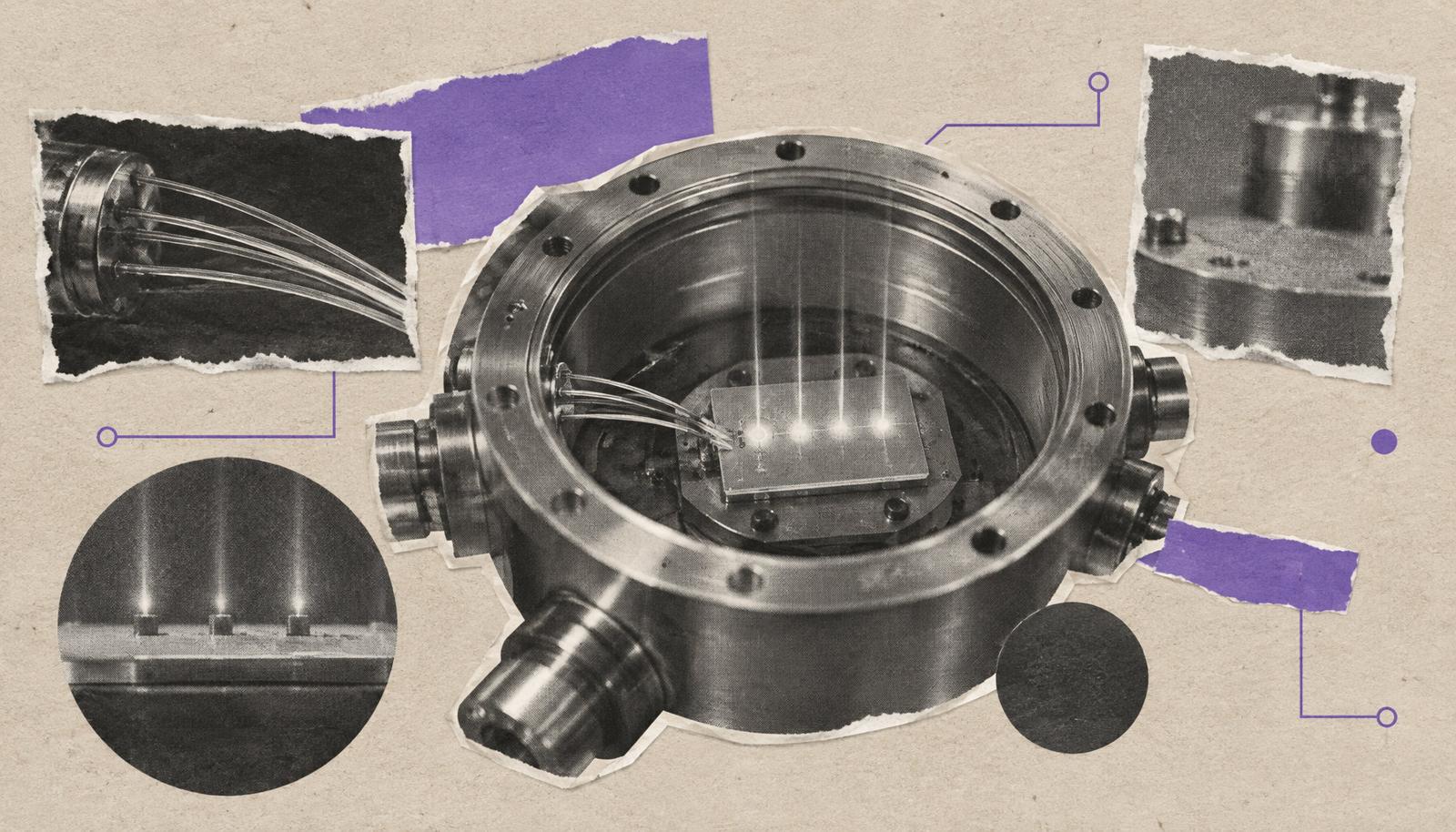
An integrated clock system
An optical clock using four trapped ytterbium ions ran autonomously while receiving all clock-operation light through waveguides built into its chip, according to a study published in Physical Review Applied on November 13. The paper reports a short-term frequency instability of 3.14(5) × 10^-14/√τ for the four-ion clock.
The ions were 171Yb+ trapped at room temperature in a multisite surface-electrode trap. The study’s authors are affiliated with Sandia National Laboratories and the University of California, Los Angeles. They report that every clock operation used light delivered through on-chip waveguides.
Replacing lost ions
The system used automated ion shuttling and reloading to address ion loss during interleaved clock measurements. When a clock site became vacant, the control sequence moved another ion into it; a newly loaded ion could be held as a buffer for replenishing clock sites.
The researchers say the clock sites were occupied by four ions more than 45% of the time, despite individual clock-site ion lifetimes of about one minute during clock operation. They also report continuous operation for more than two hours on multiple occasions.
Performance and operating limits
The reported short-term instability was 3.14(5) × 10^-14/√τ. For comparison, the paper gives an expected quantum projection noise instability of 2.30 × 10^-14/√τ for an individual clock under the reported four-ion measurement cycle; the authors say the measured performance was within a factor of two of that expectation and that technical noise likely accounted for the difference.
Long runs were predominantly limited by algorithmic interlocks. These stopped the clock when the system could not determine whether a laser had become unlocked after an extended period with no ions at any site.
Sources
Related stories
- Integrated standing-wave optics cool multiple trapped-ion modes
- Researchers track a single phonon through a 10-ion crystal
- Oxford Stores Remote Ion Entanglement in Calcium for 10 Seconds
- Trapped-Ion Benchmark Sets Conditions for Multiqubit Gates to Win
- Researchers Map Trapped-Ion Ramsey Data to Feynman Diagrams