The Signal
Integrated standing-wave optics cool multiple trapped-ion modes
Researchers demonstrated two laser-cooling methods for calcium ions using integrated optical delivery and phase-stable standing waves. The experiment cooled motional modes across an approximately 5 MHz bandwidth to near the quantum ground state within 150 microseconds.
Cooling with integrated optics
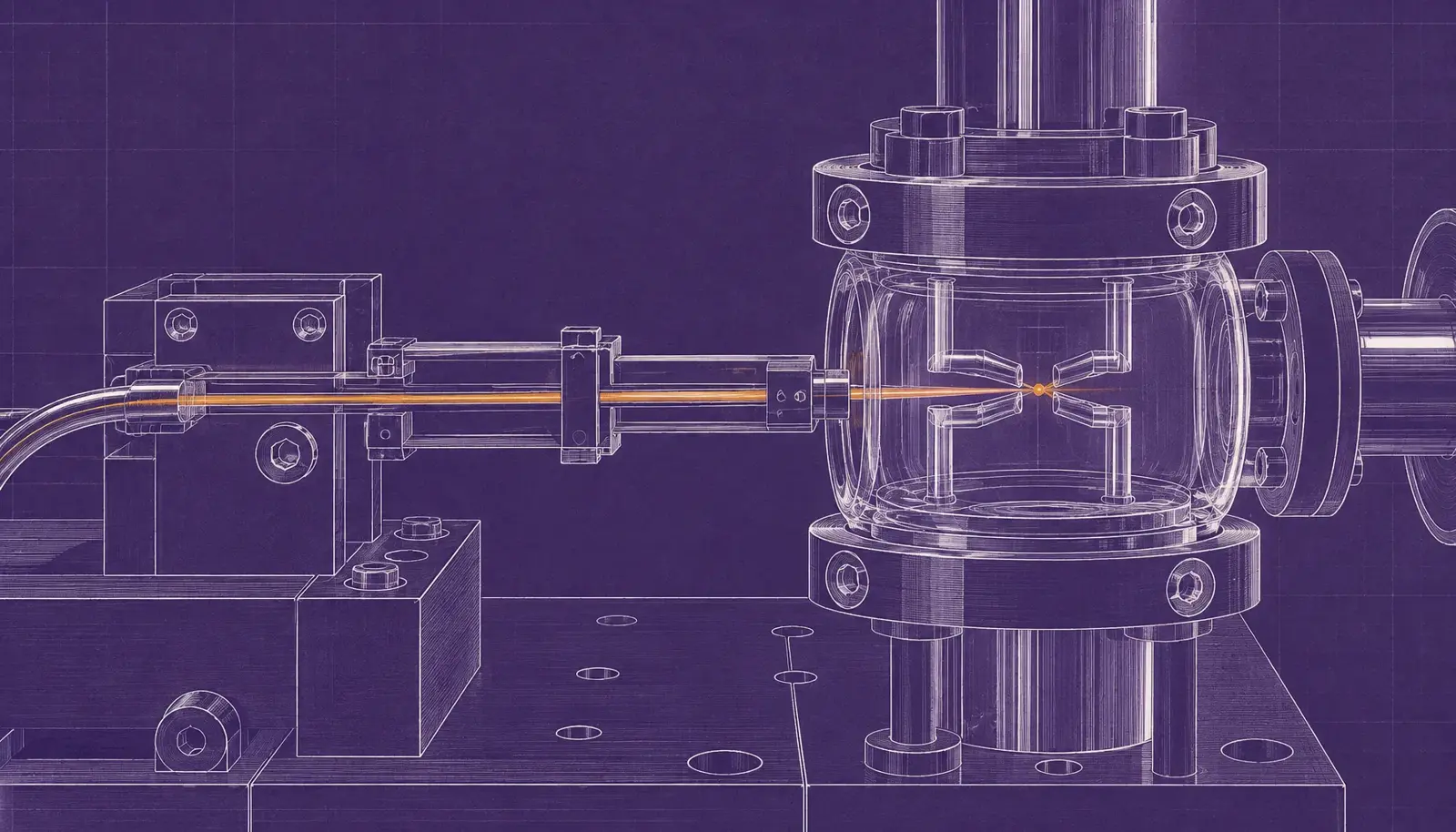
A team whose authors are affiliated with Cornell University and ETH Zurich reports two trapped-ion cooling demonstrations using integrated optical delivery and standing-wave light. The work, published in PRX Quantum on 9 November 2026, uses an ion-trap device with integrated waveguide optics to deliver ultraviolet-to-infrared light for calcium-ion control. The authors report Doppler cooling below the conventional Doppler limit at a standing-wave node, as well as ground-state cooling through electromagnetically induced transparency (EIT).
Laser cooling reduces the motion of atoms, a requirement for quantum computing and metrology applications that use atomic systems. The paper notes that cooling motion to the quantum ground state can impose limits on operation time and system architecture, particularly in larger systems. It presents integrated optical control as a way to bypass limitations of conventional cooling schemes while supporting approaches to scaling trapped-ion systems.
Two standing-wave demonstrations
In the first demonstration, the researchers used a passively phase-stable ultraviolet standing wave and cooled at a node in the light field. They experimentally verified a long-standing prediction by Cirac and colleagues: Doppler cooling at a standing-wave node can bring the ion below the conventional Doppler limit. This is the paper’s Doppler-cooling result, distinct from its second demonstration using EIT.
For the second demonstration, the team delivered an EIT probe beam as a standing wave and positioned the ion at a node. The paper describes this as the first realization of ground-state cooling using that configuration. The approach had been predicted to enable multi-mode cooling below the recoil limit. Here, the researchers report cooling motional modes spanning an approximately 5 MHz bandwidth, rather than presenting the outcome as a result for just one mode.
Rate, bandwidth and final occupancy
The experiment cooled modes from the Doppler temperature to near the ground state within 150 microseconds. For the target mode, the reported mean phonon-number occupancy was approximately 0.05. The reported bandwidth and target-mode occupancy describe different aspects of the cooling result.
The researchers also evaluated the standing-wave implementation against a comparable running-wave scheme. They report simultaneous advantages for the standing-wave setup in cooling rate, motional-mode bandwidth and final phonon number, consistent with earlier theoretical predictions. The comparison therefore concerns three measures of cooling performance, rather than a single final-temperature result.
The work combines integrated delivery of multiple wavelengths with structured standing-wave light to demonstrate both below-limit Doppler cooling and EIT ground-state cooling. Its reported multi-mode result is cooling across the measured bandwidth to near the ground state, with the target mode reaching the stated occupancy. The authors describe the experiments as showing how integrated optical delivery can enable fast cooling of multiple motional modes, and how scalable optical-control approaches can enhance atomic functionality.
Source
Related stories
- Trapped-Ion Benchmark Sets Conditions for Multiqubit Gates to Win
- Researchers Map Trapped-Ion Ramsey Data to Feynman Diagrams
- Innsbruck Team Reports Trapped-Ion Gate Errors Below 0.5%
- Researchers track a single phonon through a 10-ion crystal
- Duke Trapped Ions Cross a Programmable Vacuum-Amplification Threshold