The Signal
Researchers track a single phonon through a 10-ion crystal
An experiment followed a localized vibrational excitation through a trapped-ion crystal. The researchers report different propagation patterns depending on where the phonon started.
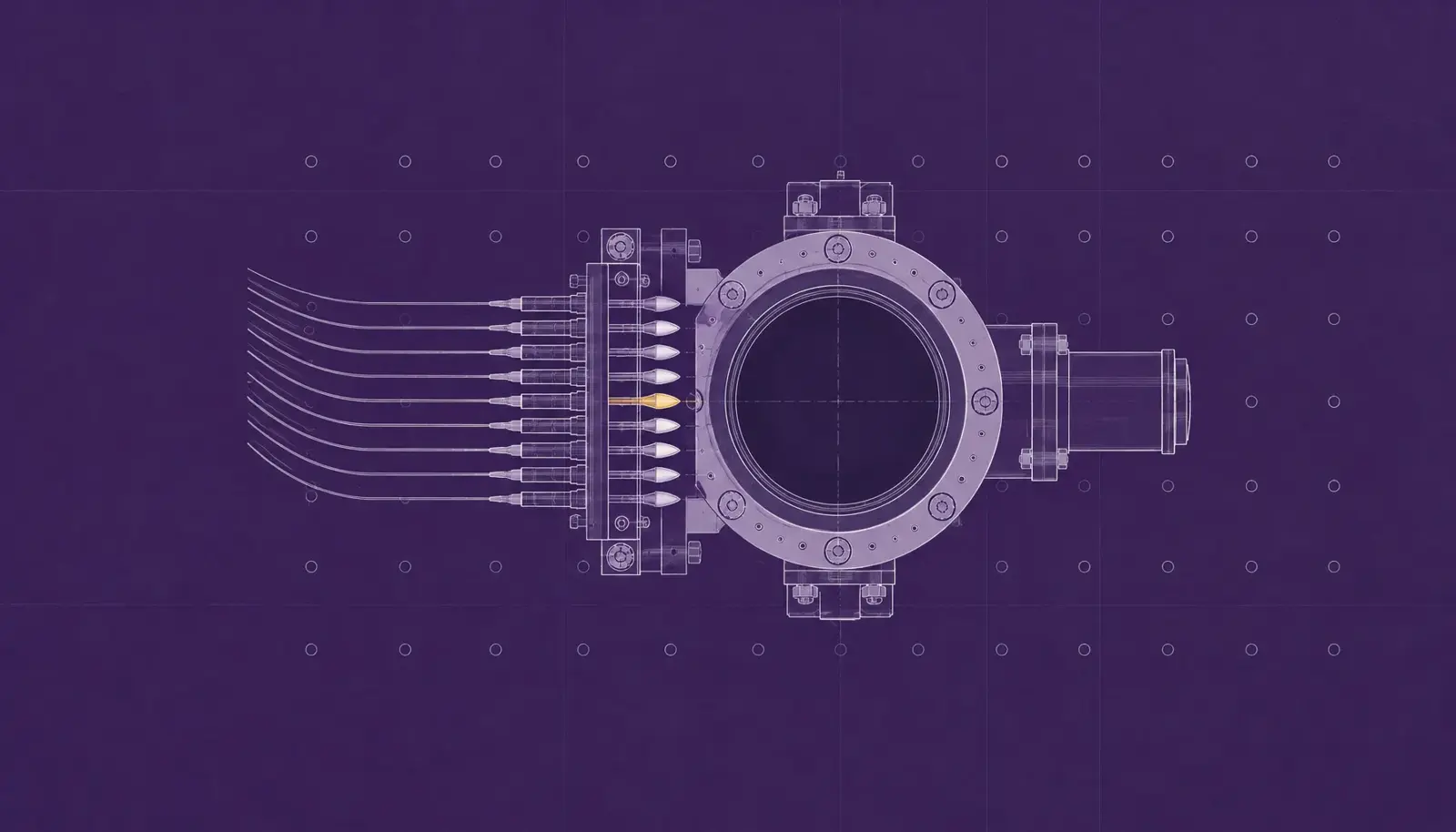
A single vibrational excitation moved through a crystal of 10 trapped ions in patterns that depended on where it started, researchers report in an arXiv preprint. The team found both movement between neighboring ion sites and movement across the chain, and reports close agreement with numerical simulations.
Takumi Yuri, Yu-Xuan Chen and Kenji Toyoda of The University of Osaka studied a localized phonon: an excitation of an ion’s vibrational motion. Their experiment tracked its propagation through a one-dimensional crystal held in a harmonic potential.
Preparing and reading the motion
The experiment used calcium ions confined in a linear Paul trap. Each ion had a dedicated optical beam for cooling, preparing a local phonon and detecting it.
After cooling the radial motion near its vibrational ground state, the researchers used an optical beam to prepare a local phonon at a chosen site. They then switched off the beams and allowed the excitation to propagate through interactions between the ions.
To read out its position after a chosen propagation period, the team mapped the vibrational state at each site onto the ions’ internal states. Fluorescence measurements then revealed those internal states across the chain.
The ions were not evenly spaced: separations were larger at the edges than near the center. The paper describes how this nonuniformity produces site-dependent frequency shifts and different hopping rates between neighboring sites.
Different starting points
Starting at an edge ion, the phonon population spread through the central region before refocusing at the opposite edge and later at the starting edge. The refocusing was not perfect; some population remained distributed across other sites.
With the excitation initially prepared at an interior site, the population split into several parts. When it started near the center, the population spread over much of the chain in a relatively short time.
The researchers also simulated the propagation from the different starting sites. An idealized calculation reproduced the broad behavior, including refocusing at the edges, while a calculation that included the duration of preparation and readout pulses generally reproduced the experimental results.
Those pulse durations mattered particularly for the interior starting points. The paper says the initial dynamics were not captured in those cases because phonon hopping proceeded during preparation.
Limits and possible extensions
The experiment was restricted to the single-phonon subspace. The authors say future experiments may extend the approach to multiple phonons in larger systems and to interacting spin-phonon systems.
They identify several challenges for scaling the platform, including stable trapping of longer linear crystals, cooling more motional modes and maintaining individual optical access. Detecting multiple phonons at a site could also require more complex mapping techniques, because typical internal-state measurements provide binary information at each ion site.
The team says remaining differences between experiment and simulation are more likely associated with technical imperfections in preparation, control and readout. Potential sources include imperfect phonon initialization, fluctuations in optical control and imperfect mapping from motion to internal states.
Sources
Related stories
- Duke Trapped Ions Cross a Programmable Vacuum-Amplification Threshold
- Researchers Map Trapped-Ion Ramsey Data to Feynman Diagrams
- Batched optimizer reaches quantum training loss in fewer jobs
- PRISM preprint reports up to 30.8% fewer routing SWAPs
- Sound Emission Can Increase Kelvin Waves on a Superfluid Vortex