The Signal
Sound Emission Can Increase Kelvin Waves on a Superfluid Vortex
A Gross–Pitaevskii simulation finds that sound can leave a superfluid vortex with more Kelvin waves even as those waves lose energy. In a reflecting cavity, shifting the initial sound phase reverses the transfer, while the paper’s example r
Quantum.world Team · Written with AI · fact-checked ·
A Gross–Pitaevskii simulation finds that sound can leave a superfluid vortex with more Kelvin waves even as the waves lose energy. The result, in a paper Weican Yang submitted to arXiv on October 29, 2026, describes a route for redistributing motion along a quantized vortex rather than simply damping it away.
One Kelvin quantum becomes two
Kelvin waves are transverse motions that travel along a quantized vortex line. Yang describes a process in which one Kelvin quantum emits a phonon—a sound excitation—and splits into two softer Kelvin quanta. The daughters retain most of the parent’s axial momentum while carrying less total energy, allowing the vortex-wave population to grow as it cools.
“A subsonic Kelvin quantum can emit a phonon and split into two softer quanta, increasing Kelvin population while losing energy.”
Weican Yang, the paper’s author, writes that sentence in the abstract. The paper contrasts this channel with pair annihilation, in which counter-propagating Kelvin quanta emit sound and reduce the Kelvin population. Which process occurs matters for predicting the vortex’s shape after it dissipates energy.
A sound phase reverses the transfer
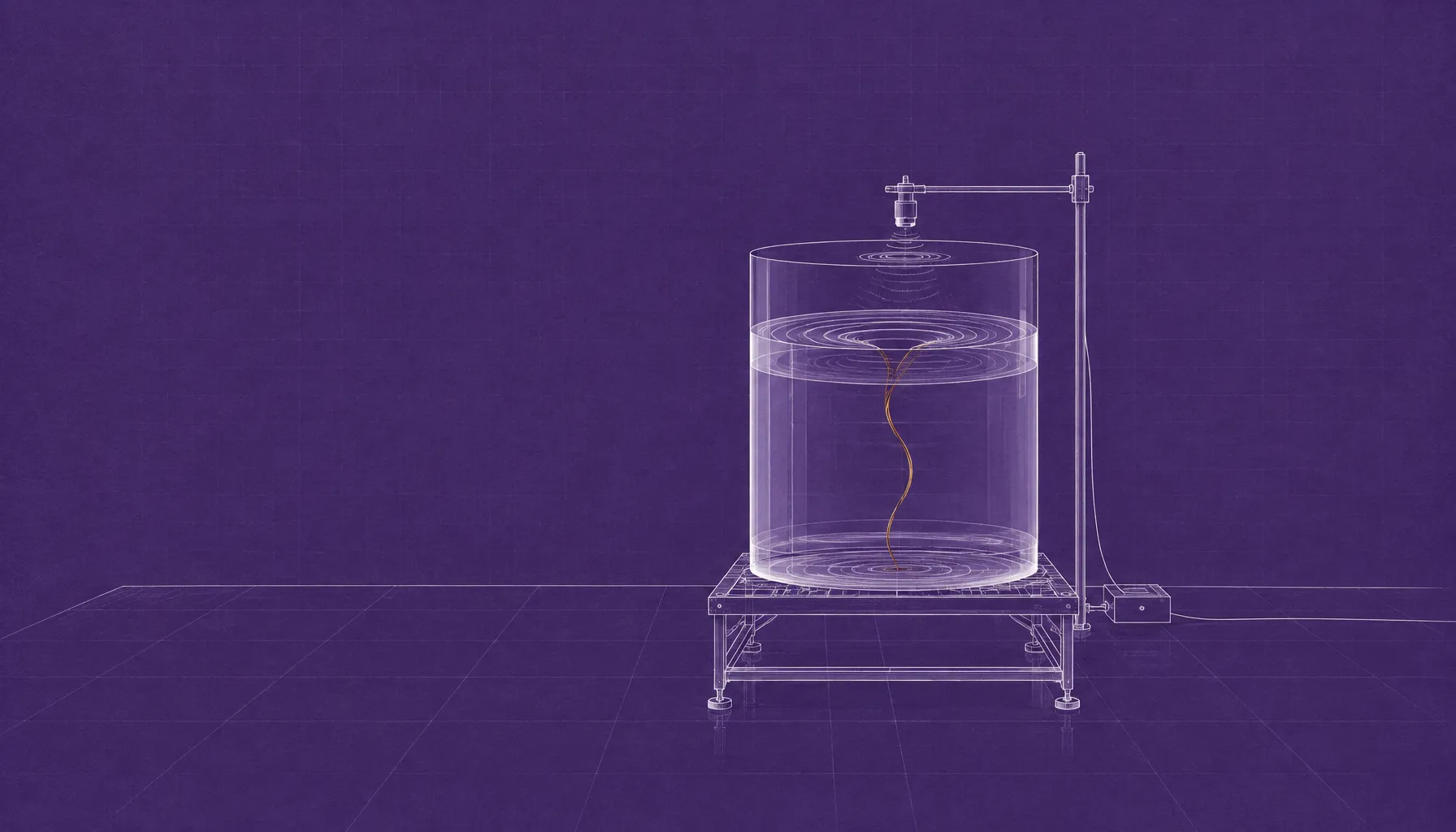
Yang tests the conversion in a radially reflecting cylinder using Gross–Pitaevskii evolution. The simulation coherently seeds a parent Kelvin mode, a daughter mode and an angular-momentum-carrying sound mode; the calculated interaction is set before the simulated evolution rather than fitted to its results. Changing the initial sound phase by π reverses the direction of population transfer. The paper reports dimensionless time, with a baseline integration step of 0.01.
At dimensionless time t=1,000, one phase raises the bound Kelvin population by 17.6% while lowering its quadratic Kelvin energy by 11.9%. With the sound phase shifted by π, the population falls by 6.1% and the Kelvin energy rises by 4.3%. Averaging over eight equally spaced initial sound phases still produces a 5.8% increase in Kelvin population at that time, though individual phases can produce a decrease.
The simulated vortex changes shape
The calculations also track the vortex core, whose displacement and slope need not follow the Kelvin population in the same way at finite wavelengths. In the amplifying preparation, mean-square displacement rises by 10.5% and mean-square slope falls by 17.0% at time 1,000. The opposite sound phase changes those measures by −8.2% and +2.0%, respectively.
For an illustrative rubidium-87 condensate, Yang maps that simulation time to 159 milliseconds, using a chemical-potential frequency μ/h of 1 kilohertz. The paper estimates a 45.7-nanometer difference between the two preparations’ daughter-mode displacement amplitudes. Those are simulated values, not a report of an experiment or a claim about detection sensitivity; the modeled axial cell is periodic, and the paper says an experiment would need a longer uniform segment and control of sound reflections.
Spontaneous emission is much weaker
The coherent cavity result does not mean an isolated Kelvin wave will multiply quickly in an open system. For the paper’s stated vacuum-rate example, with wave number 0.60, axial period 50π and Nξ=20 (where Nξ=n₀ξ³), the spontaneous splitting rate is 2.93 × 10⁻¹¹ μ/ℏ. Yang notes that conservative scattering, returning sound and thermal drag also affect relaxation, so the long-term Kelvin population requires a kinetic treatment of competing processes.
The paper’s main contribution is a link between the Kelvin-wave dispersion and the leading sound-coupling amplitude in the soft-phonon limit. Its simulations show how coherent sound can turn that interaction into either amplification or attenuation, while the extremely small example vacuum rate sets a limit on what the calculation establishes about spontaneous relaxation.