The Signal
EPFL preprint reports around 67% internal efficiency in millimeter-wave transducer
A preprint describes an integrated lithium niobate device that converts between millimeter-wave and optical signals, with internal conversion efficiency around 67%. Its authors also report room-temperature thermal photon detection and electro-optic back-action on the optical resonances.
A compact link between two frequency ranges
A preprint by researchers at EPFL reports an integrated electro-optic transducer connecting millimeter-wave signals with optical signals. The device reached cooperativities approaching 0.3, corresponding to internal conversion efficiencies around 67%, the authors write in the paper’s abstract. The preprint was submitted to arXiv on Oct. 30, 2026.
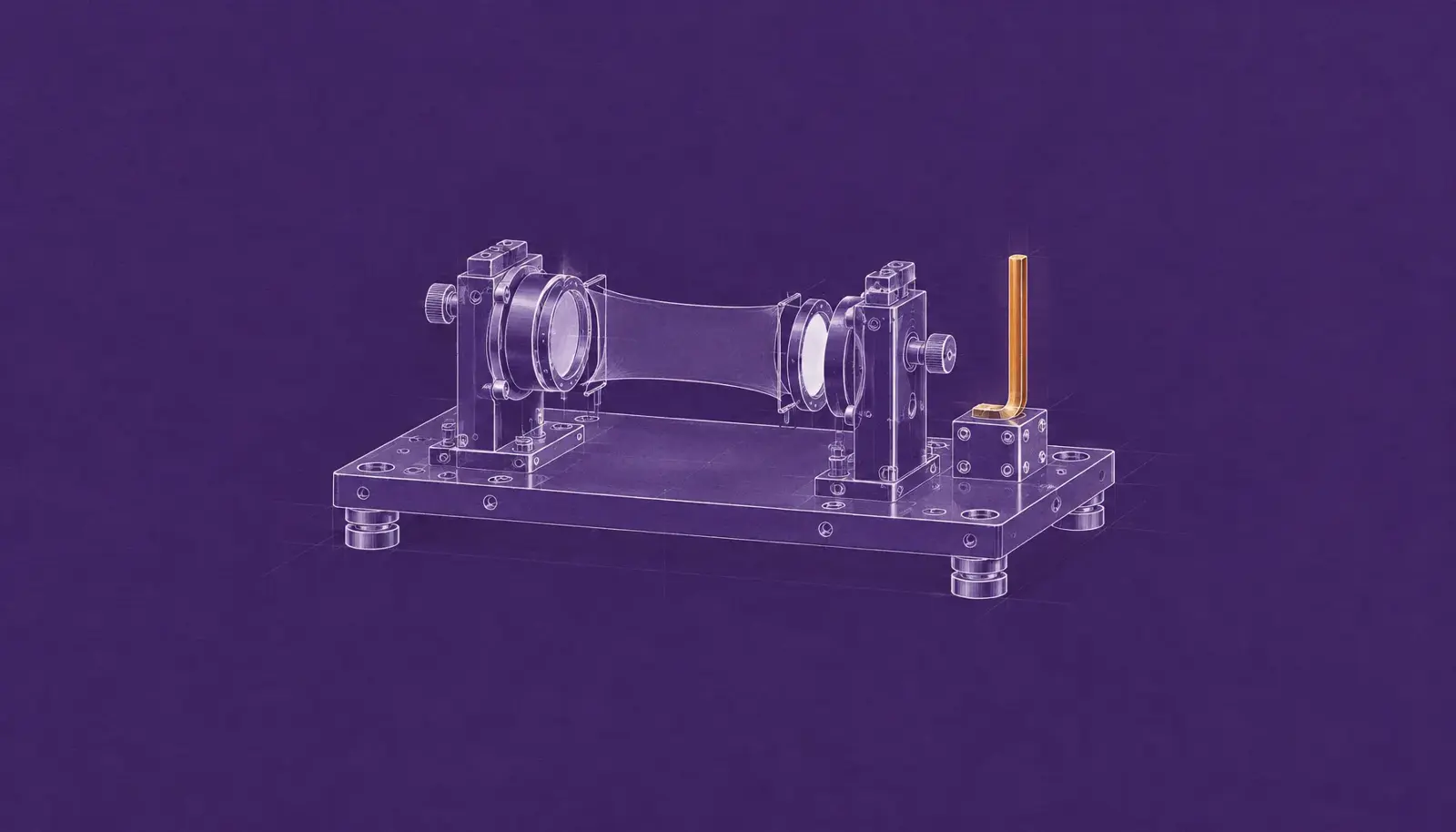
The device pairs coupled lithium niobate Fabry–Pérot cavities with a quarter-wave gold resonator operating at 263 GHz. The optical frequency is 192 THz, or 1,561 nm, and the optical cavities have lengths of 110 μm and 119 μm, according to Quantum Computing Report. The paper reports optical free spectral ranges above 650 GHz and quality factors up to 106.
The design addresses a size mismatch that can limit electro-optic coupling: the millimeter-wave and optical resonators need to be small while maintaining their quality factors and spatial overlap. In this device, the optical and millimeter-wave resonators have comparable dimensions and small mode volumes, according to the preprint. The optical cavities and the nearby millimeter-wave resonator form a triply resonant system.
Coupling and thermal detection
The preprint reports a vacuum electro-optic coupling rate of about 60 kHz. The paper says this is six times larger than in previous millimeter-wave transducers and 60 times larger than at microwave frequencies. Quantum Computing Report describes the optical cavities as formed in a suspended 400 nm lithium niobate membrane, with photonic-crystal mirrors defining the compact resonators.
The device also detected room-temperature thermal millimeter-wave photons at effective occupancies below one, according to the preprint. Quantum Computing Report lists an effective thermal detection value of 0.21 ± 0.08 photons and says the thermal sideband served as an internal reference for measuring cooperativity.
The report describes additional design details, including tuning electrodes used to adjust the detuning between the optical modes. It says the cavities are aligned to the lithium niobate crystal’s Z-axis, where the material’s Pockels response is strongest. The preprint’s abstract presents the thermal signal as a calibration tone for measuring transduction efficiency.
Back-action and efficiency
The researchers report electro-optic dynamical back-action that can broaden or narrow the optical resonances. Quantum Computing Report describes the broadening as an added dissipation path during beam-splitter up-conversion, while parametric down-conversion narrows the optical mode.
The paper’s reported efficiency is internal, rather than a measure of the complete path into and out of the device. Quantum Computing Report says free-space coupling into the integrated antenna limits total wireless efficiency. It also describes replacing the gold resonator with a superconductor such as niobium titanium nitride as a proposed way to reduce internal ohmic damping and increase total transduction efficiency at liquid-helium temperatures.
Potential applications
The preprint frames the architecture as relevant to weak-signal sensing and quantum and classical networking. Optical carriers can route signals over optical links, while millimeter-wave frequencies are of interest for applications including atomic Rydberg transitions. The reported device combines a compact optical resonator pair with a millimeter-wave resonator and demonstrates coherent conversion alongside thermal detection and back-action effects.
Sources
Related stories
- NIST Team Reads a Superconducting Qubit at 99.2% with Millimeter Waves
- Phys.org reports microrotor spins at 138 million rpm
- Horizon Quantum says multiplexing cuts ZZ crosstalk characterization experiments on a 100-qubit processor from about 5,000 to 7
- Paderborn team demonstrates quantum-dot entanglement swapping
- SQS says quantum nodes are operational in Albuquerque and Mesa