The Signal
Paderborn team demonstrates quantum-dot entanglement swapping
An international team including Paderborn University researchers demonstrated entanglement swapping with photon pairs from two separate semiconductor quantum dots. The team reported fidelity reached up to 0.71 ± 0.02, while saying a complete quantum repeater has not yet been realised.
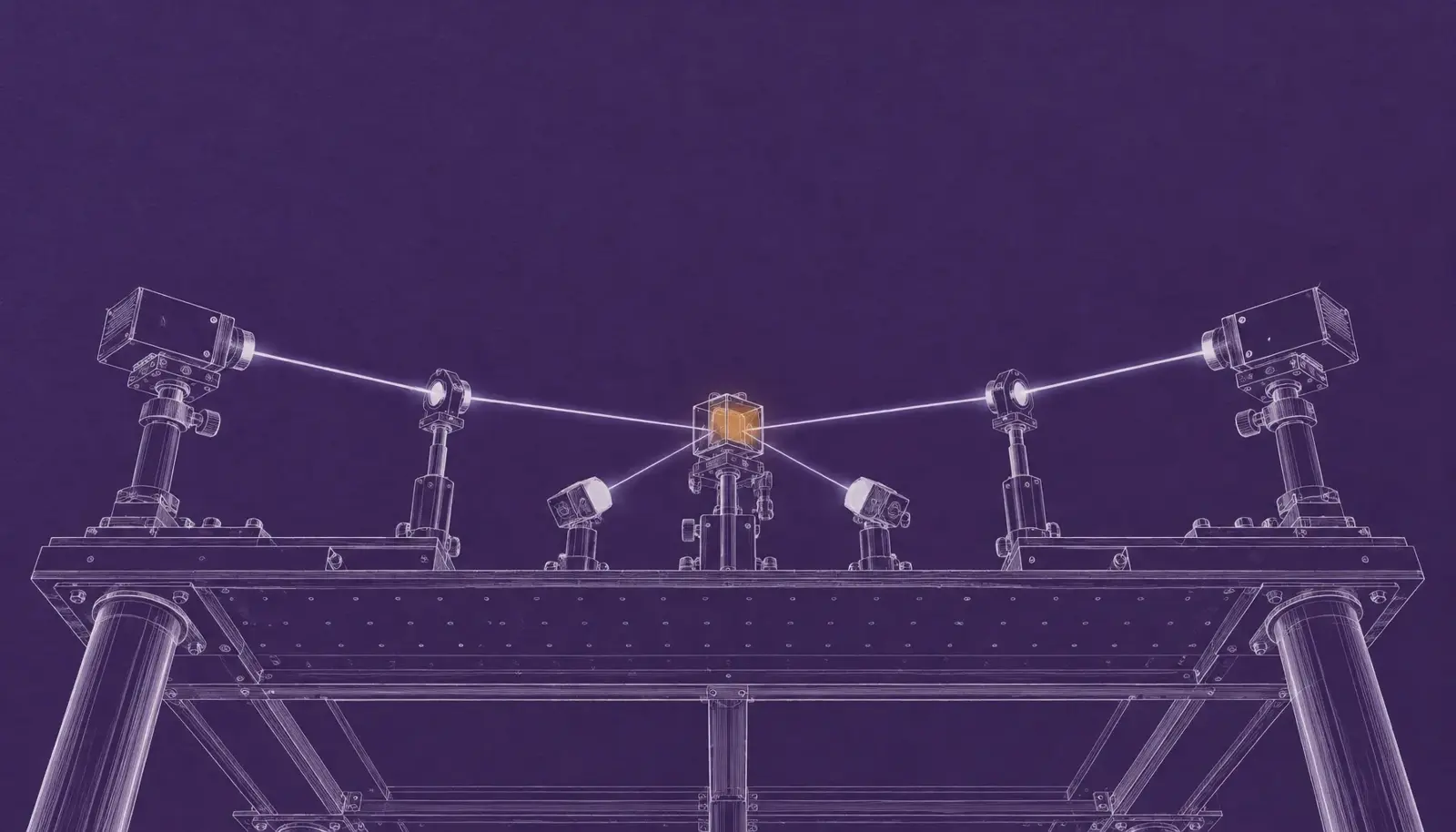
Swapping entanglement between photon pairs
An international research team including Paderborn University researchers demonstrated photonic entanglement swapping using entangled photon pairs from two separate semiconductor quantum dots, which the university described as the first such demonstration. The university announced the result on Nov. 10, 2026, and said it was published in Science Advances.
Quantum repeaters are designed to establish entanglement across multiple links, the university said, and swapping is the process used to link those connections. In the experiment, each of two separate gallium arsenide quantum dots generated a pair of entangled photons: photons 1 and 2 formed one pair, and photons 3 and 4 the other.
The researchers made photons 2 and 3 interfere and subjected them together to a Bell-state measurement. A suitable measurement result left photons 1 and 4 entangled despite their never having directly interacted, according to the university. Klaus Jöns of Paderborn University said, “It is precisely this capability that we need to combine individual quantum connections into larger networks.”
Measured result and operating limits
The team reported fidelity of up to 0.71 ± 0.02 for the match with the desired entangled state. That result was more than ten statistical standard deviations above the classical limit of 0.5, the university said. The protocol was implemented at event rates in the hertz range.
Earlier demonstrations of photonic entanglement swapping between spatially separated systems relied on probabilistic light sources, the university said. Those sources produce photon pairs randomly, and increasing their excitation also makes unwanted multiple pairs more frequent, which can impair entanglement quality.
Quantum dots can be selectively excited to generate entangled photon pairs on demand, without the same fundamental trade-off between pair-generation rate and entanglement quality, according to the university. The swapping operation still succeeds only when the measurement results are suitable; the university describes on-demand pair generation as a prerequisite for future scaling.
Devices built for matching photons
The experiment used stress-free gallium arsenide quantum dots in circular Bragg resonators, structures that the university said enable efficient collection of emitted light. The dots were integrated into hybrid semiconductor-piezo devices, and triaxial piezoelectric actuators were used to tune their properties. The tuning made photons from the two emitters virtually identical, allowing them to interfere, the university said.
Development and nanofabrication involved Sapienza University of Rome, the University of Würzburg, Vorarlberg University of Applied Sciences and Johannes Kepler University Linz. Jöns said the work builds on a roadmap for quantum dots in repeaters that he developed with Rinaldo Trotta and Armando Rastelli in 2014.
A complete quantum repeater has not yet been realised, although a component for such a system has now been demonstrated, the university said.
Source
Related stories
- Stuttgart Team Runs Quantum-Dot QKD for 19 Hours on Campus Fibre
- PRX Quantum paper demonstrates phase-controlled photon routing
- Waterloo Researchers Set a Direct-Link Ceiling for Gaussian Repeaters
- Researchers report coherent photon reflection from a quantum-dot waveguide
- Quantum Dots Outpace Laser Pulses in an MDI-QKD Model