The Signal
Time-Domain Multiplexing Reaches 0.960 GKP Fidelity with One Source
A study submitted to arXiv on October 30 finds that time-domain multiplexing can prepare simulated GKP states with fidelity above 0.95 while reusing one or two squeezed-light sources. The modeled circuits reduce photon-number resolution demands, but some configurations have much lower heralding probabilities than spatial benchmarks.
One source, nine modes
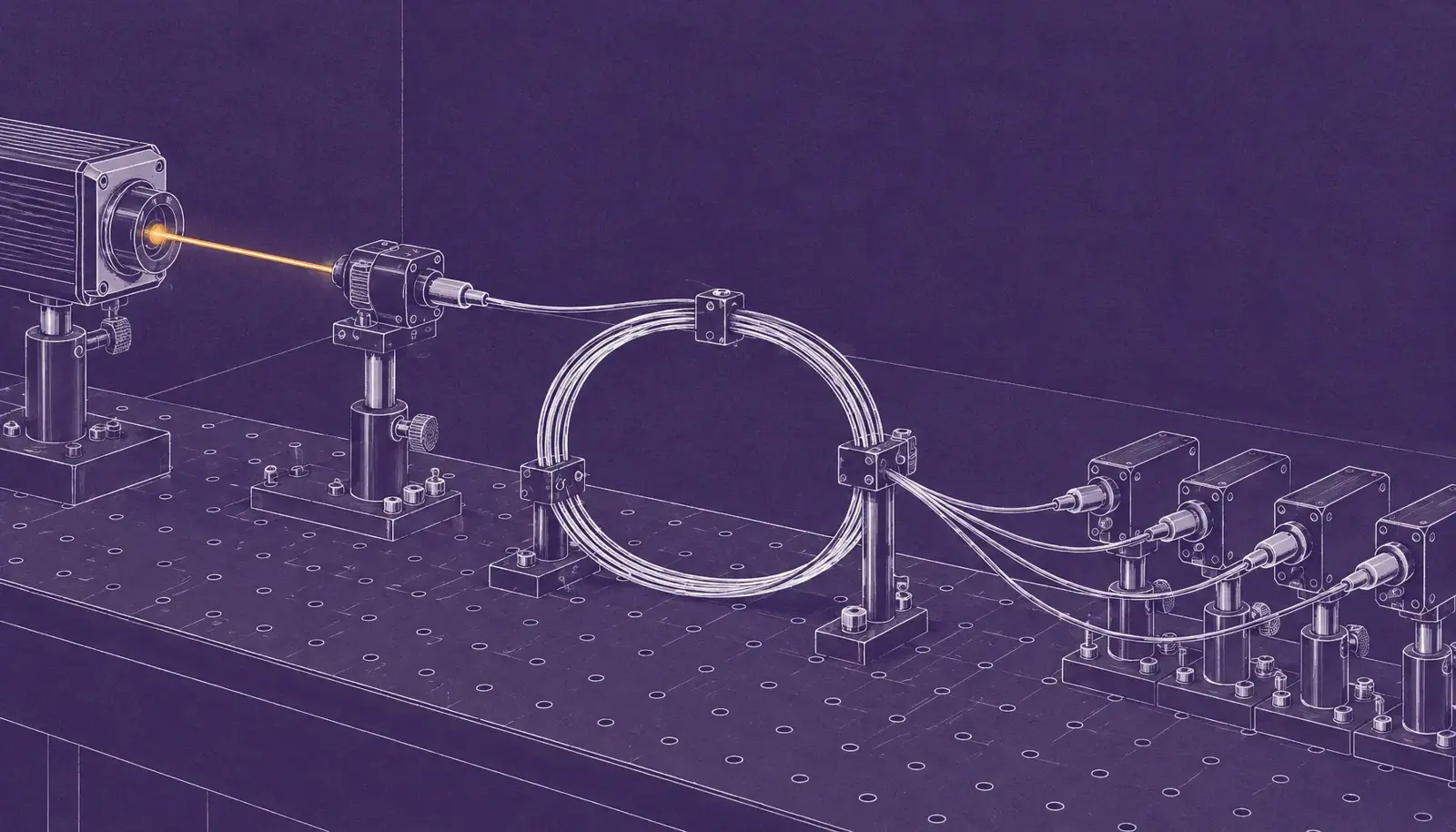
A single squeezed-light source reaches a simulated GKP-state fidelity of 0.9600 in a nine-mode circuit, according to a paper submitted to arXiv on October 30. The result comes from time-domain multiplexing: a source sends pulses into a loop in succession, reusing hardware to build a larger optical circuit over time rather than operating a separate squeezed source for every mode.
The study, by Ke-Ming Hu, Jun-Jie He, Yu-Ze Zhu, Pei-Lin Du, Lin Yang, Hao Tang and Xian-Min Jin, compares these loop-based designs with spatial circuits that run multiple squeezed inputs at once. In the nine-mode case, the single-source and two-source time-domain circuits reach fidelities of 0.9600 and 0.9599. The fully squeezed spatial benchmark reaches 0.9582.
“Selected nine-mode configurations retain fidelities above 0.95 with one photon heralded in each measured mode, mitigating detector resolution demands without a proportional increase in source count.”
Ke-Ming Hu, Jun-Jie He, Yu-Ze Zhu, Pei-Lin Du, Lin Yang, Hao Tang and Xian-Min Jin
GKP states encode quantum information in repeating grids in an oscillator’s phase space. The paper studies one route to preparing approximate versions of those states: mix squeezed optical modes, then use photon-number measurements on all but one mode to herald the desired state in the remaining mode. Its results come from numerical optimization, not an experimental demonstration.
Fewer source units, but rarer successful outcomes
Spreading heralding photons across more measured modes can reduce the photon-number resolution a detector needs for each accepted outcome. In the nine-mode example, each measured mode registers one photon. That detection pattern avoids asking a detector to distinguish several photons in a single mode, while the reused source supplies the squeezed pulses at successive time steps.
The trade-off is the probability of obtaining the required measurement pattern. For eight detected photons across nine modes, the paper reports heralding probabilities of 1.10 × 10⁻⁶ for single-source TDM and 5.27 × 10⁻⁶ for two-source TDM; the spatial benchmark reaches 2.37 × 10⁻⁵. Those figures mean the modeled TDM states can match the benchmark’s fidelity while being less likely to appear on a given attempt.
The authors point to restricted connectivity in the studied single-loop circuits as one possible contributor to the probability gap: the loops do not access all the transformations available to the universal spatial interferometer used for comparison. At 13 modes, the two-source TDM circuit reaches fidelity 0.9611 for a pattern with one photon in each measured mode, compared with 0.9595 for the spatial benchmark. Its heralding probability is 2.94 × 10⁻⁷.
Loss changes the comparison
The team also reoptimizes circuits under modeled optical loss. At 1.0 dB of spatial loss per channel, two-source TDM reaches fidelities of 0.8020 and 0.7976 in two tested configurations. The corresponding spatial circuits reach 0.5939 and 0.5973.
That comparison depends on where the paper places the loss. In the spatial model, attenuation affects every terminal mode, including the retained output; in the TDM spatial-loss model, it affects outgoing measured rails at each step but not the final stored loop mode. The authors test delay-line loss separately, and report that under that model the two-source circuit stays near the spatial benchmarks in the configurations examined. The results therefore do not establish a general advantage under every kind of optical loss.
A numerical case for temporal reuse
The simulations use an end-to-end differentiable Bargmann framework to optimize finite-energy GKP states, with a Fock cutoff of 80 for final ideal-circuit evaluations. The target state fixes two parameters, Δ and κ, at 0.36. The authors also vary the time-step count and allow squeezing and interferometer settings to change from one time bin to the next, so the source reuse depends on programmable operations as well as the loop.
The study’s central engineering trade is clear: fewer physical squeezed sources and simpler per-mode photon counts can come with lower success probabilities, while loop connectivity and loss placement affect the comparison. The next practical test is whether an optical system can implement the required programmable time-bin settings and achieve useful state-generation rates with real loop losses. The paper establishes simulated fidelities and modeled trade-offs, not those experimental outcomes.