The Signal
Photonic Processor Classifies Quantum States by Stellar Rank
A programmable photonic processor classified 180 single-mode quantum states as stellar rank zero or one using a quantum-kernel method. The experiment showed accurate classification despite imperfections, while the paper’s polynomial-resourc
Quantum.world Team · Written with AI · fact-checked ·
Researchers posted a proof-of-principle demonstration on October 29: a programmable photonic processor helped classify quantum states by stellar rank, a measure of non-Gaussianity in light. The experiment distinguished two classes—single-mode states of stellar rank zero and one—using quantum-kernel learning. Its result is a narrow but practical test of whether a quantum device can help identify a resource in quantum data without reconstructing each state in full.
180 states, two stellar-rank classes
The team assembled a labeled dataset of 180 states. Each was made by applying a Gaussian operation to either a vacuum state, assigned stellar rank zero, or a single-photon state, assigned rank one. The researchers experimentally measured the pairwise fidelities needed to build the classifier’s kernel, a way of quantifying how similar two quantum states are.
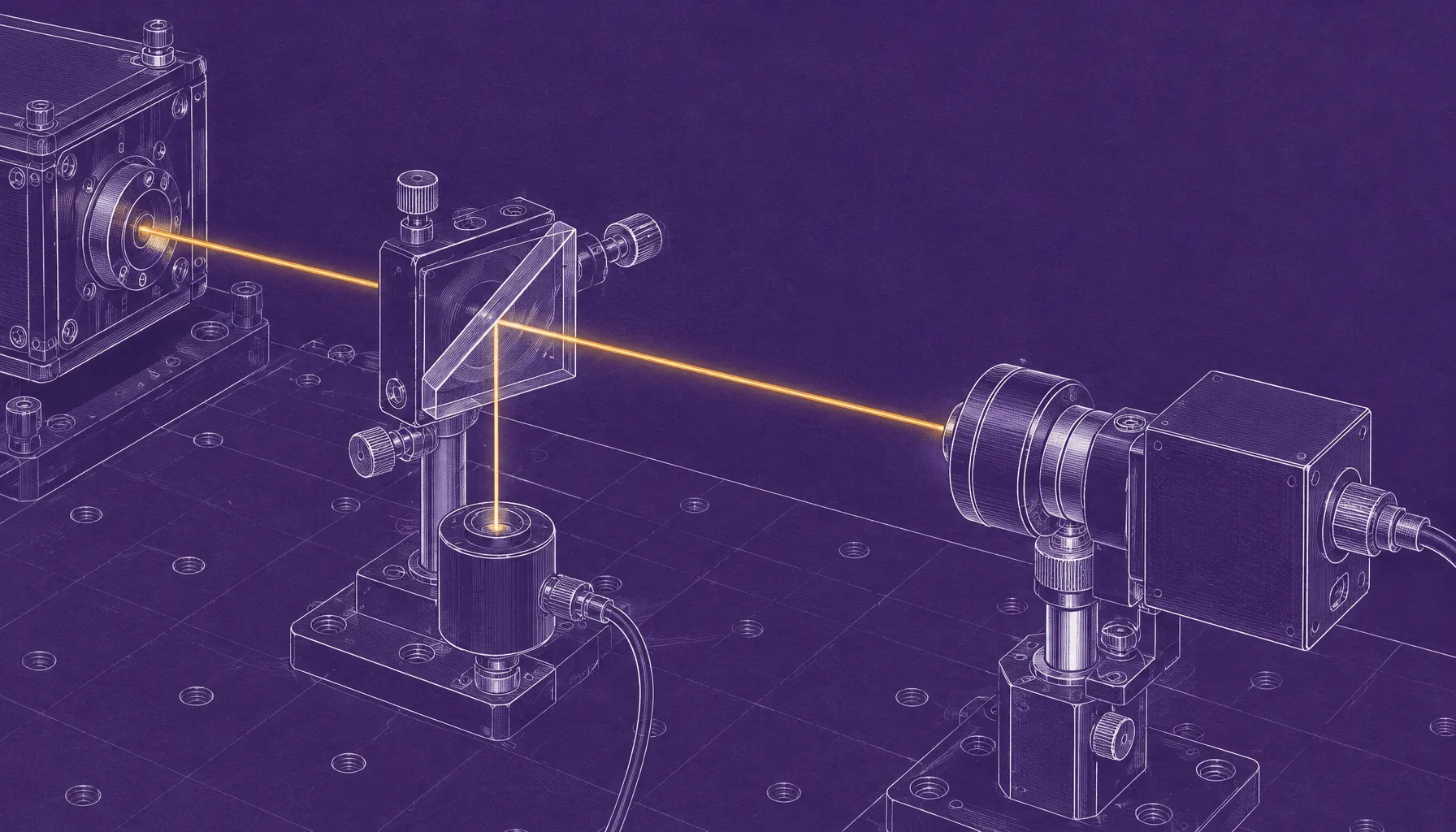
Rather than perform full quantum-state tomography, the processor measured those fidelities through a compute-and-uncompute procedure: prepare one state, apply the inverse operation associated with another, then estimate the relevant output photon component. The setup uses optical parametric oscillators, a photon detector and homodyne measurements. A classical support-vector machine uses the measured kernel values to learn and assign labels.
Why the RBF kernel mattered
The paper compares a basic fidelity kernel with a nonlinear radial-basis-function (RBF) kernel built from the same fidelity measurements. In simulations of one-, two- and three-mode datasets, the RBF classifier’s accuracy improved as the training set grew. In the experiment, its accuracy likewise approached unity as the number of training examples increased, tracking the authors’ simulation that included experimental imperfections.
Optical loss and noise during gate operations reduced the contrast of measured fidelities against ideal predictions. The authors also attribute larger differences for rank-one states to false counts in photon detection. Even with those imperfections, the RBF classifier lost less accuracy than the fidelity-kernel and non-machine-learning baselines in the tested setup.
“For now, we lack an experimental quantum advantage because we deal with small-scale and simple quantum states.”
Keitaro Anai et al., the paper’s authors
A theorem with conditions, not a universal shortcut
The paper’s efficiency result is conditional: it requires a margin that does not shrink too quickly with system size, a class that does not collapse onto its representative states, and a bounded measurement model. Under those assumptions, the authors derive polynomial scaling for the number of training states and measurement shots. The experimental homodyne-based fidelity estimator does not satisfy the theorem’s measurement model: an individual outcome can fall outside the interval from zero to one. The guarantee therefore does not directly cover the estimator used in the experiment. The method estimates similarities between states directly, avoiding the need to first reconstruct a full quantum state.
The experimental processor classified one mode and two stellar-rank labels: zero and one. The paper says the framework can be extended to higher stellar ranks and refers readers to a supplementary discussion; its numerical simulations focus on binary classification of rank-zero and rank-one states. The result supports a specific claim: fidelity-based kernels can classify a simple quantum resource on photonic hardware despite measured imperfections. It does not establish quantum advantage, which the authors explicitly say the experiment lacks.