The Signal
Study reports chip-to-chip entanglement over 80 km
A published experiment distributed path-encoded entangled photons between integrated silicon photonic chips over an 80 km fiber link. The team measured 85.7 ± 0.2% Bell-state fidelity and a secure key rate of 2.03 bit/s in the infinite-key regime.
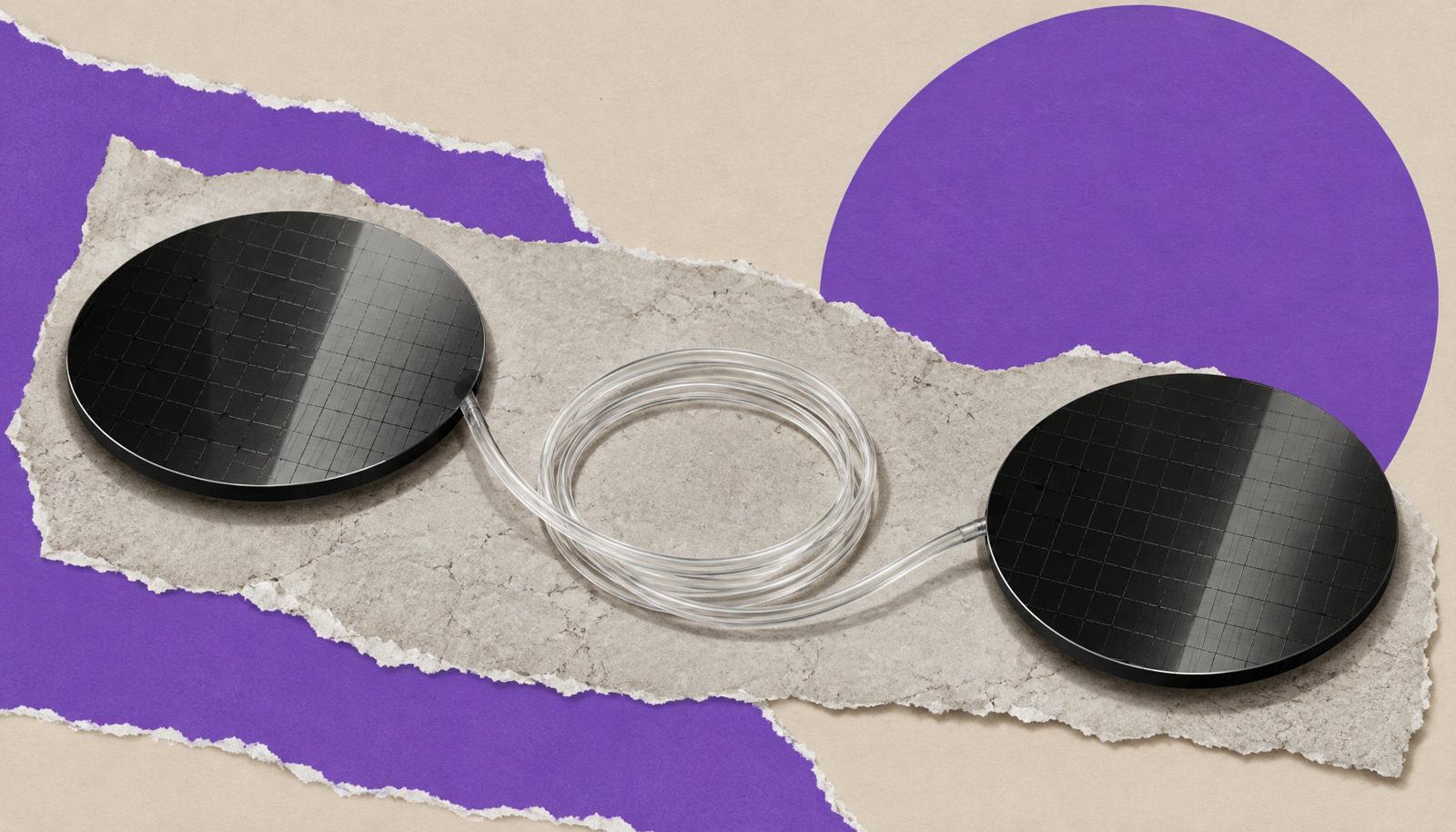
Entanglement carried directly between chips
Integrated silicon photonic chips exchanged path-encoded entangled states across an 80 km dual-core fiber link, with a measured Bell-state fidelity of 85.7 ± 0.2%, according to a paper published in PRX Quantum on November 19. The experiment also produced a secure key rate of 2.03 bit/s under an infinite-key analysis using the BBM92 protocol.
Source journals.aps.org
The setup used a silicon photonic transmitter and a separate receiver. On the transmitter chip, two spiral waveguides generated telecom-band photon pairs through spontaneous four-wave mixing. One photon from each pair stayed at the transmitter for local measurement; its partner traveled through the fiber to the receiver. The photons’ path, or spatial mode, carried the encoded state, and the link did not convert that encoding during transmission.
Active phase control
The researchers actively stabilized the relative phase between the fiber’s two cores. Residual pump light traveling through the link served as a phase reference: after reaching the receiver, it was detected and used by a feedback loop to control an external fiber stretcher. The authors report that the adjustment compensated for slow phase fluctuations in the link.
They assessed the distributed state with quantum-state tomography. The paper reports fidelity of 94.0 ± 0.1% when both photons were measured on one chip, 92.5 ± 0.5% across a short, approximately 4 m connection between chips, and 85.7 ± 0.2% over the 80 km fiber. In the long-link test, the measured state also violated the classical bound for the Clauser-Horne-Shimony-Holt test, with a value of 2.648 ± 0.004.
Key-rate limits and next steps
The 2.03 bit/s key rate is calculated in the infinite-key regime, rather than for a finite block of data. The authors say the key rate remains robust for block sizes down to 10⁵, with only a modest reduction from the asymptotic limit; their Table II lists 1.87 bit/s over 80 km at that block size.
The authors identify fiber-chip coupling losses, about 7 dB per grating coupler, as the main constraint on the maximum transmission distance. They also say the integrated thermo-optic phase shifters, operating at about 5 kHz, limit the basis-switching rate and therefore the key rate. The paper describes its result as the longest transmission distance in its comparison of integrated entanglement-based QKD systems.
Sources
- Original source · Paper American Physical Society journals.aps.org
Related stories
- Peixue Wu Finds No Entanglement Advantage for Phase-Covariant Channels
- Preprint reports 100-km fiber link carrying timing, data and quantum signals
- Silicon Cavity Records 1.29 Million Photon Counts per Second
- Preprint reports live keys from four-city Slovak QKD network
- Quantum study derives entanglement and correlations in Motzkin chains