The Signal
Silicon Cavity Records 1.29 Million Photon Counts per Second
A silicon-based source produced near-infrared single photons at 1217 nanometers, with a saturated count rate of 1.29 million per second. The study reports separate measurements of photon antibunching and purity under different excitation co
Quantum.world Team · Written with AI · fact-checked ·
“Here we present an all-silicon single-photon source at 1217 nm wavelength, fabricated by nanoscale positioning of a single W center in a circular Bragg grating cavity.”
The authors of the Nature Communications paper, including Baptiste Lefaucher and Yoann Baron, write:
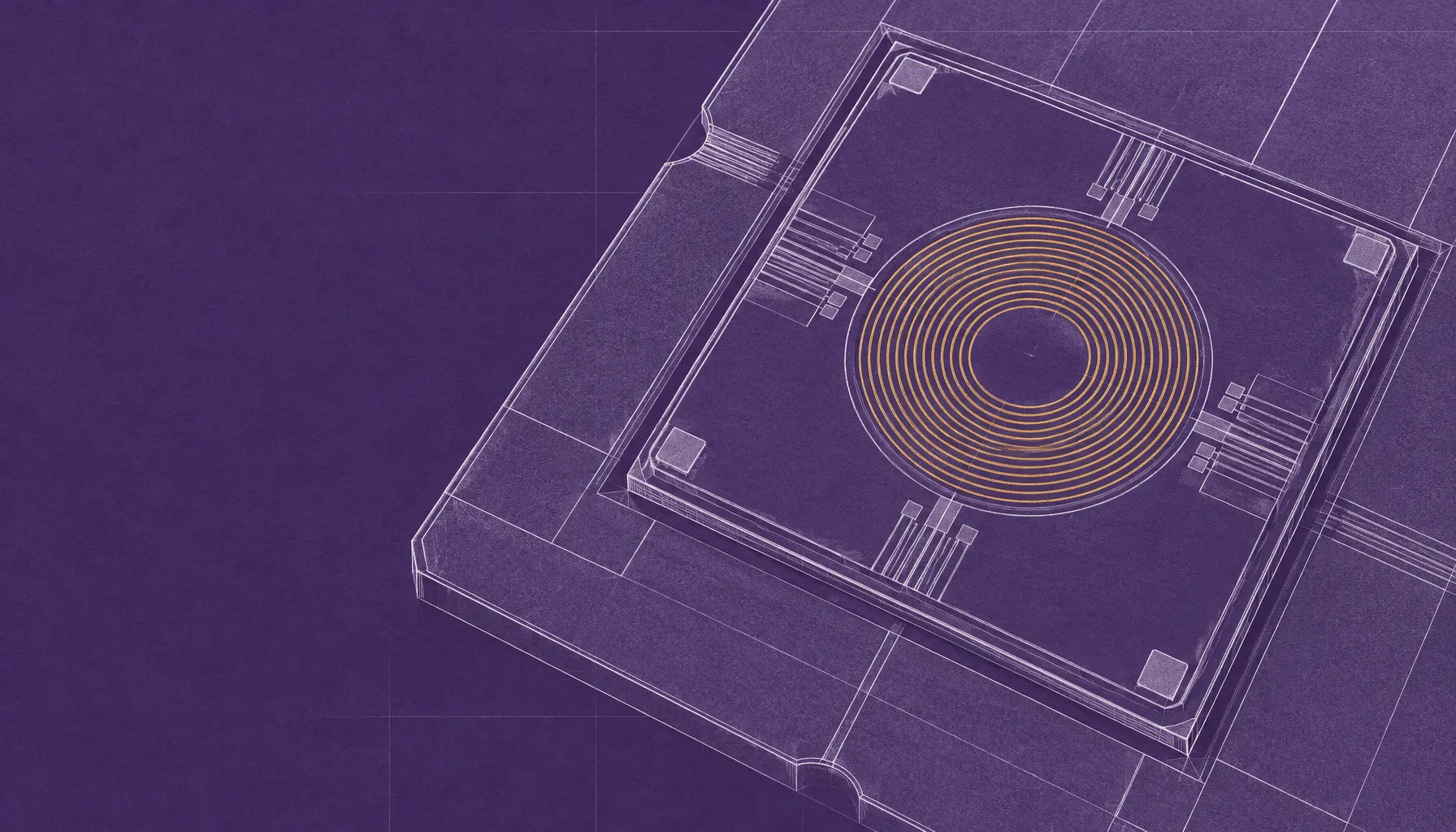
A team from institutions in Grenoble and Montpellier reports a silicon-based source that produces near-infrared single photons at 1217 nanometers. The peer-reviewed study was published in Nature Communications on October 28, 2026. Its central approach is to position an individual W center—a color center in silicon—at a nanoscale site associated with a circular Bragg grating cavity tuned to the center’s zero-phonon line.
The paper describes an all-silicon source, addressing the challenge of integrating single-photon emitters into near-infrared silicon photonics. A related preprint by the same research team describes creating the W center through silicon-ion implantation at a nanohole-defined site, then fabricating the circular Bragg grating cavity there. In the published paper’s abstract, the authors say the emission wavelength corresponds to the W center’s zero-phonon line, which the cavity enhances. The reported 1217-nanometer output is therefore tied to both the emitter’s optical transition and the cavity design.
Count rate and purity come from different tests
Under above-gap continuous-wave excitation, the source reaches a saturated photon count rate of 1.29 million counts per second. The same operating regime shows pronounced photon antibunching, with a second-order correlation value, g(2)(0), of 0.06 ± 0.02. Antibunching is evidence that emission is dominated by individual photons rather than simultaneous pairs; the reported value is a measurement of that behavior, not a count of photons generated inside the device.
The researchers also tested triggered emission under weak pulsed excitation, reporting single-photon purity of 93 ± 2%. These figures describe separate operating conditions: the million-count rate comes from continuous-wave pumping at saturation, while the purity result comes from weak pulsed pumping. They should not be read as one combined performance measurement. Count rate describes detected brightness under a specified excitation condition, while purity indicates how often the output behaves as a single-photon source in the measurement.
Repumping limits purity at saturation
The authors report purity degradation at saturation due to repumping processes. They say selective excitation schemes could mitigate the effect in the future; the paper presents that possibility as a prospective approach, not as a fix already demonstrated. This limitation is relevant when comparing the bright saturated continuous-wave result with the purity measured using weak pulses: the source’s behavior changes with its excitation regime.
The study presents a positioned color center and cavity operating together in silicon, with brightness, antibunching and triggered emission assessed through distinct tests. Its abstract frames the results as a step toward on-demand sources of indistinguishable single photons in silicon photonics, rather than reporting indistinguishability as a demonstrated result. The benchmarks reported in the abstract are emission at 1217 nanometers, a saturated rate of 1.29 million counts per second with g(2)(0) of 0.06 ± 0.02 under above-gap continuous-wave excitation, and 93 ± 2% purity under weak pulsed excitation.