The Signal
USTC Team Reports Bell-Inequality Violation of 2.455(77) With Telecom Photons From a Rubidium Atom
Researchers report Bell nonlocality using entanglement between a rubidium atom’s spin and a photon emitted directly at a telecom wavelength. The experiment measured spin–photon entanglement fidelity above 91.4% and a Bell-inequality value of 2.455(77), exceeding 2.
Bell nonlocality with directly generated telecom-band spin–photon entanglement
Long-distance entanglement distribution requires photons that travel through optical fiber in the telecom band, where the fiber has minimum loss, according to the paper. But although researchers have worked to generate entanglement directly between C-band telecom photons and stationary spins, verifying quantum nonlocality with such pairs has remained a challenge.
Source nature.com
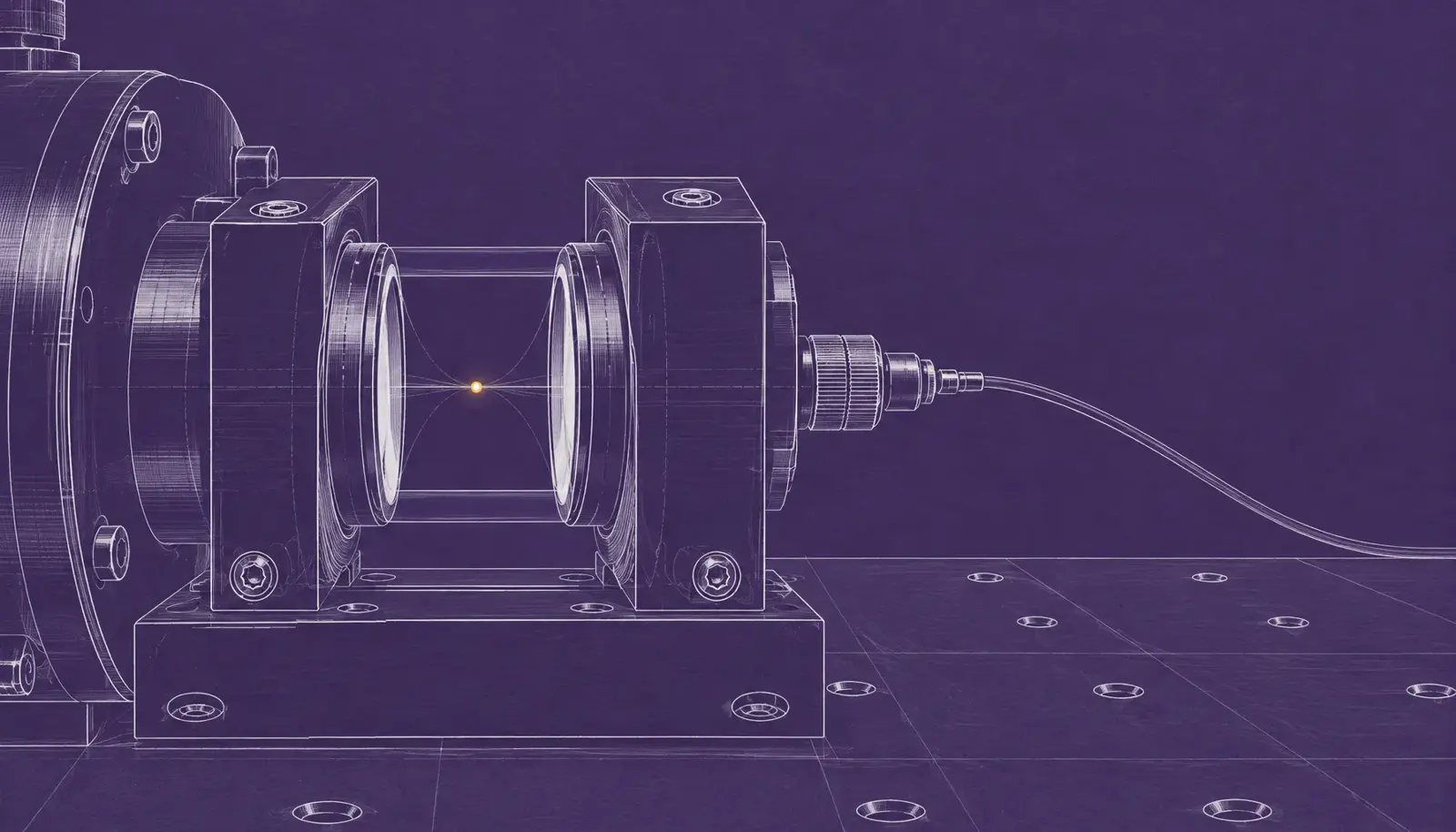
The study reports a result addressing that challenge: a Bell-inequality violation using entanglement between the spin of a single rubidium atom and a photon emitted directly at a telecom wavelength. The team used a rubidium dipole transition at 1530 nanometers and a cavity-assisted protocol to resonantly excite the atom and generate C-band telecom photons. The paper describes the photons as directly emitted from the atom.
Fidelity above 91.4% and a Bell-inequality violation
The researchers measured the fidelity of the resulting spin–photon entangled state at greater than 91.4%. They then used the entangled pair to test a Bell inequality and report a measured value of 2.455(77), greater than the threshold of 2. The paper presents that violation as verification of Bell nonlocality with the telecom-band pair.
The two measurements describe different aspects of the result: the fidelity measurement characterizes the reported entangled state, while the Bell-inequality value is the reported test of nonlocality.
The authors say the work extends the wavelength of a single-atom quantum emitter to the telecom C-band. They connect that extension with the measured high-fidelity spin–photon entanglement and the Bell-inequality violation. The significance described in the article is that direct generation at this wavelength is paired with a verification of nonlocality, rather than only a demonstration of entanglement generation.
Research affiliations and publication
The authors list affiliations at the University of Science and Technology of China in Hefei, including the Laboratory of Quantum Information, the Anhui Province Key Laboratory of Quantum Network, and the CAS Center for Excellence in Quantum Information and Quantum Physics. Some authors are also affiliated with Hefei National Laboratory. Dong-Yu Huang and Jian Wang are identified as equal contributors; Jian Wang and Chuan-Feng Li are named as corresponding authors.
Nature Communications published the open-access article on 4 November 2026. It was received on 8 May 2026, and accepted on 13 October 2026. The journal identifies the published text as accepted research being shared early, subject to further edits before replacement by the final Version of Record. The authors declare no competing interests.
Funding and acknowledgements
The article lists support from China’s National Key R&D Program; the Quantum Science and Technology-National Science and Technology Major Project; the National Natural Science Foundation of China; and the Fundamental Research Funds for the Central Universities. The acknowledgements thank Prof. Zong-Quan Zhou for lending the researchers a single-photon detector for C-band photons and Prof. Jin-Ming Cui for discussions.
The reported finding rests on the combination of direct C-band photon emission from a single rubidium atom, spin–photon entanglement with measured fidelity above 91.4%, and a Bell-inequality result of 2.455(77) greater than 2. Those are the measurements the paper cites in reporting verification of Bell nonlocality for this telecom-band spin–photon system.