The Signal
Qblox and AMD report microsecond quantum-feedback tests
Qblox and AMD describe a direct connection between Qblox quantum-control hardware and AMD processors, with measurement data sent to accelerator memory without host software in the path. In tests using Qblox-generated LINQ frames, the companies report median round trips of 4.05 µs to an AMD GPU and 2.70 µs to a CPU core.
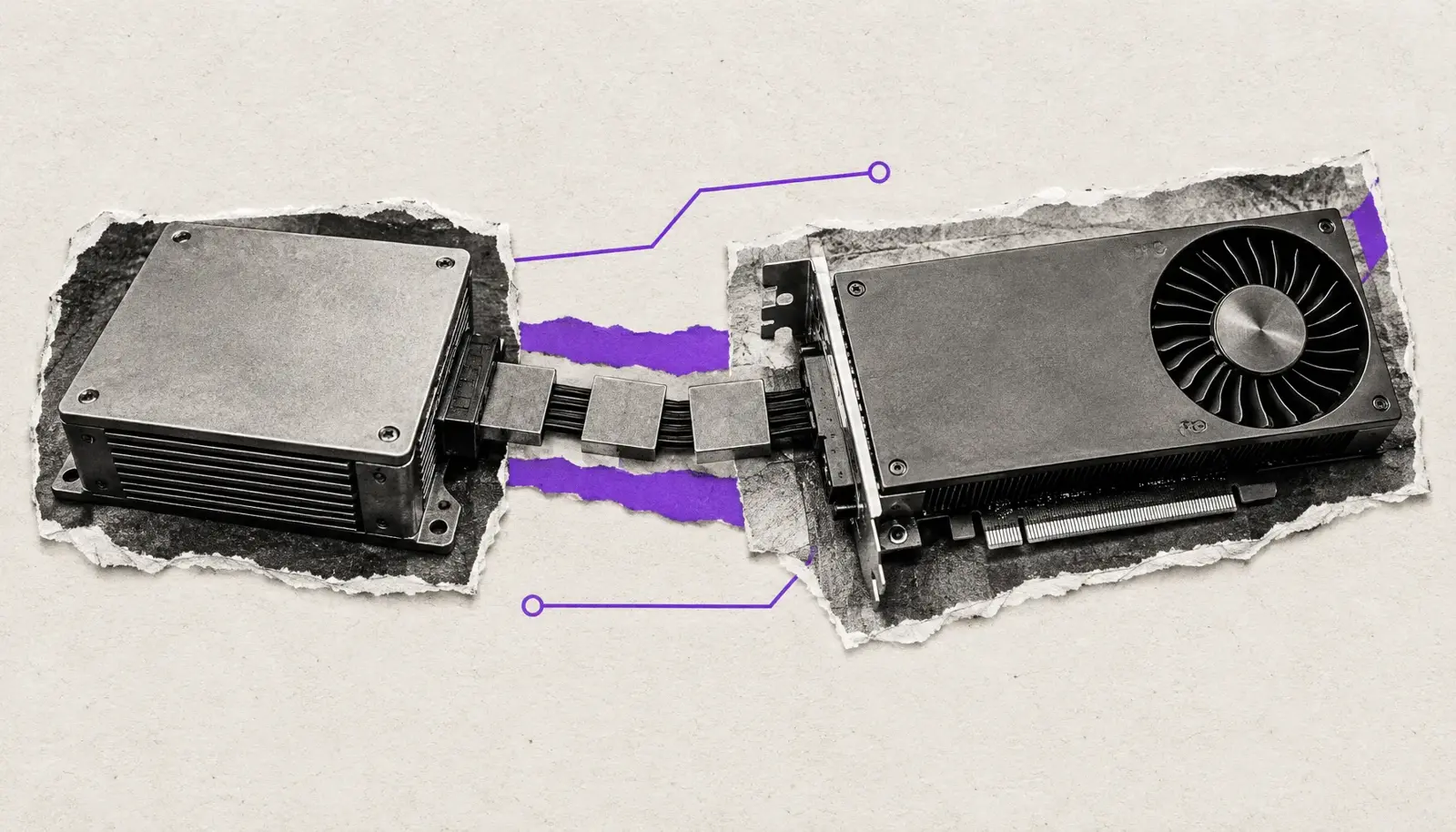
A Qblox control system can now send measurement data directly to AMD processor memory and receive computed responses without host software in the path, according to a technical post on Qblox’s newsroom written with AMD. Published November 12, 2026, the post describes a connection for real-time quantum error correction and other tasks in which measurement results guide what a quantum computer does next.
A direct route to compute
Real-time quantum error correction involves measuring qubit states, decoding error syndromes and returning corrections within the qubits’ coherence window, the post explains. Qblox and AMD connect the control system to an AMD Alveo V80 card over an Aurora 64B/66B serial link; the card sends each request directly into accelerator memory over PCIe and receives the reply back in its own memory.
The companies say host software does not handle the measurement frames. The devices exchange data through a shared memory layout that can be used by a GPU kernel, a CPU thread or programmable logic. The post says the same connection can serve AMD Instinct GPUs, EPYC CPUs and Versal adaptive system-on-chips.
Round-trip measurements
In an end-to-end test using real LINQ frames generated by Qblox, the companies measured a median round trip of 4.05 µs to an AMD Instinct MI210 GPU and 2.70 µs to one AMD EPYC CPU core. The test timed a request through its computed reply, rather than simply looping the data back, according to the post.
The companies report that 90% of CPU replies landed within a 0.184 µs window. Each run sent 10,000 frames and received 10,000 replies, with no drops or stray responses. In a separate sweep, frame sizes ranged from 64 to 2,048 bytes in 8-byte steps, with 2,000 frames tested at each size; median latency rose by about 1.35 ns per byte.
Code across processors
The runtime is described as a library rather than a framework, with support for Python, C and OpenMP. The same decoder could be moved between GPU, CPU and Versal adaptive SoC without changing the link card’s logic, image, driver or interface, according to the post.
Tests of small error-correction decoders for the Steane-7 and repetition-3 codes produced replies the companies say were bit-identical across GPUs, CPUs and the V80, and matched a reference decoder. The post also describes a numerical function of the kind a calibration step uses that ran on an AMD Instinct GPU and matched the host’s results on all 3 million replies.
Early access and next steps
The current setup connects devices in pairs. The teams identify a mesh linking multiple control endpoints, accelerators and programmable logic as the next step, while they work on the FPGA-to-FPGA serial fabric inside the Qblox system and explore a path for multi-rack systems.
The integration is available to early-access partners. The Qblox post presents the work as an engineering result and says some ways of integrating code currently add a few microseconds compared with the fastest path.
Source
Companies in this story
Related stories
- PsiQuantum and AMD expand quantum pact; AMD plans investment
- Researchers publish simulated feedback protocols for quantum drift
- PsiQuantum and AMD report microsecond decoder timing on FPGA
- A Dissipative Controller Adds a Hidden Cost to Quantum Gates
- Simulations test faster fluxonium gates using picosecond pulses