The Signal
A Dissipative Controller Adds a Hidden Cost to Quantum Gates
A theoretical study links noise from a dissipative classical controller to errors in quantum gates. Its models show a tradeoff between control error and entropy production, while leaving the cost in real hardware undetermined.
Quantum.world Team · Written with AI · fact-checked ·
“In the most experimentally relevant regime of fast control and high fidelity, we find a tradeoff between dissipation and control errors.”
The authors—Serhat C. Kadıoğlu, Saulo V. Moreira, Mark T. Mitchison and Anthony Kiely—write in Dissipative controller as a hidden source of errors in quantum gates.
A paper submitted to arXiv on October 29 examines a source of quantum-gate error that sits outside the qubit: fluctuations in the classical equipment used to control it. The authors model a controller that dissipates energy as it generates a field, then trace how noise in that field affects gate fidelity. Their calculations identify regimes where lowering control error carries a thermodynamic cost in the controller itself.
A resistor enters the quantum-control model
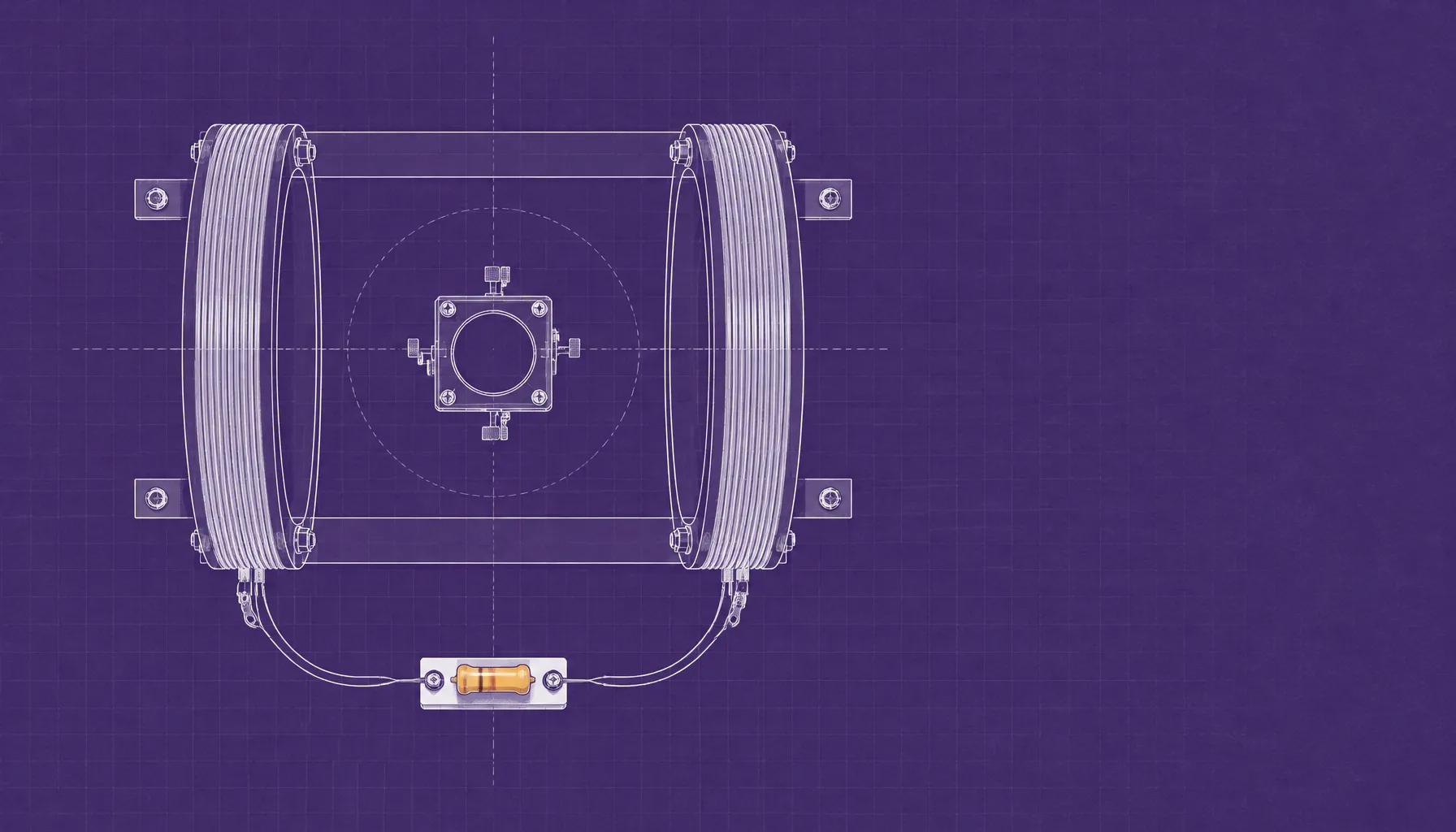
The work uses a classical resistor-inductor circuit connected to a Helmholtz coil, whose current produces a magnetic field acting on a qubit. Thermal fluctuations in the resistor generate Johnson–Nyquist noise, which creates fluctuations in that field. The paper links those fluctuations to errors in the controlled quantum system and measures the controller’s cost through irreversible entropy production, which it relates physically to Joule heating.
The authors calculate fidelity loss using a perturbative treatment of the noisy control signal. Their model assumes the controller follows a prescribed average current and focuses on the fluctuations around it. It is a theoretical framework, not a measurement of energy consumption or gate errors in a particular processor.
Fast pulses trade lower error for more dissipation
For gates generated by commuting control dynamics, the authors calculate the relationship between gate infidelity and dissipation for the S, T, H and CNOT gates. In their model, shorter operations have lower control-induced gate susceptibility but require greater dissipation. The gates’ costs also differ with their rotation angles.
The paper’s Landau–Zener example examines state transfer using shortcuts to adiabaticity, which add a counterdiabatic field to drive the system quickly. In the short-duration regime, the calculations show the trade-off directly: entropy production rises as infidelity falls. For longer protocols, the pattern changes; both the error and the cost can rise as the main control field is maintained for longer.
The reported power-law fits for the short-duration branch vary with the assumed noise-correlation rate. For the sampled rates from 10−2 to 10 in the paper’s units, the fitted exponent ranges from −1.917 to −1.586. The authors restrict their perturbative calculations to a specified validity regime, including a plotted boundary of τ2γ/τc = 10−2; the numerical trends are therefore not a universal hardware law.
The CNOT estimate stops short of hardware accounting
The CNOT calculation uses a simplified effective generator in which the terms share one time-dependent control function. The authors caution that a physical two-qubit gate can require several local drives and tunable interactions, each produced by different control circuits. Those details could add a hardware-dependent factor to the entropy cost, which their model does not determine.
That caveat sets the paper’s reach: it identifies a mechanism and explores its consequences in model gates and state-transfer protocols, rather than prescribing an energy budget for a processor. The authors also speculate that their minimal controller may give a lower bound on dissipation, but say more complex controller models are needed to develop that comparison. The concrete result is a modeled link between control-field noise and the classical device’s entropy production, with the size of the cost in an actual gate still dependent on its hardware.