The Signal
Ca₂CoN₂ Orders Near a Predicted Spin-Liquid Boundary
Researchers report that the nitride Ca₂CoN₂ develops incommensurate magnetic order below 54 K. Its measured spin pattern sits near, but does not reach, a theoretically predicted crossover to a modulated spin liquid.
Ca₂CoN₂ settles into a complex ordered state
Nature Communications published new measurements of Ca₂CoN₂ on November 2, 2026, reporting a magnetic state that approaches a theoretically predicted spin-liquid regime without entering it. The compound orders below 54 kelvin into an incommensurate pattern: its magnetic repetition does not fit neatly to the underlying crystal lattice. The finding puts a transition-metal nitride among materials researchers can use to examine frustrated magnetism, a subject more often studied in oxides and halides.
The distinction matters: Ca₂CoN₂ is not reported as a spin liquid. Neutron diffraction instead detects long-range magnetic order, while the measured order lies near a model-predicted crossover to a modulated spin liquid. That proximity makes the nitride a candidate for studying how changes to a material can shift its magnetic ground state.
A double-k wave below 54 kelvin
“Our magnetisation and neutron diffraction experiments reveal an incommensurate spin order below 54 K, consistent with a double-k spin density wave with propagation vectors (k00) and (0k0) where k = 0.57.”
Our magnetisation and neutron diffraction experiments reveal an incommensurate spin order below 54 K, consistent with a double-k spin density wave with propagation vectors (k00) and (0k0) where k = 0.57.
Dominik Werhahn et al., Nature Communications
The two propagation vectors describe modulations along perpendicular directions of the body-centred tetragonal lattice. In the authors’ analysis, the observed value of k is 0.57; a predicted crossover toward a modulated spin liquid lies at k values of 0.64–0.69. The measured structure therefore approaches that predicted interval but remains on the ordered side, rather than demonstrating a liquid phase.
The supporting dataset reports that the spins align along the crystal’s c axis. At 5 K, the maximum magnetic-moment amplitude is 5.00(3) μB; at 46 K, it is 3.21(7) μB. Those measurements track the ordered phase as it approaches its 54 K transition.
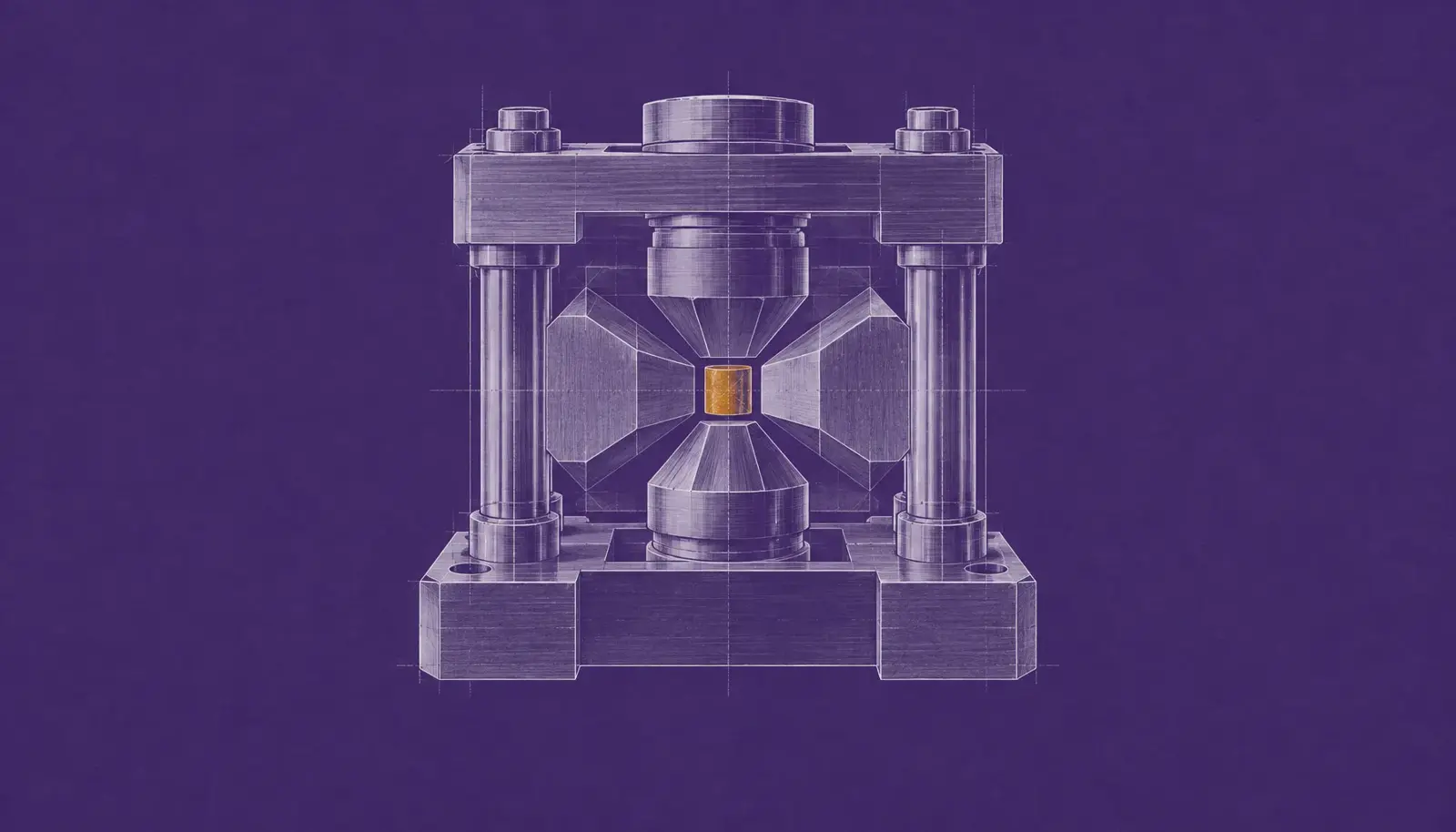
Making the nitride required 8 gigapascals
The team synthesized Ca₂CoN₂ from calcium nitride, cobalt and sodium azide in a multianvil large-volume press at 8 gigapascals and about 800 °C. The resulting compound has a Na₂HgO₂-type structure, with cobalt ions in linear two-fold coordination. The preparation route matters because the magnetic behavior depends on a structure that weakens the dominant interactions within square layers and increases frustration across the body-centred tetragonal lattice.
Magnetic susceptibility measurements add evidence for competing interactions. Between 150 and 300 K, the data follow a Curie–Weiss trend with an effective moment of 5.04(1) μB and a Weiss temperature of −222.7(2) K, consistent with dominant antiferromagnetic exchange. The susceptibility also shows a broad maximum at 62 K, above the onset of long-range order at 54 K.
Chemical tuning is a proposal, not a result
The authors point to further chemical tuning as a way to explore the predicted crossover. Their report does not demonstrate that tuning Ca₂CoN₂ reaches a spin liquid, nor does it establish a practical quantum-device use for the compound. Instead, the immediate contribution is a measured, unusual magnetic order in a nitride class that offers another route to test models of frustrated spins.
For now, the clearest boundary is numerical: neutron diffraction finds k = 0.57 in the ordered state, while the predicted modulated-spin-liquid crossover begins at k = 0.64–0.69. Ca₂CoN₂ approaches that interval, but its spins still order below 54 kelvin.