The Signal
IBM Nighthawk Prepares a Laughlin-Like Chern Insulator
A team used IBM’s Nighthawk R1 processor to prepare two bosonic fractional Chern insulator states on a 4×4 qubit lattice. Measurements captured particle correlations and circulating currents around quasiholes, while hardware noise remained a major limitation.
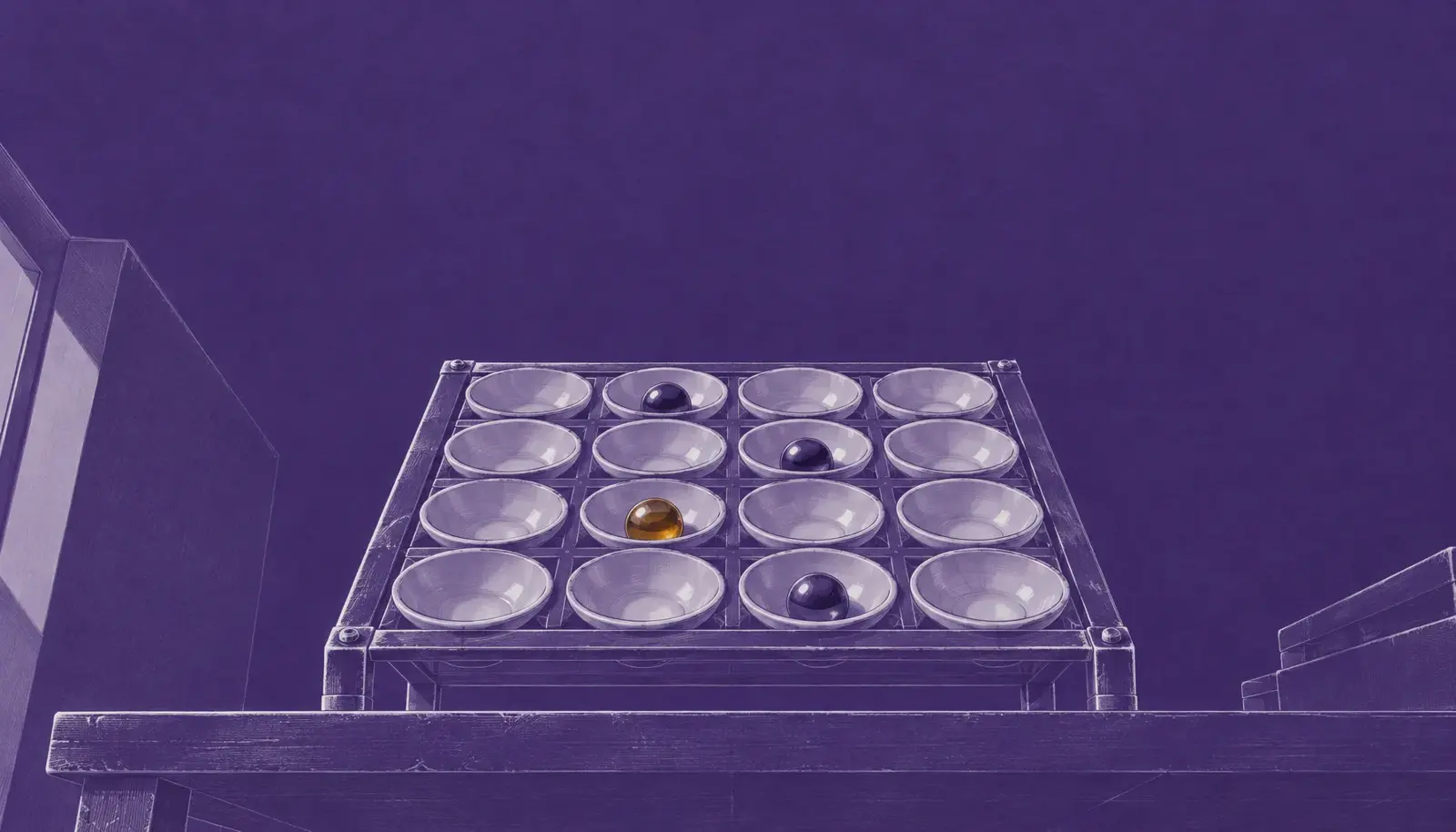
A 4×4 lattice, built from superconducting qubits
A team has prepared two Laughlin-like fractional Chern insulator states on an IBM Nighthawk superconducting quantum processor, using a 4×4 patch of qubits to represent a lattice of hard-core bosons. The researchers report a four-boson ground state and a three-boson state containing two quasiholes, localized vacancies in the particle pattern. Their preprint appeared on arXiv on October 29, 2026.
“On a 4×4 qubit lattice, we prepare both the four-boson FCI ground state and a three-boson state hosting two quasiholes,” write Kamil Dutkiewicz, Bárbara Andrade, Geza Giedke and Tobias Grass.
Fractional Chern insulators are lattice counterparts of fractional quantum Hall states, which can host excitations with fractionalized properties. The team targeted the bosonic Laughlin phase at filling factor one-half, using the Kapit–Mueller Hamiltonian as its theoretical model. Periodic boundary conditions make the small lattice behave like a torus, removing physical edges that would otherwise affect the state.
Shallow circuits approximate a long-range model
The target Hamiltonian uses fine-tuned, long-range complex hopping. The processor’s preparation circuits do not implement those long-range terms directly: instead, the researchers classically optimized circuits built from on-site operations and interactions between neighboring qubits. The variational approach preserves total particle number and folds the circuit’s Trotterized structure into the optimization.
The three-boson quasihole state used 168 controlled-Z gates across 28 two-qubit gate layers. The four-boson state used 264 such gates across 44 layers. Both circuits reached a fidelity of 0.95 in noiseless simulation; that figure is a simulated preparation fidelity, not a measured hardware fidelity.
The experiments ran on a 4×4 patch of IBM’s 120-qubit Nighthawk R1 processor, identified in the paper as backend ibm_miami. For measurements of particle configurations, the team collected 80,000 shots for the three-boson state and 60,000 for the four-boson state, then kept outcomes with the intended particle count. That post-selection retained 34.6% and 33.3% of the respective shots.
Quasihole currents survive, but noise blunts them
Post-selected measurements reproduced the target states’ particle-density patterns and spatial correlations. In the four-boson state, the measured density was approximately uniform across the 16 sites; in the quasihole state, density fell near the two pinned vacancies. The measured configuration probabilities preserved the target pattern but shifted toward a mixed-state background, which the authors attribute mainly to hardware noise.
For the quasihole state, the researchers also reconstructed bond currents from two-qubit measurements. The measured current profile followed the simulated direction and spatial pattern of circulation around the quasiholes, but its magnitude was attenuated; a fit to the simulated current values had a slope of 0.624. The paper’s discussion identifies hardware noise as the experiment’s principal limitation, noting that particle-number post-selection cannot remove all errors.
Topology tests remain ahead
The experiment demonstrates preparation and measurement of selected features of a fractional Chern insulator on gate-based hardware. It does not report a direct measurement of a many-body Chern number, topological entanglement entropy or anyonic braiding. The authors identify those as possible next probes, while also noting that their method depends on classically accessible target states and that larger lattices will demand deeper circuits and better control of accumulated noise.
For now, the result rests on a small, 16-site system and observables that can be checked against classical calculations. Its concrete advance is narrower: the processor prepares both a bosonic ground-state candidate and a quasihole state, then resolves the circulating-current pattern around those quasiholes despite substantial shot loss and noise.
Sources
Related stories
- Yonsei Installs IBM’s Latest Quantum Nighthawk Processor at Its Quantum Computing Center
- IBM plans 520-qubit Nighthawk r3 and linked system for 2027
- IBM Team Entangles Logical Qubits on Nighthawk Processor
- IBM Connects Two 120-Qubit Chips With 99% State Transfer
- IBM Puts Quantum System Two Online in Chicago