The Signal
IBM Connects Two 120-Qubit Chips With 99% State Transfer
IBM researchers link two 120-qubit Nighthawk R1 processors with four superconducting coaxial cables and report 99.00% mean fidelity for quantum state transfer. The links also support distant gates and entangled states, though controlled-Z g
Quantum.world Team · Written with AI · fact-checked ·
Four links, 99% mean transfer fidelity
Four links between two 120-qubit processors transferred quantum states with a mean fidelity of 99.00%, according to an IBM research team’s paper submitted to arXiv on October 21. The best link reached 99.29% with an uncertainty of 0.07 percentage points. The results come from four “L-couplers,” each built around an 80-centimeter superconducting aluminum coaxial cable connecting two IBM Nighthawk R1 processors.
“Here we demonstrate four L-couplers operating between two 120-qubit IBM Nighthawk R1 superconducting qubit processors.”
Neereja M. Sundaresan et al., IBM Research
The transfer figure is not the fidelity of a two-qubit gate across the full system. The authors separately report a mean fidelity of 94.75% for controlled-Z gates between lattice qubits on different processors, with the best link at 96.42%. That distinction matters: transferring a state across the cable is one operation; building a gate between computational qubits requires additional operations at both ends.
How the 80-centimeter bridge works
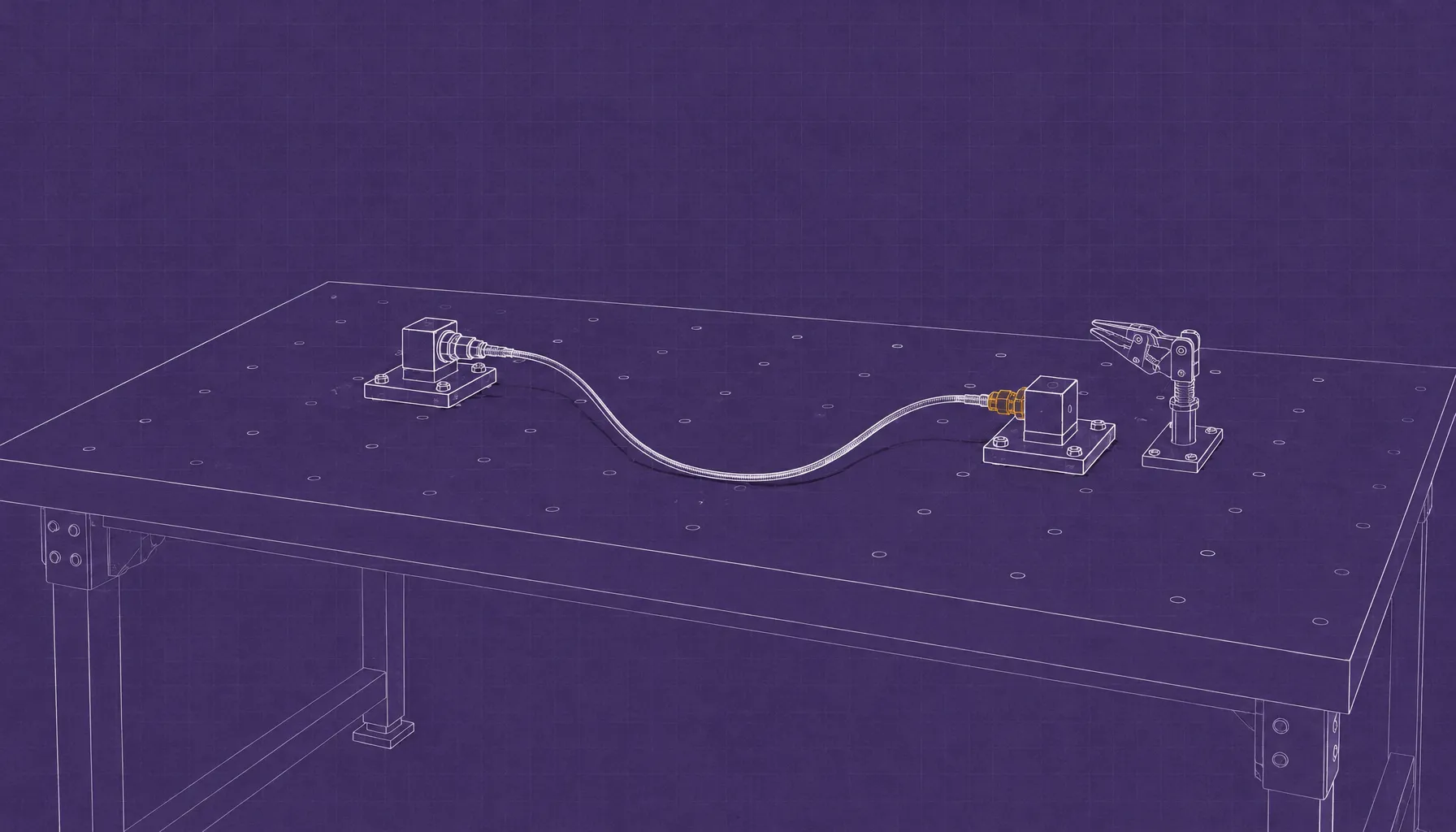
Each L-coupler routes a quantum state from a lattice qubit to a dedicated, frequency-tunable L-qubit, through the coaxial cable, and back to the other processor. Two tunable RF-SQUID-based couplers control the connection between the L-qubits and the cable. The cable runs perpendicular to the chip surface and attaches through an indium-to-indium pressure bond made at room temperature after both processor modules are mounted in the cryostat.
A custom spring-loaded holder installs two cable connections at a time. In tests, the four assembled links stayed operational through three thermal cycles without the connections being disturbed. That is a practical result for hardware that must be cooled, warmed and serviced, though the paper says the team did not test remating a connection.
The gate fidelity exposes the extra cost
To perform a distant controlled-Z gate, the team combines three local controlled-Z gates, two state transfers, four single-qubit gates and a virtual phase correction. The resulting operation therefore carries error from both the interconnect and the steps needed to reach it. The authors’ measured mean of 94.75% reflects the full gate sequence, rather than the cable’s transfer performance alone.
Across the four links, the best distant gate reaches 96.42% fidelity. The team’s error budget for that gate predicts an upper bound of 97.34% based on separately measured components; the authors attribute much of the gap to residual population left on the L-qubits after incomplete state transfer. They also say that dedicated L-qubits and their couplers sit outside the Nighthawk square lattice by design, adding transfer and local-gate steps that an integrated design could remove.
Entanglement reaches beyond a single chip
The researchers use the distant gates to create Bell pairs between qubits on separate processors, including two pairs generated simultaneously over adjacent L-couplers. The pairs remain entangled without readout mitigation, although their measured fidelities vary by link. The team also creates four- and six-qubit GHZ states spanning the modules, extending entangling operations beyond qubits immediately next to the interconnect.
Those demonstrations show more than a cable carrying a single state: multiple links can operate together, and the connection can help distribute entanglement across processor modules. But the paper’s own measurements expose limits. The mean distant-gate fidelity is lower than the state-transfer figure, and the setup has four links—not the larger numbers of repeatable connections a modular system would require.
Shielding remains a hardware problem
The coaxial cables lose performance when they cool through aluminum’s superconducting transition in a magnetic field. In controlled tests, the cable’s median internal quality factor fell from 1.5 million at zero applied field to 250,000 at 14 gauss, a sixfold change. The team found that changing the field after the cable became superconducting did not restore the lost performance.
Shielding improved the result, but the researchers describe their two-layer braid as a temporary measure. They also identify the shared braid around all four cables as a possible reason the assembled links performed below a separate shielded-cable test. The paper leaves two concrete engineering questions open: whether the cable shielding can be made repeatable as link counts grow, and whether the indium connection can be remated without adding loss.