The Signal
63-qubit experiment tracks electric strings in gauge theory
Researchers used 63 superconducting qubits to simulate the evolution of electric flux strings in a two-dimensional gauge theory. The preprint reports agreement with converged classical calculations for up to seven simulation steps.
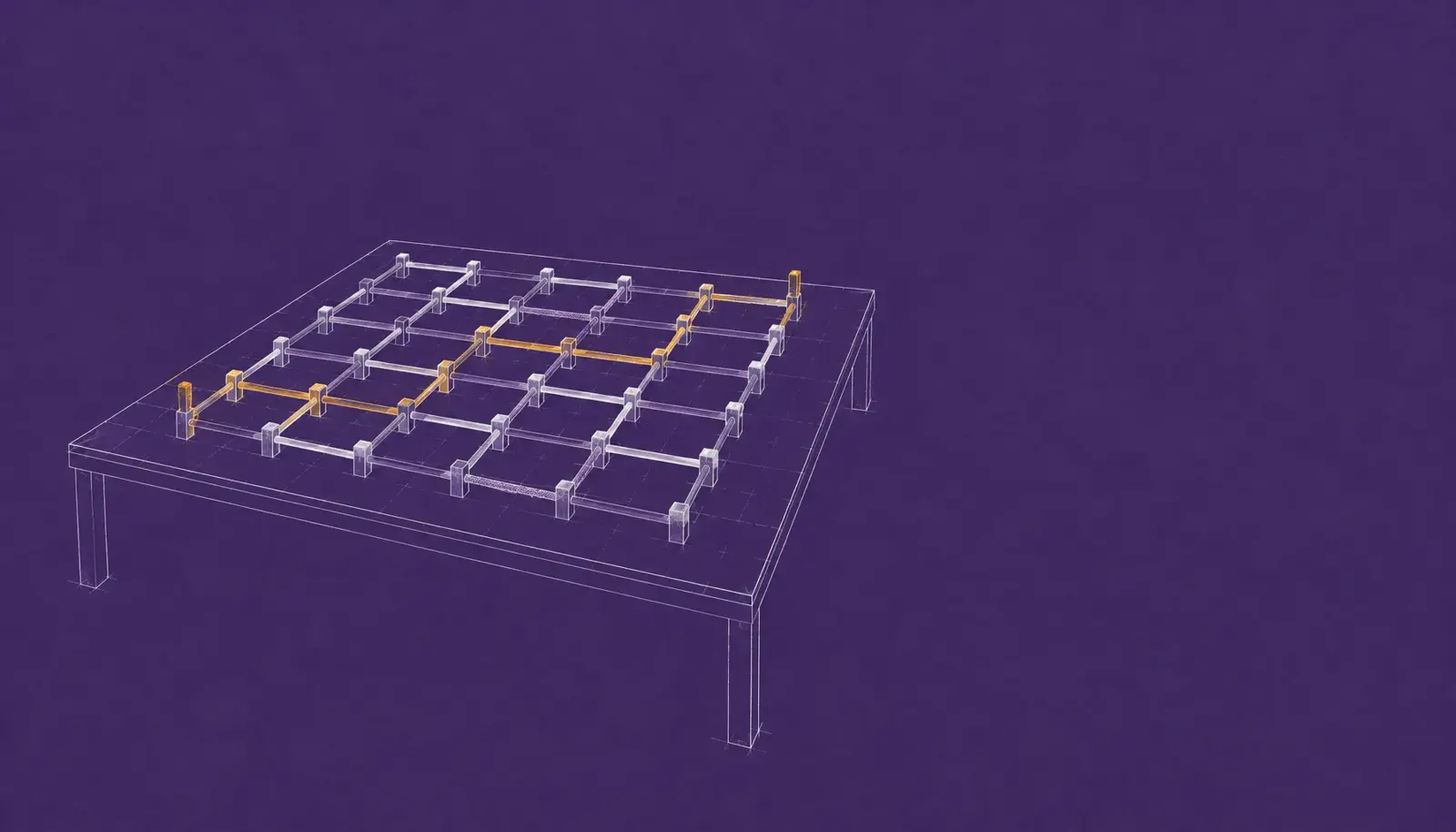
Researchers used 63 superconducting qubits, including 12 ancillary qubits, to track electric flux strings in a two-dimensional gauge-theory simulation. Their preprint reports different patterns of charge and field spreading across the model, as well as a way to use its constraints to detect errors in measurements.
Source arxiv.org
The researchers posted their preprint to arXiv on November 10, 2026. The experiment used a 5-by-4 matter-site lattice on the ibm_phoenix superconducting processor, with separate qubits representing matter and the fields connecting lattice sites.
Strings on a lattice
The simulated strings are configurations of electric flux connecting charges. The model includes moving matter and an interaction that can change the path of a string across the lattice, allowing the researchers to examine how an initially localized configuration evolves.
In the deconfined regime, the team reports that charges and flux spread rapidly across the lattice. Under strong electric fields, by contrast, the flux remained much closer to its initial configuration, with limited widening over the evolution shown.
The experiment also examined strings whose endpoint charges were fixed and strings whose endpoints could move. With fixed endpoints, the preparation excluded displacement of those charges while still allowing the creation of new matter pairs and subsequent string breaking.
For moving endpoints, measurements of matter occupation at the ends, interior and outside the initial string gave the team a way to distinguish charge displacement from splitting. Near the pair-creation resonance, the researchers observed faster growth of matter occupation in the string interior.
Checks built into the model
The researchers kept matter and gauge degrees of freedom separate rather than removing the redundant gauge description. That choice preserved local constraints linking the charge at a site to the electric fields on neighboring links, making those constraints available for error detection.
For local quantities, the analysis used post-selection to discard samples that violated relevant constraints, together with checks on ancillary qubits. It also applied a rescaling procedure based on estimated hardware noise to the retained measurements.
The checks do not catch every error. The paper notes that simultaneous errors on neighboring qubits can leave local constraint values unchanged, and that post-selection becomes less effective as errors accumulate in deeper circuits.
Comparing the results
The circuits ran for up to 15 second-order Trotter steps, an approximation that divides the simulated evolution into discrete operations. The team compared its measurements with classical tensor-network calculations where those calculations had converged.
The researchers report that their processed results reproduced classical reference results converged up to seven Trotter steps. They say convergence became slow at longer times, particularly in the deconfined regime, where entanglement grew rapidly.
The comparison therefore covers a shorter interval than the longest circuits. The paper also reports that, at later times, hardware data approached an almost fully mixed state and mitigation produced large error bars; its rescaling method was better suited to circuits with small electric-field strength.