The Signal
Preprint by Weinstein and Garratt Reports Efficient Decoder for Transverse-Field Toric Code
A preprint reports efficient decoding for the transverse-field toric code near its quantum critical point, with finite thresholds for bit-flip and phase-flip decoherence. It also examines the transverse-field Ising model as a deformation of the repetition code.
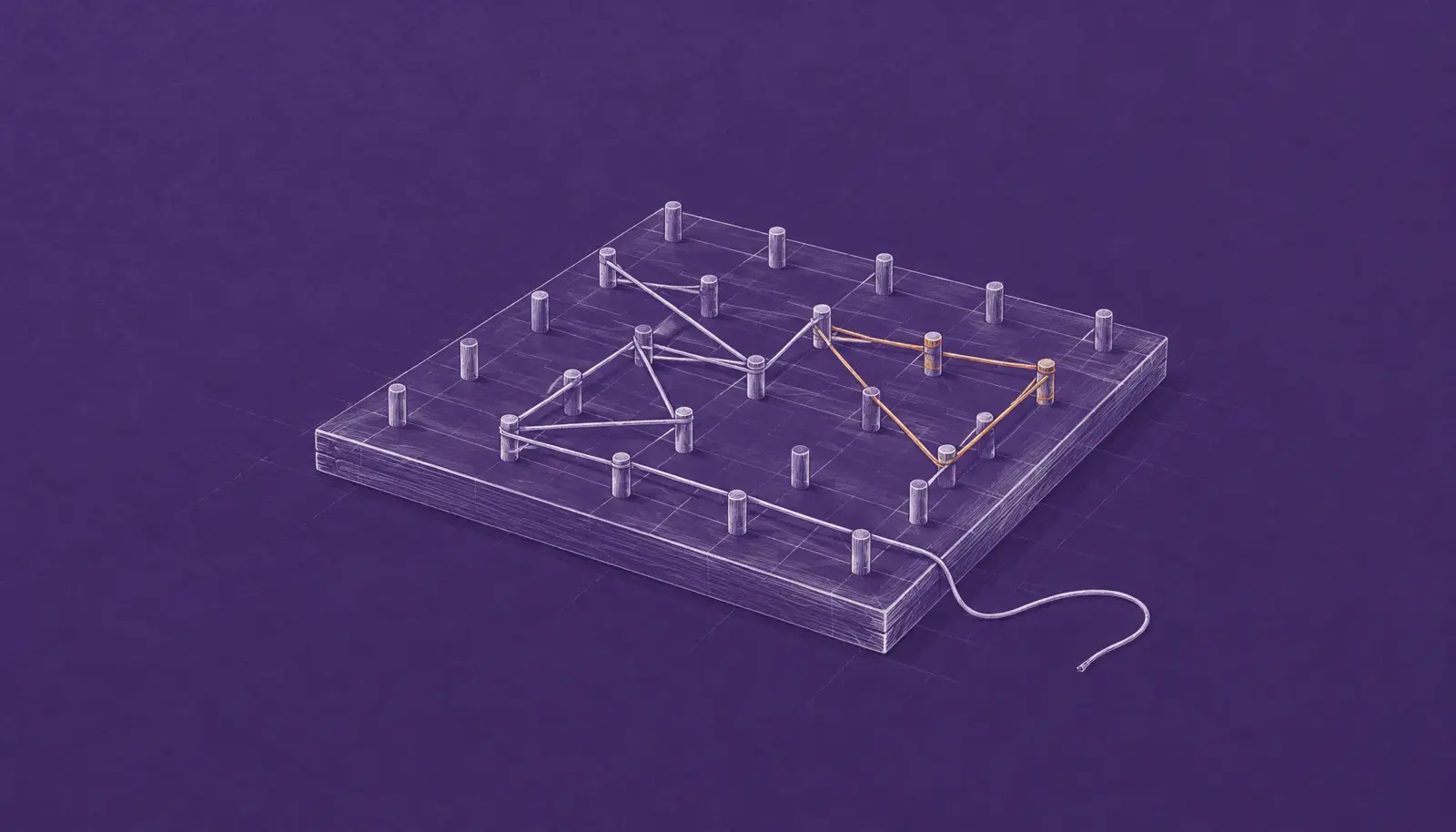
Finite thresholds near the quantum critical point
A preprint by Zack Weinstein and Samuel J. Garratt reports an efficient decoding algorithm for the transverse-field toric code (TFTC), with finite thresholds for both bit-flip and phase-flip decoherence. The paper, Quantum Error Correction in Nearly Critical Toric Codes, was submitted on 3 November 2026. It studies quantum information stored in the ground-state manifold of topological codes deformed away from their stabilizer limits as they approach transitions into trivial phases.
Source arxiv.org
The authors consider independent bit-flip and phase-flip decoherence acting on the TFTC. In this model, a transverse field produces quantum fluctuations of m anyons in the ground states. The paper reports that projectively measuring the unperturbed, or “bare,” toric code stabilizers can still provide a basis for efficient decoding, including when the transverse field is tuned infinitesimally close to the quantum critical point.
Although the transverse field induces strong quantum fluctuations of m anyons in the ground states, we show that projective measurements of the “bare” toric code stabilizers can nevertheless be used to construct an efficient decoding algorithm which exhibits a finite threshold to both types of decoherence, even when the transverse field is tuned infinitesimally close to the quantum critical point.
The authors write that their focus is on optimal postmeasurement decoders: decoders that operate after the stabilizers have been measured. This is different from the unrestricted optimal recovery channel for the fluctuating ground states, which the paper describes as generally highly nonlocal and exponentially complex, and dependent on precise ground-state wavefunctions for the non-solvable TFTC Hamiltonian. The proposed approach instead uses stabilizer measurements before decoding.
Stoquasticity and a classical lattice gauge theory
The decoder construction relies on the stoquastic nature of the TFTC Hamiltonian. The paper explains that stoquasticity makes it possible to describe the ground states using the classical statistical physics of lattice gauge theories. The authors say they prove that stabilizer measurements act unitarily on undecohered TFTC ground states to excellent approximation. They also describe an efficient implementation of the optimal postmeasurement decoder using Monte Carlo simulation of a constrained lattice gauge theory.
For TFTC states subject to bit-flip and phase-flip decoherence, the authors numerically demonstrate a finite decoding threshold close to the quantum critical point. They provide theoretical evidence that stabilizer measurements are an optimal decoding strategy in this setting, while noting that this part is not proved rigorously. For phase-flip decoherence, they prove a separate result: the optimal postmeasurement decoding threshold does not depend on the transverse-field strength anywhere in the topological phase.
A result for the transverse-field Ising model
The paper also briefly considers quantum information in the ground-state manifold of the ferromagnetic transverse-field Ising model, treated as a Hamiltonian deformation of the repetition code. For bit-flip decoherence, the authors prove that the error threshold is maximal throughout the ferromagnetic phase, including arbitrarily close to the quantum critical point. They further report that stabilizer measurements followed by majority voting provide an efficient optimal decoder in this model.
Together, the results address whether efficient decoding can persist when a code is moved away from its stabilizer limit and toward a phase transition. For the TFTC, the work gives a measurement-based decoding construction and reports thresholds near criticality; it also establishes a field-independent threshold for postmeasurement decoding under phase-flip decoherence throughout the topological phase.
Sources
Related stories
- NVIDIA releases QEC decoder, claims up to 13,000× speedup
- Correlated Decoding Can Cost Surface Codes Effective Distance
- IBM says revised code and decoder advance its path to Starling
- Study Finds Coherent Errors Can Drive Honeycomb Surface Code Into a Critical Regime
- He, Wang, Song and Gu Set a CSS-Code Decoupling Criterion