The Signal
IBM says revised code and decoder advance its path to Starling
IBM says changes to its error-correction code reduce the connections and junctions needed in processors planned for its Starling system. The company also reports progress in decoding, processor links, cryogenics and control electronics ahead of its 2029 target.
IBM says changes to its quantum error-correction code have reduced the number of connections needed between qubits from six to five, part of a redesign of processors planned for its fault-tolerant Starling system. In a November 11 research post, the company also reported that its Relay-BP decoder has reached the performance required for Starling.
Starling is planned for 2029, with a goal of running circuits comprising 100 million quantum operations on 200 qubits. The proposed system uses modules containing quantum memory and logical processing units, joined through long-range connections called l-couplers.
For the same logical error rate, IBM says its quantum low-density parity check, or qLDPC, architecture requires about ten times fewer physical qubits than prior approaches.
Fewer connections and junctions
IBM says its improved qLDPC code delivers 20 to 100 times lower logical errors while reducing the number of qubit connections. Together with coupler changes, the advances cut the number of Josephson junctions needed from around 5,000 to 2,000.
With a junction yield target of 99.95%, the company estimates that about one in 12 processors with 5,000 junctions would be fully functional, compared with one in three with 2,000 junctions. The company also increased the length of its c-coupler, which links qubits across a chip, to 20 millimeters.
On IBM Quantum Loon, the company measured qubit relaxation times, or T1, of about 200 microseconds, reset time constants of 20 to 40 nanoseconds, and median gate error rates near 0.3%. The target for Starling is T1 in the millisecond range and gate errors in the low 0.01% range.
Decoding and processor links
Decoders are classical algorithms used to identify errors in quantum circuits. IBM introduced Relay-BP in 2025 and is developing a real-time decoder application-specific integrated circuit, or ASIC, using 2-nanometer nanosheet technologies for Starling.
Its researchers have extended the decoder and found that errors for memory-only operations and measurement operations are nearly consistent. The observed performance already meets Starling's requirements, according to IBM.
IBM also reports connecting two Nighthawk processors with four l-couplers, achieving an average 1% error rate and a best result of 0.7%. Starling will need more than 100 l-couplers per module with 0.1% error rates, the company says.
Cooling and controls
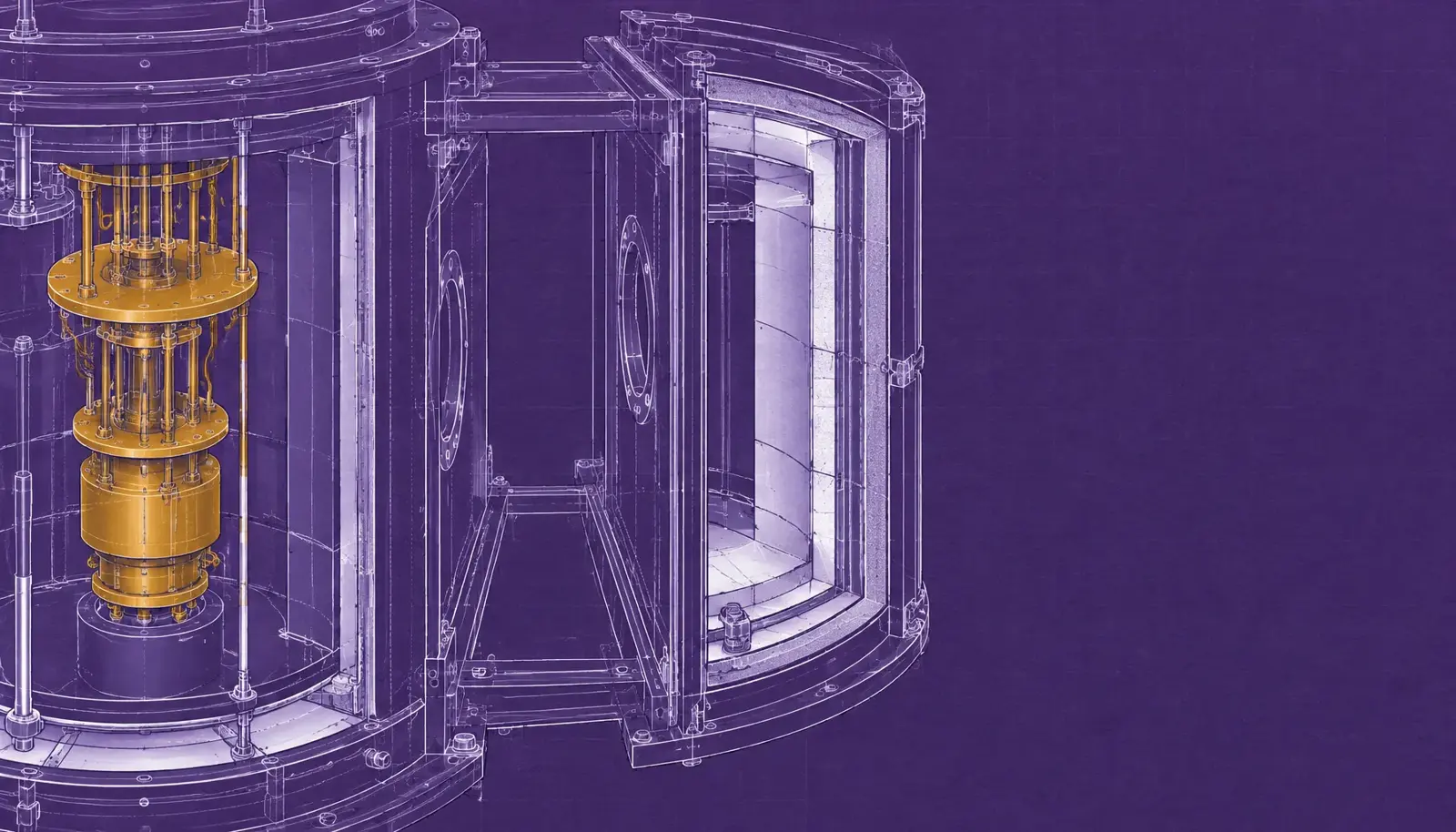
The modular cryostats designed to house the processors are rectangular, unlike the cylindrical cryostats previously used. Their design separates the cooling engine from the vacuum shell, shielding and wiring, and includes pathways for l-couplers between cryostats.
As of November 2026, two Nighthawk r2 devices attached by l-couplers were cooling in the cryostats, with the latest l-coupler quality factors in the usual range of 1 million to 2 million. The company says Starling will need up to twelve connected cryogenic modules.
IBM has also developed cryogenic control ASICs that it says match or exceed the gate performance of room-temperature control electronics. An earlier demonstration used ASIC control for around half of the two-qubit gates on a Heron processor, while single-qubit gates remained under room-temperature control.
The main Starling architecture has not changed, according to the company, which says work continues on logical processing units and reducing the overhead associated with magic state injection.
Source
Companies in this story
Related stories
- IBM says million-round repetition code can run in one circuit
- IBM plans 520-qubit Nighthawk r3 and linked system for 2027
- Fermilab, IBM and NVIDIA plan modular quantum platform
- IBM Puts Quantum System Two Online in Chicago
- Yonsei Installs IBM’s Latest Quantum Nighthawk Processor at Its Quantum Computing Center