The Signal
StealthCores Ships PQC IP With Side-Channel and Glitch Defenses
StealthCores says its StealthPQ cryptographic IP is available for FPGA and ASIC designs, supporting NIST’s ML-KEM and ML-DSA standards. An optional configuration adds masking and fault protections, while the company’s published performance figures exclude that option.
“The new algorithms solve the quantum problem, but they do not solve the implementation problem. An attacker with physical access can still go after the keys through side-channel and glitch attacks.”
Stuart Audley, President of StealthCores
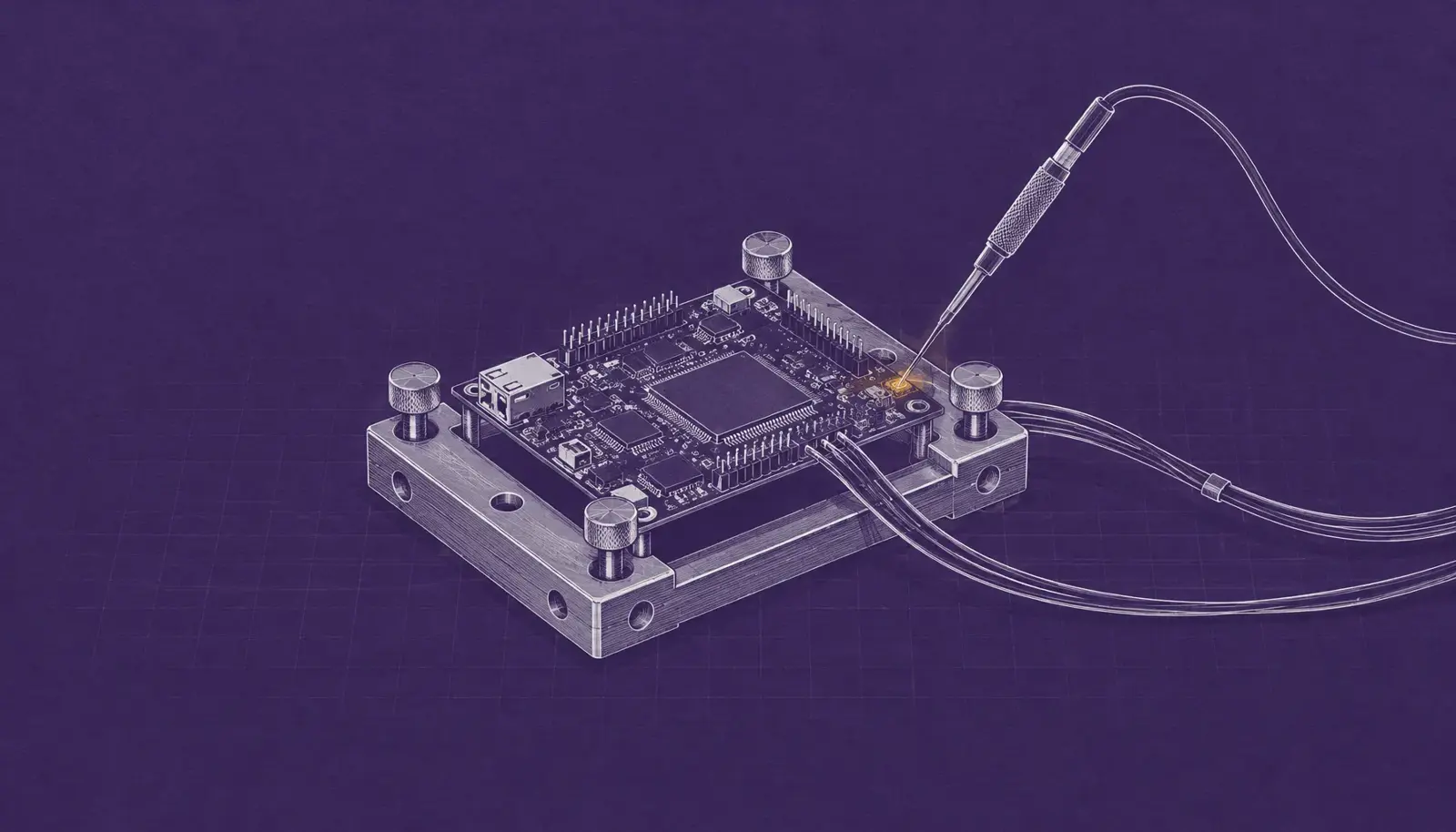
StealthCores announced StealthPQ on November 2, 2026, describing it as post-quantum cryptography IP for field-programmable gate arrays (FPGAs) and application-specific integrated circuits (ASICs). The core implements ML-KEM for key establishment and ML-DSA for digital signatures, and the company says its Standard and Fast configurations are available now. A separate, optional configuration adds defenses against side-channel, fault and glitch attacks.
StealthPQ keeps private keys in hardware
The product supports all six parameter sets in FIPS 203 and FIPS 204, including ML-KEM-1024 and ML-DSA-87, which StealthCores identifies as the parameter sets required for CNSA 2.0 compliance. The IP handles operations from key generation through signing and decapsulation. Its host interface uses AXI4-Lite, while private keys stay in internal key slots and software refers to them by slot number.
For key establishment, the resulting shared secret exits through a dedicated output that can connect directly to StealthKey, the company’s hardware key manager, or another key store. StealthCores says the design can therefore keep session keys out of software. The company lists TLS 1.3, IPsec IKEv2 and MACsec among its target uses, alongside secure boot, code signing, hardware security modules and device provisioning.
Masking and fault checks are an optional configuration
StealthCores says the countermeasure configuration applies cryptographic masking to secret-dependent operations and includes more than 30 fault and glitch protections. One named measure is a dual-lockstep controller. If the core detects a fault, the company says, it locks until all keys are erased.
That distinction matters for buyers comparing the product’s security features with its performance claims: the published throughput figures apply to configurations without the countermeasure option. In the Fast configuration, StealthCores reports up to 12,400 ML-KEM-768 encapsulations and 5,190 ML-DSA-65 verifications per second at 200 MHz. For the highest parameter sets, it reports up to 9,270 ML-KEM-1024 encapsulations and 3,640 ML-DSA-87 verifications per second.
Availability comes with an integration and validation caveat
StealthPQ is supplied in Verilog or VHDL for major FPGA families and ASIC implementation. The announced software support includes the StealthAPI library, a Linux driver and wolfSSL integration; customers can also choose an ML-KEM-only or ML-DSA-only configuration. StealthCores describes the core as ready for NIST’s Automated Cryptographic Validation Testing System, while an ACVP harness with validation support is an optional offering.
The company places StealthPQ within a broader CNSA 2.0 suite that also includes its AES-256 and SHA-384/SHA-512 cores. The launch announcement says the suite’s cores share interfaces and a software library, and that StealthKey can take StealthPQ’s shared secret directly in hardware. It does not provide performance figures for the countermeasure-enabled configuration, leaving that version’s throughput to be assessed separately by prospective customers.
Physical attacks remain an implementation problem
StealthCores frames StealthPQ’s added defenses as a response to attacks on how cryptographic algorithms run, rather than on the mathematical standards themselves. Side-channel attacks can use power consumption or electromagnetic emissions to extract secrets, while glitches can disrupt a computation and provoke errors. The product’s stated availability gives FPGA and ASIC designers a shipping implementation to evaluate, but the announcement’s speed figures describe the configurations without the optional defenses.
Source
Related stories
- Blue Light Can Make CV-QKD Estimate a Positive Key Rate When the Correct Rate Is Nonpositive
- NowSecure Finds 97% of 136,711 Mobile Apps Lack Detectable PQC
- Federal PQC Plan Deadline Passes, Compliance Still Unclear
- ETH Zurich paper says PQC could reshape internet routing security
- HKMA Launches Post-Quantum Toolkit as Banks Lag on Readiness