The Signal
QwaveMPS Brings Delayed Waveguide Feedback to Python
QwaveMPS is an open-source Python package for simulating waveguide quantum systems, including delayed feedback between emitters and photons. It uses matrix product states to model dynamics such as mirror reflections, coupled emitters and fixed-photon pulses.
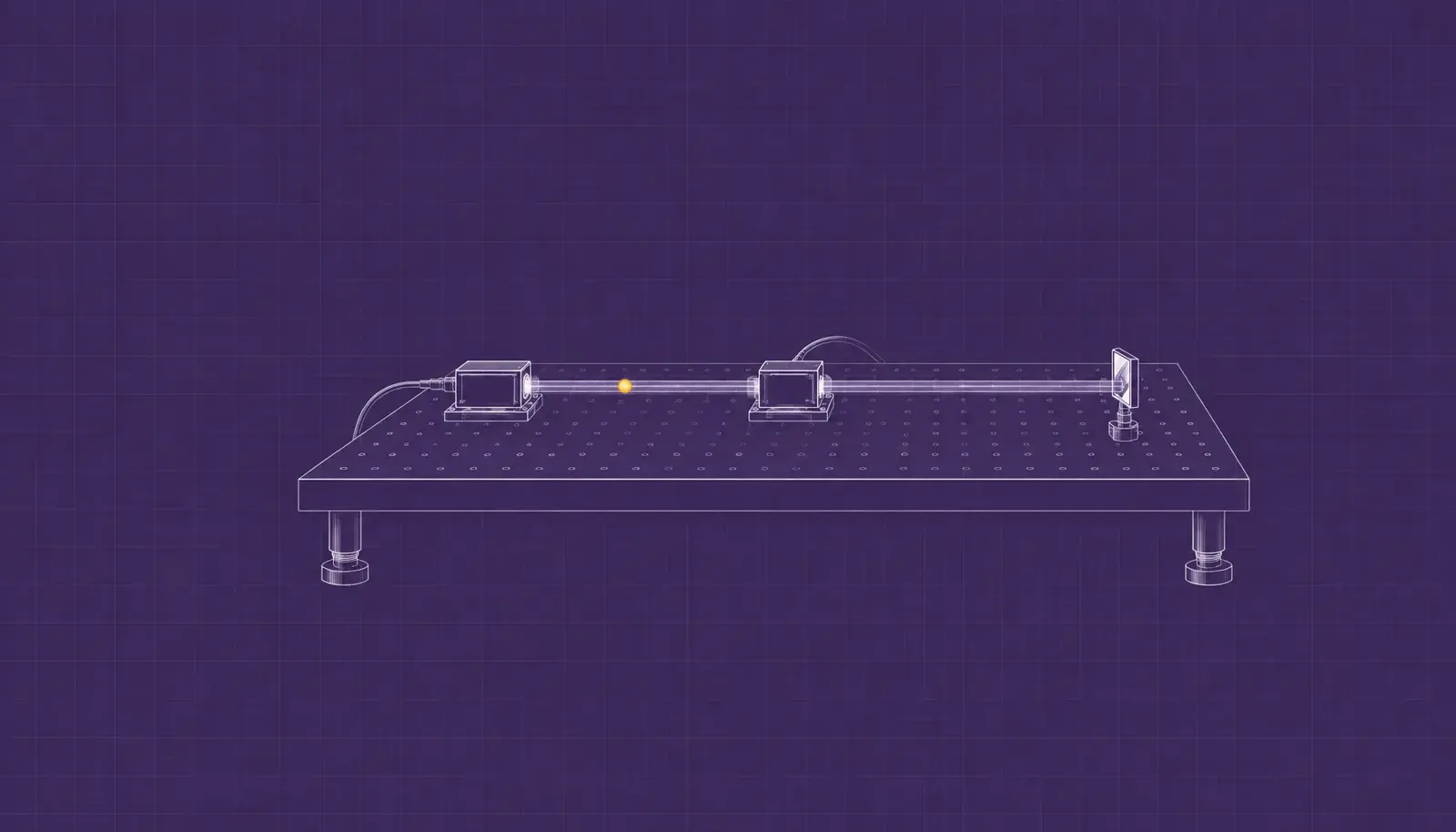
A photon emitted into a waveguide can travel to a mirror, return after a delay and interact again with the emitter that released it. The paper published by Quantum on November 3, 2026, describes QwaveMPS, an open-source Python package built to simulate those delayed interactions alongside other waveguide quantum electrodynamics (waveguide-QED) dynamics.
Source arxiv.org
Keeping the returning photon in the calculation
Many standard treatments assume an emitter’s photon leaves and does not return. That assumption misses time-delayed feedback, such as a photon reflected by a mirror or exchanged between spatially separated emitters. The returning field can affect later dynamics, while tracking photons across the waveguide directly makes the calculation grow quickly in complexity.
QwaveMPS uses matrix product states (MPS) to represent the system as linked pieces, including time bins for the electromagnetic field. For delayed feedback, the software automatically moves the relevant feedback bin next to the emitter and the current field bin before applying the time-evolution operator. Its interface also handles other waveguide-specific tensor-network tasks, including constructing the evolution operator from physical parameters, managing truncation and calculating field observables.
“In this work, we introduce QwaveMPS, our open-source Python library designed to simulate waveguide-QED systems using MPS.”
— The authors write in their paper.
From mirror feedback to fixed-photon pulses
The examples cover a two-level system (TLS) coupled to a waveguide, a TLS facing a mirror in a semi-infinite waveguide, two coupled TLSs, and emitters driven by classical fields or quantum pulses. The package calculates emitter populations, photon flux and single-time or two-time field correlations. For Fock-state pulses, users can specify the photon number, direction of travel and pulse shape.
The paper’s benchmarks report sub-second runtimes for several simulations on one workstation. A one-emitter non-Markovian feedback example with a delay of γτ = 1 took 0.68 seconds; a two-emitter example with γτ = 0.5 took 0.67 seconds. Both used a time step of γΔt = 0.05, a final time of γtmax = 8 and a maximum bond dimension of 4.
Another test modeled Gaussian Fock-state pulses incident on a chiral TLS. The six-photon case took 0.18 seconds and used 13.67 MB of simulation memory; the paper says that figure excludes the memory used by the Python process. These results describe the paper’s tested examples, not a general runtime guarantee for every model or input.
The tested models leave out loss
The authors say their examples exclude loss processes: the simulations do not include photons lost from the modeled system. They identify off-chip decay and pure dephasing as effects that could be added to bring simulations closer to experimental systems. The paper says the authors have implemented such effects in their current version of QwaveMPS, with a package-compatible feature planned for a future version.
The package was listed on the Python Package Index before the journal publication, with a release date of April 15, 2026. PyPI lists a GNU General Public License v3 license and Python 3.10 or later as a requirement. The journal paper’s main contribution is a set of automated operations that lets researchers model delayed feedback and quantized light without writing the underlying MPS routines themselves.