The Signal
MOF hosts light-made radical pairs with selected spin state
Researchers report producing light-generated radical pairs in a metal–organic framework, with spins selectively polarized into a triplet state. The radical pairs’ spin-lattice relaxation time changed with the solvent molecules held in the framework’s pores.
A framework for controlled spin states
A metal–organic framework held light-generated radical pairs whose electron spins were selectively polarized into a particular triplet state, the University of Tokyo reports. The study, published in Nature Communications, also found that the pairs’ spin-lattice relaxation changed with the solvent molecules inside the framework’s pores.
Source s.u-tokyo.ac.jp
The work was published on November 13, 2026. The international team was led by Nobuhiro Yanai of the University of Tokyo and Michael R. Wasielewski of Northwestern University; the paper is titled “Sublevel-Selective Electron Spin Hyperpolarization of Triplet Radical Pairs in Metal–Organic Frameworks.”
Donor and acceptor inside the pores
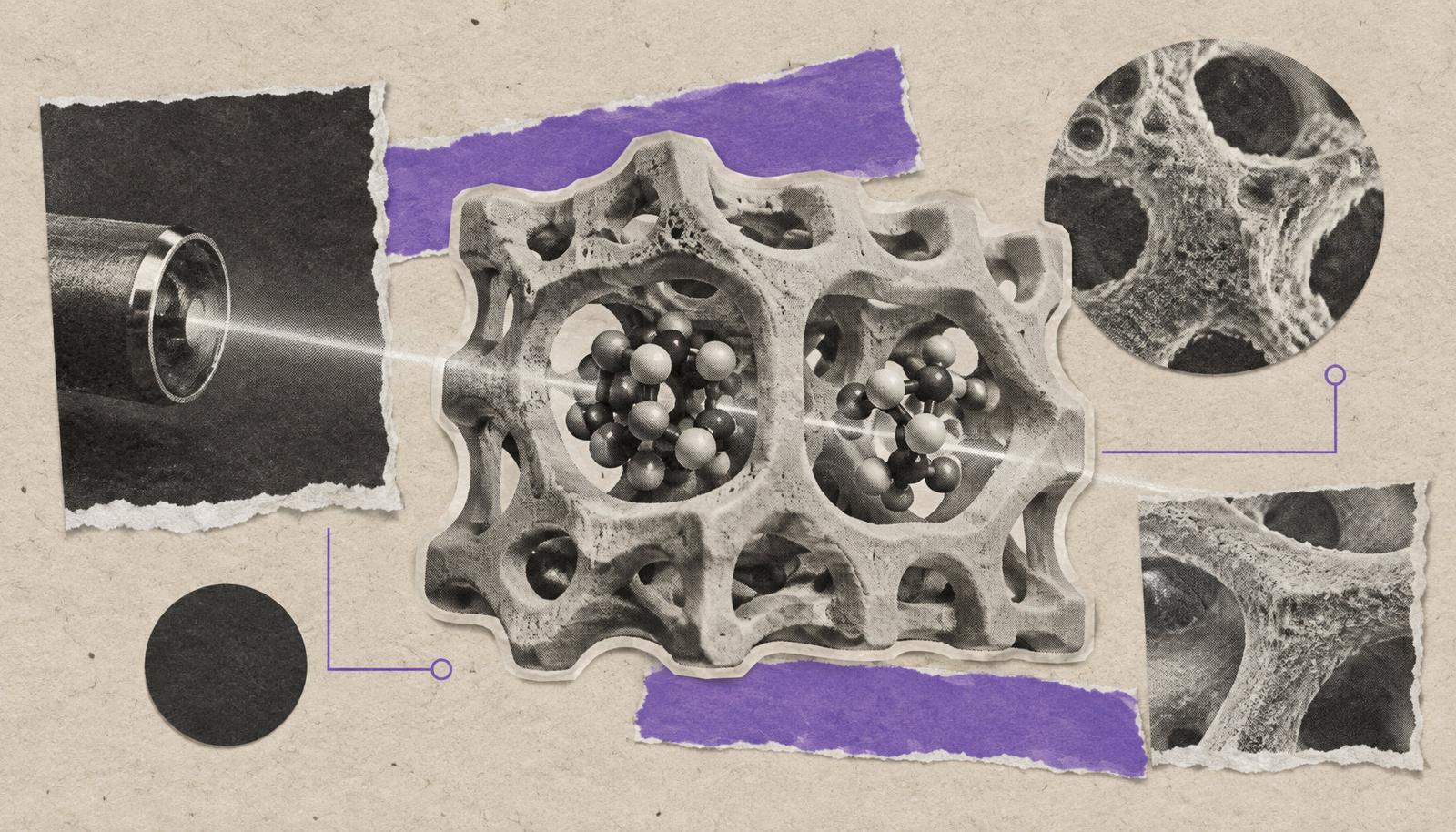
In the experiment, researchers placed an electron-accepting naphthalene diimide derivative, DPNDI, inside a framework made from zinc porphyrin, ZnTCPP. DPNDI coordinated to zinc centers and bridged two ZnTCPP units, positioning the electron donor and acceptor close together. A metal–organic framework is a porous material built from metal ions and organic molecules.
The team examined the light-driven process using transient absorption spectroscopy and time-resolved electron paramagnetic resonance. The measurements showed that light excitation caused charge separation from ZnTCPP to DPNDI, initially producing a singlet radical pair before a triplet pair formed. The researchers report selective polarization into the triplet’s T0 spin sublevel and a sharp electron paramagnetic resonance signal.
Solvent changes relaxation
The team also introduced different solvent molecules into the framework’s pores, including pentane, cyclohexane, carbon tetrachloride, toluene and chloroform. The spin-lattice relaxation time, T1, varied with the guest molecule, according to the research account.
The University of Tokyo describes radical-pair research to date as focused mainly on isolated molecules in solid materials. The researchers say the framework’s ordered arrangement offers a way to control how the pairs form and which spin state is populated.
Potential sensing application
The team says the solvent-dependent relaxation could let spin properties respond to chemical surroundings. It describes chemical sensing and magnetic-resonance signal enhancement as potential applications, not demonstrated devices. The researchers say they plan to explore other spin systems in metal–organic frameworks and their responses to chemical stimuli.
Sources
Related stories
- Diamond spin spirals sustain collective dynamics, paper reports
- Photon Pairs Improve Loss Estimates in Whispering-Gallery Resonators
- Delft Researchers Resolve Nuclear Spin Transitions in One Titanium Atom
- Researchers Extend NV-Spin Memory to 565 Microseconds
- Preprint reports proton sensing with silicon-carbide nanopillar arrays