The Signal
Mandel interferometer stays at shot-noise scaling under loss
A study published in Quantum finds that differential-intensity detection in a Mandel-type nonlinear interferometer retains shot-noise scaling when light is lost. The comparison also finds that a Yurke-type setup can reach below-shot-noise sensitivity under balanced loss and moderate gain, but can fare worse when losses differ.
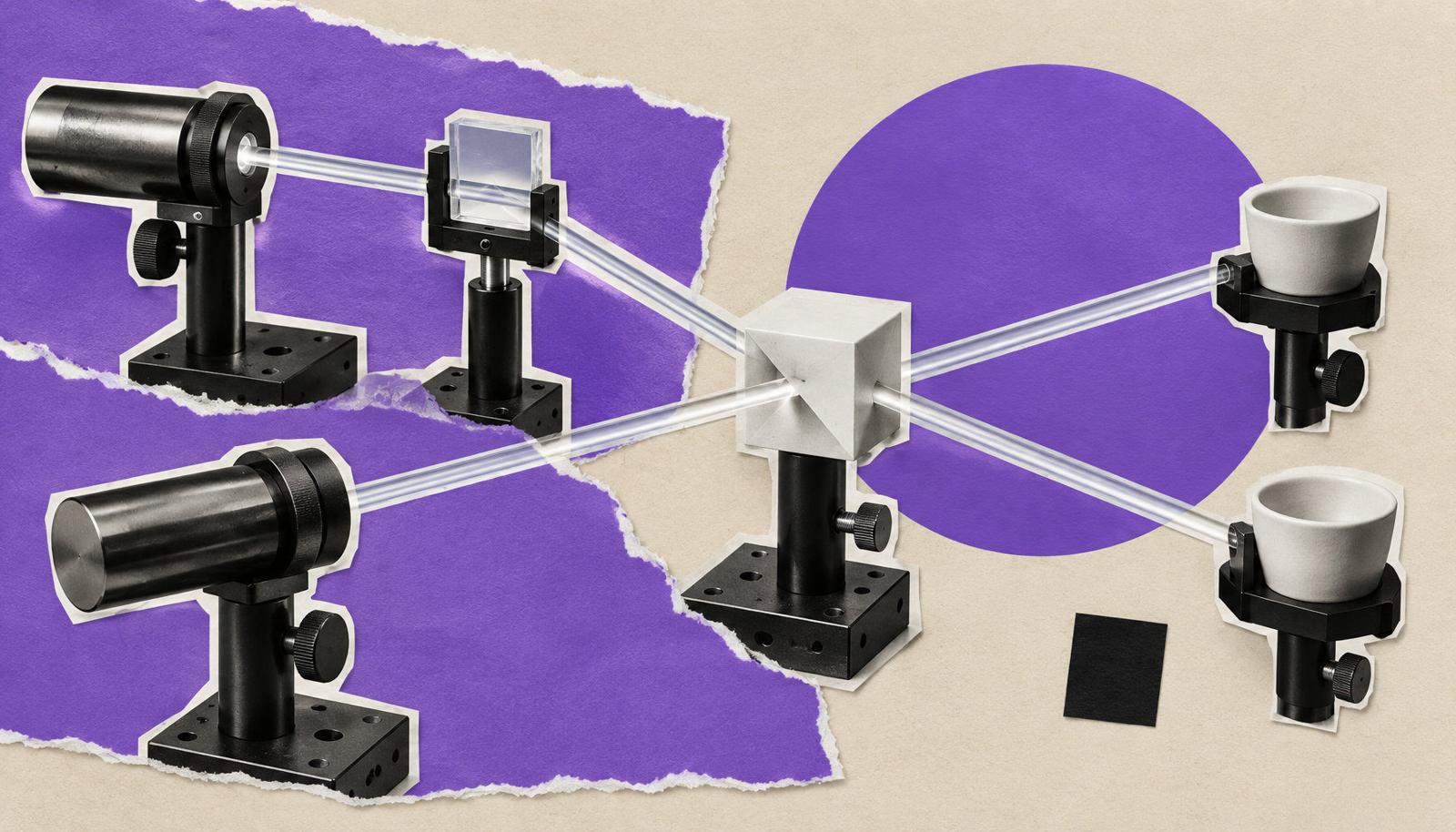
A differential-intensity readout in a Mandel-type nonlinear interferometer retains shot-noise scaling when light is lost, while a compared Yurke-type setup can lose sensitivity when its two paths have different losses. The result comes from a theoretical comparison of phase-estimation schemes published in Quantum on November 18, 2026; it is not a report of a new hardware demonstration.
Three ways to estimate phase
The study compares three configurations using intensity measurements: a Yurke-type SU(1,1) interferometer, a Mandel-type induced-coherence interferometer and a hybrid arrangement between them. Nonlinear interferometers use optical parametric amplifiers in place of the beam splitters in a standard interferometer.
In the modeled systems, a first nonlinear medium generates correlated signal and idler light. The idler probes a sample, while the signal can be detected; the two colors can therefore let an instrument probe at one wavelength and measure at another. The calculations assume unseeded inputs and equal gain in the two nonlinear media.
The configurations differ in how the generated light reaches the second nonlinear medium. In the Yurke arrangement, both signal and idler enter it; in the Mandel arrangement, only the idler does, while the signal outputs are combined and measured. The hybrid scheme adjusts how much signal enters the second medium, bridging the two setups.
Loss changes the comparison
The paper finds that a single-output intensity measurement in the Yurke configuration can achieve below-shot-noise sensitivity with balanced losses and moderate gain. But the result is sensitive to conditions: the paper reports degraded performance at high gain and says unequal losses can cause the sensitivity to saturate rather than continue improving with more photons.
For one illustrative case, the authors set signal transmission to 0.8 and idler transmission to 0.7; the Yurke configuration reaches a constant sensitivity limit at high gain. When the transmissions are balanced at 0.8, the model instead gives shot-noise scaling for that configuration. These are modeled values in the paper, not measurements from an operating device.
Differential detection in the Mandel setup
The Mandel configuration’s performance depends on how its output is read. Measuring the difference between the intensities at both signal outputs preserves shot-noise scaling in the high-gain regime, including when there is loss; the paper also reports a loss-dependent factor that leaves sensitivity above the ideal lossless bound.
The study compares sensitivity against the number of photons probing the sample. It defines shot-noise scaling as an uncertainty proportional to 1 divided by the square root of that photon number, and Heisenberg scaling as proportional to its inverse. The differential Mandel measurement reaches, but does not surpass, the shot-noise limit in the analysis.
With unequal losses, the paper finds that the differential Mandel readout overtakes the Yurke configuration at sufficiently high photon numbers. The authors’ comparison is limited to unseeded configurations with equal gain and intensity-based measurements; they note that more involved approaches, including coincidence measurements or homodyne detection, were outside the study’s scope.
Sources
Related stories
- Ghosh Team Finds Squeezed Sensors Lose Ground in Negative Noise
- Photon Pairs Improve Loss Estimates in Whispering-Gallery Resonators
- PRX Quantum paper reports homodyne readout of spin information
- Feedback Nearly Doubles Qubit Frequency-Estimation Information
- Jesús Fuentes Aguilar Proposes a Quantum Sensor That Resets After Gain