The Signal
Jesús Fuentes Aguilar Proposes a Quantum Sensor That Resets After Gain
A theoretical protocol drives a quantum oscillator through transient parametric gain, then returns it to the vacuum while preserving the signal’s displacement. The paper analyzes the method’s sensitivity and the noise cost of dissipation, b
Quantum.world Team · Written with AI · fact-checked ·
Preparing a squeezed quantum state can improve a sensor’s precision, but the state is vulnerable to energy loss and must be prepared again for each measurement cycle. Jesús Fuentes Aguilar proposes a different trade-off: drive an oscillator through a period of strong parametric gain, then return it to the vacuum state before reading the signal. The theory, published October 26 in Discover Quantum Science, aims to preserve the signal’s imprint without carrying the temporary squeezing into the next cycle.
Gain during the cycle, vacuum at the end
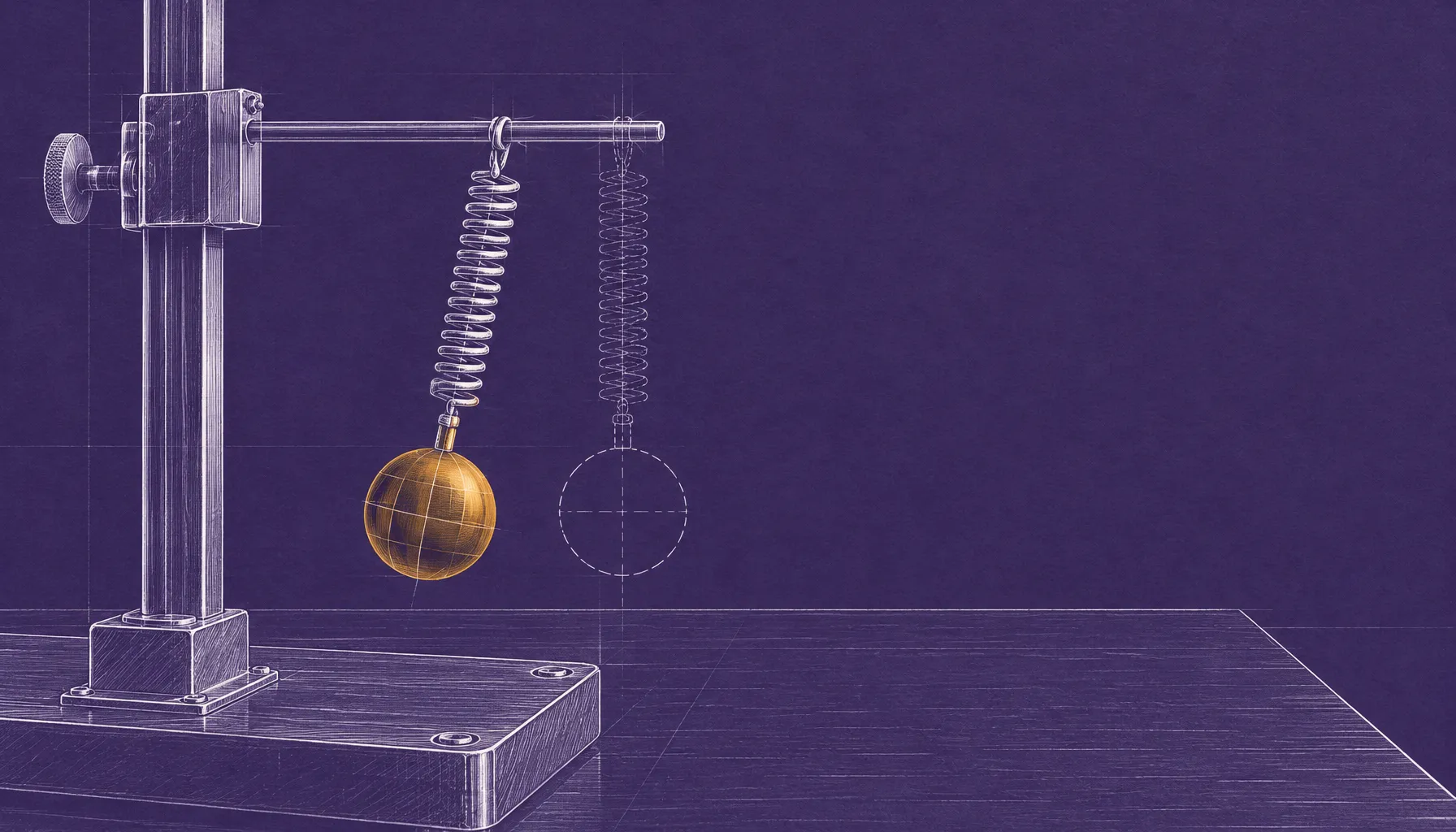
The proposal targets a weak force that displaces a quantum oscillator in phase space. A time-varying quadratic Hamiltonian steers the oscillator through a closed path in the symplectic group, the mathematical description of its linear transformations. Along the path, transient squeezing amplifies the oscillator’s response; when the path closes, the squeezing disappears while the force-induced displacement remains.
A homodyne measurement of one quadrature reads that remaining displacement. Because the probe returns to its initial vacuum state, the next cycle does not require a fresh squeezed-state preparation. In the paper, its author, Jesús Fuentes Aguilar, writes:
“The inequality has the shape of a second law: the first term is what a loop that merely rotates already achieves, the second is the price of the gain.”
The paper’s main example is a superconducting oscillator whose effective stiffness can be tuned by external magnetic flux. The probe is a single bosonic mode—not a qubit—and the signal couples to one of its quadratures. The paper also discusses how the framework could be adapted to a trapped ion’s motion or an optical parametric amplifier, where the control parameter and practical constraints differ from those of the superconducting example.
The gain has a noise cost
Transient amplification does not remove the effects of dissipation. When the oscillator loses photons to a bath, that bath adds noise while the gain is active, and the paper derives a bound linking the quantum Fisher information to signal energy, cycle duration and this dissipative exposure.
In the paper’s scaling estimate, if the oscillator reaches peak squeezing during a window of duration δt, the exposure grows approximately as κδt e2ρ*, where κ is the loss rate and ρ* measures the peak squeezing. Keeping that exposure small requires κδt to be much less than e−2ρ*. The estimate makes the design constraint explicit: stronger gain is useful only if the sensor can confine it to a short enough interval relative to its losses.
A theoretical comparison, not a device demonstration
Aguilar compares the loop with Ramsey sensing and Ramsey sensing that starts from a squeezed vacuum. In the modeled comparison, all three protocols use the same device duration and bath, and each receives its own signal waveform matched to its response. The calculations show the loop losing sensitivity more slowly as damping rises than the initially squeezed alternatives; by κτ around one, their calculated performance has converged.
That comparison is a theoretical result, not an experimental measurement. The paper develops the control waveforms and sensitivity bounds analytically and numerically; it does not report a sensor built to run the protocol. The proposed circuit implementation also depends on controlling the oscillator’s stiffness over time while keeping the motion within the regime where the quadratic model remains valid.
Closing the path is the practical test
The protocol’s attraction is that its amplification is temporary: the probe finishes each cycle without residual squeezing, so the same initial state can serve again. Whether that advantage survives in hardware depends on how accurately a platform can implement the prescribed drive and close the evolution loop in the presence of loss and control errors. The paper supplies a design method and a bound for assessing that trade-off; it does not establish a measured sensitivity advantage in an operating quantum sensor.