The Signal
Researchers publish framework for mapping non-Gaussian entanglement
A paper in Quantum presents a geometric framework for analyzing non-Gaussian entanglement in bosonic states with finite stellar rank. It uses polynomial decompositions and a structural graph to identify entanglement patterns, with separability criteria for two-mode states and for stellar-rank-2 states across any number of modes.
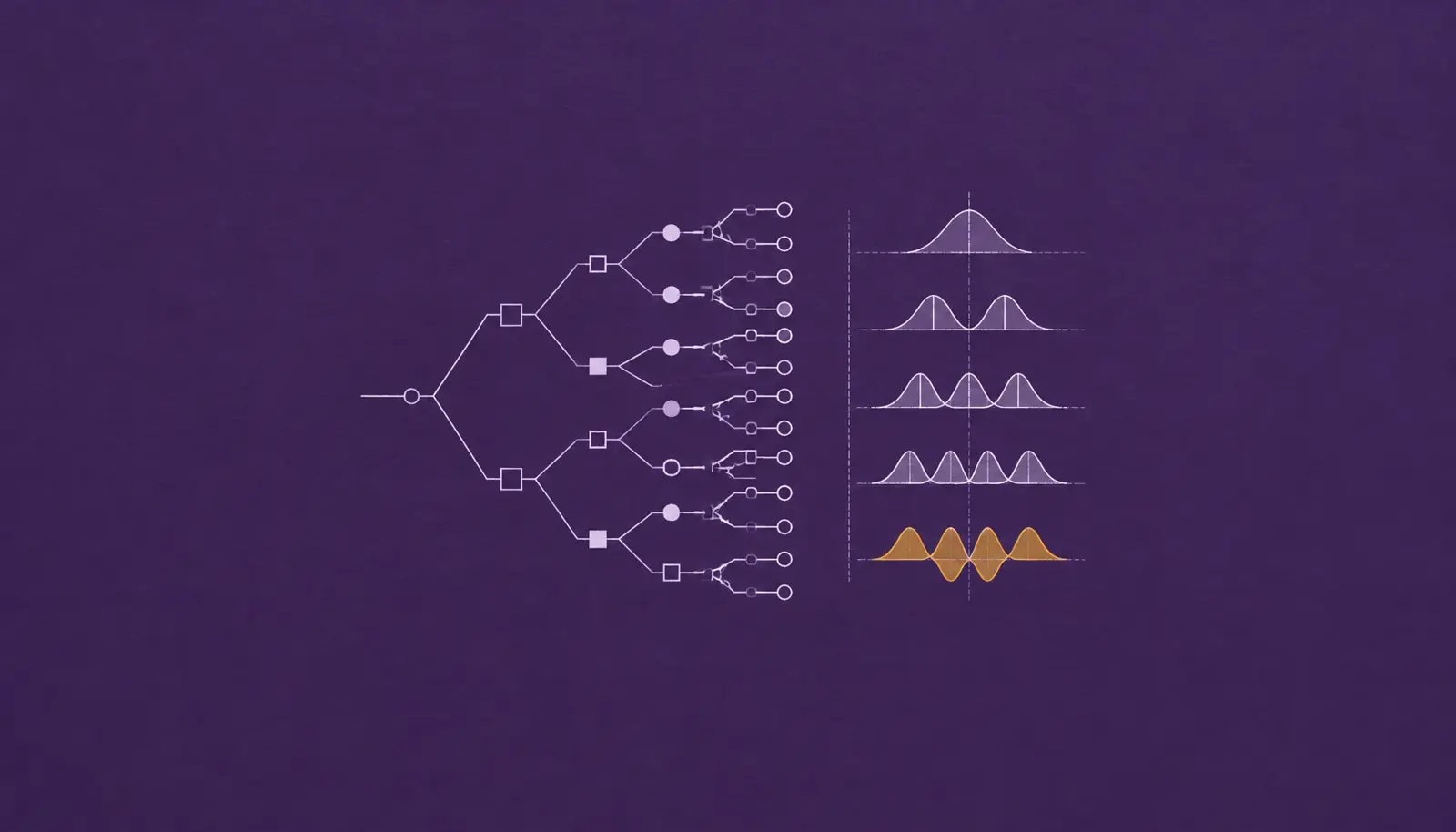
A polynomial route to entanglement structure
A paper published in Quantum on Nov. 10 presents a geometric framework for characterizing non-Gaussian entanglement in bosonic states with finite stellar rank. The work is by Carlos E. Lopetegui-Gonzalez, Massimo Frigerio and Mattia Walschaers.
The framework starts from a mathematical representation of the states: pure bosonic quantum states with a finite number of photons can be described uniquely by complex polynomials, the paper’s popular summary says. The authors use algebraic geometry to analyze those polynomials, linking the physical properties of a state to algebraic properties of its representation.
The paper focuses on two kinds of entanglement that can arise only in non-Gaussian states. Mode-intrinsic entanglement cannot be removed using passive linear optics, such as beam splitters and phase shifters. Genuine non-Gaussian entanglement cannot be removed with arbitrary Gaussian operations. The framework addresses how these forms of entanglement are structured in finite-stellar-rank states, rather than treating entanglement as separate from the state’s mathematical form.
Reading the polynomial’s structure
The central method breaks a state’s stellar polynomial into atomic factors and links that decomposition to a structural graph. The graph’s connected components determine the state’s mode-intrinsic entanglement content and identify the partitions compatible with passive separability, according to the paper’s abstract.
The authors describe the atomic decomposition as invariant under Gaussian operations. That invariance is intended to capture the state’s inherent non-Gaussian entanglement structure even when Gaussian operations are considered. The paper’s summary presents the method both as a tool for characterizing entanglement and as a way to inform the complexity of preparing different quantum states.
Another part of the framework identifies “essential variables”: the minimum number of effective modes involved in a core state. The paper connects that number directly to the symplectic rank. This reduction underpins the decomposition of stellar polynomials into atomic factors and the subsequent identification of entanglement structure.
Separability tests and applications
The authors derive complete separability criteria for two-mode states. These criteria are expressed through hyperplane decompositions of the zero sets of the states’ polynomials. The paper also establishes criteria for stellar-rank-2 states across an arbitrary number of modes, extending that part of the analysis beyond a fixed number of modes.
Applications to example states illustrate how the method can isolate genuinely non-Gaussian resources and quantify preparation complexity. The paper’s popular summary says the framework also highlights fundamentally different alternatives for generating non-Gaussian entangled states, which may be relevant to different information-processing protocols.
The work is motivated by the role of bosonic quantum states in computational problems. Its summary says realizing a quantum advantage with these states requires both entanglement and non-Gaussianity, while the interplay between the two is only starting to be understood. The framework gives a structural way to examine that interplay by connecting entanglement properties to polynomial decompositions and their graph representation.
Source
Related stories
- Kun Wang Sets Out Three Protocols to Compare Remote Bosonic States
- Photonic Processor Classifies Quantum States by Stellar Rank
- PRX paper bounds entanglement growth and its spectrum
- Researchers show how adaptive circuits can realize quantum instruments
- Researchers estimate X-ray spectroscopy model at 100 logical qubits