The Signal
Preprint extends GKP error correction to measurement sequences
Researchers have proposed a mathematical framework for tracking dynamical GKP codes through sequences of measurements. They illustrate it with a two-mode code that switches between square and hexagonal encodings.
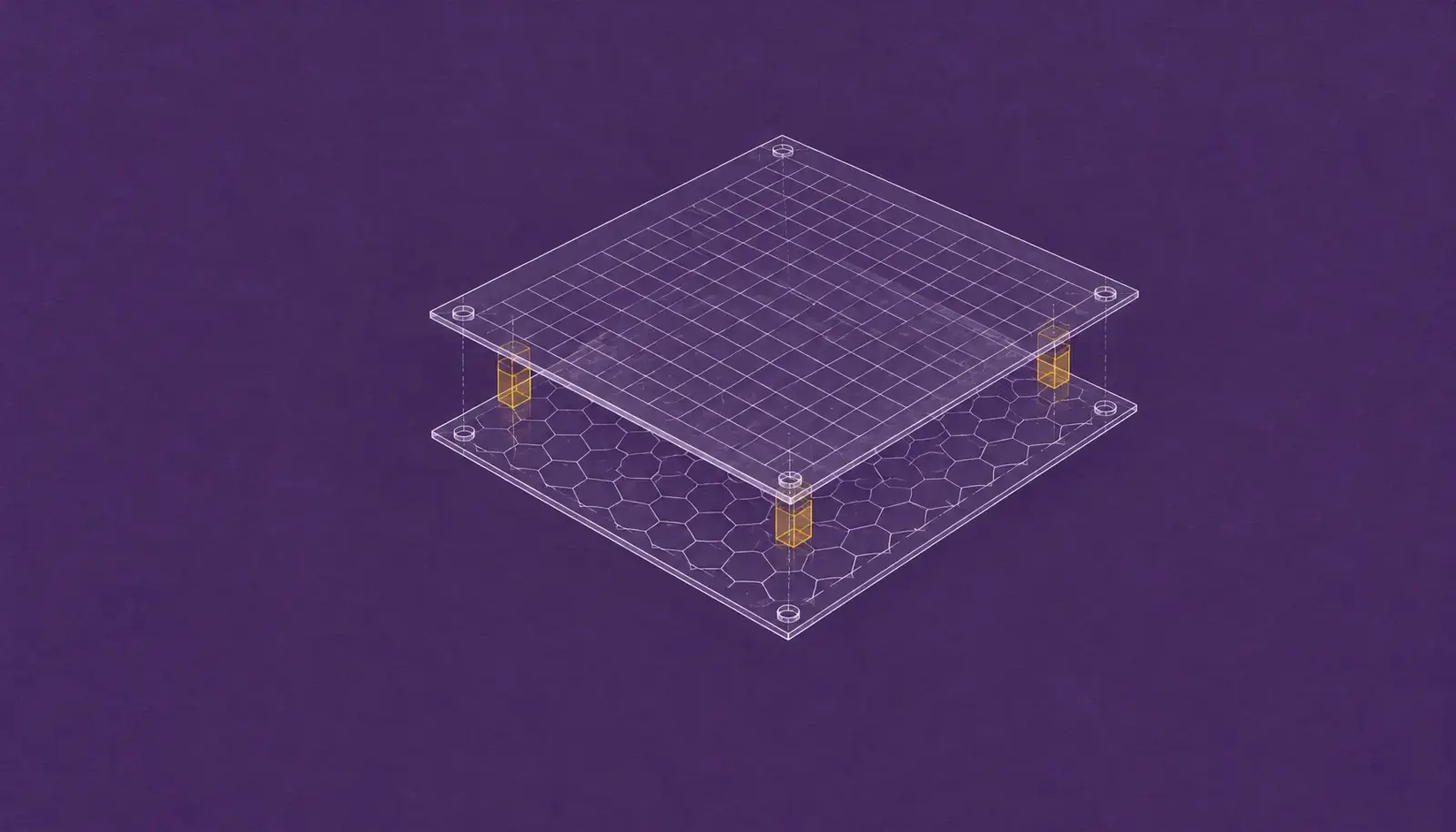
A new theoretical framework extends GKP quantum error-correction codes to sequences of measurements, providing a way to calculate their syndromes and distances. In a November 10 preprint, Jonathan Pelletier and Baptiste Royer of the Université de Sherbrooke describe how they adapted tools from dynamical qubit codes to encodings in oscillators.
Source arxiv.org
The authors illustrate the method with a two-mode example that switches between square and hexagonal GKP encodings. They say the example reduces measurement weight compared with both static codes while combining their sets of logical gates.
From static codes to sequences
Gottesman–Kitaev–Preskill, or GKP, codes encode qubits in the continuous phase space of oscillators. They are designed to protect against small random displacements and can also partially correct oscillator loss, according to the paper.
Dynamical codes instead describe protection through a sequence of measurements. The preprint extends that approach to GKP codes by combining lattice encodings with translation measurements that change over time.
The paper notes that GKP encoding has previously been realized in superconducting circuits, trapped ions and optical systems. The new work is a theoretical framework, rather than a report of a hardware demonstration.
Tracking errors across rounds
Pelletier and Royer first generalize GKP codes into subsystem GKP codes using scaled symplectic lattices. They derive update rules for the lattices as translation measurements are made, describing how the encoding changes between measurement rounds.
The researchers then adapt tools known as ancestry, detectors and benign errors from dynamical qubit codes. Ancestry traces how a measurement outcome depends on earlier outcomes, while benign-error generators help classify undetectable errors.
The resulting method uses a persistent stabilizer lattice and a bounded inference window to calculate a code's syndrome and distance. The authors define the inference window in terms of how many recent measurement rounds are needed to infer the relevant stabilizer values.
A switching example
The paper's example uses a two-mode Floquet code with a measurement sequence of period eight. It encodes a single logical qubit that is teleported between the modes every two rounds. Every four rounds, the stabilizers of the maximal persistent lattice are measured.
The example combines the logical gates of the square and hexagonal codes. According to the authors, it also requires shorter measurement vectors than the corresponding static codes.
The authors say shorter measurements should, in theory, improve individual measurement fidelity. They connect measurement length to the interaction time needed to perform an operation, while presenting the improvement as a theoretical expectation rather than a measured result.
A link to homodyne detection
The preprint also examines measurements with irrational symplectic overlap. The authors find that, in the single-mode case, these reduce to destructive homodyne detection; they describe the measurement as having no analogue in discrete qubit codes.
For finite-energy GKP codes, the paper distinguishes measurements that are close to homodyne-type detection from those that can be approximated as rational measurements. The latter can be understood using the subsystem GKP update rules, the authors write.