The Signal
Paper Reports Sub-10⁻⁵ Bounds for Optical Bell Resources
A paper proposes an optical quantum-computing architecture that separates verified Bell-resource preparation from online logical processing. In simulations, two level-2 conditions each have a one-sided 95% upper error bound below 10⁻⁵, with
Quantum.world Team · Written with AI · fact-checked ·
On October 23, seven researchers affiliated with OptQC Corp. posted simulations in which a prepared optical Bell resource has a one-sided 95% upper logical-error bound below 10⁻⁵ under two specified noise conditions. The result applies to one encoded resource in a modeled system—not to a working quantum computer or every operation it might perform. Their paper, “Modular optical fault-tolerant quantum computation via an interface between verified resources and online logical operations,” proposes separating resource preparation from the processor that uses those resources.
A factory prepares what the processor consumes
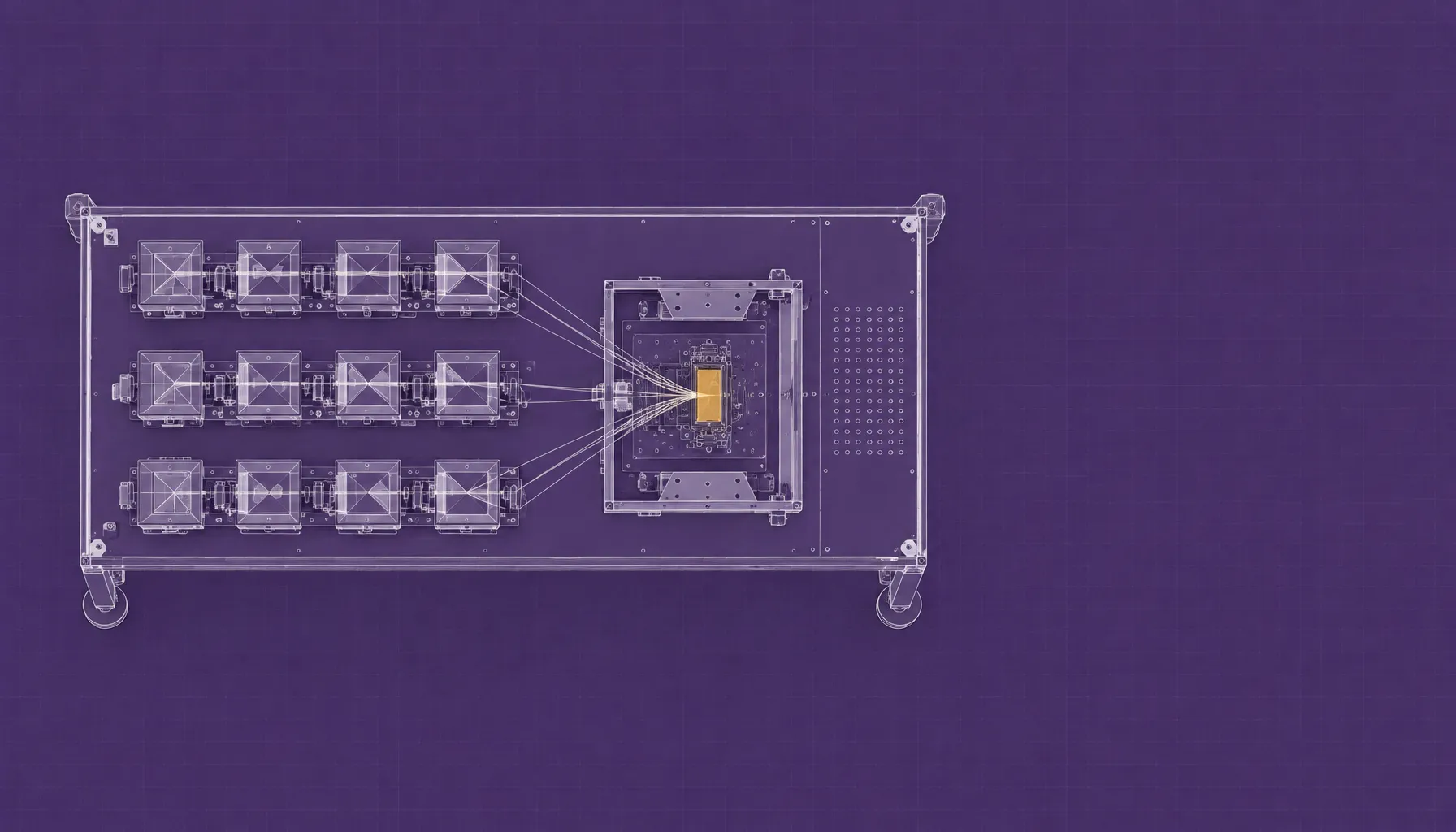
The design pairs an offline factory for verified Bell resources with an online processor based on time-domain measurement-based quantum computation. The factory uses Gottesman–Kitaev–Preskill (GKP) qubits combined with recursively concatenated C₄ codes; the processor uses a Gaussian optical platform called the quad-rail lattice. The paper’s interface specifies more than the encoded state: it tracks optical-mode addresses, measurement roles, correction frames and verification records as a resource enters the processor.
That bookkeeping matters because the optical computation moves quantum information through measured time-bin modes. A known routing or code permutation can change which mode carries the intended logical state, so the processor must keep its address and correction records aligned with the resource. The authors describe constructions for logical CNOT, Bell measurement, SWAP and Hadamard operations, while limiting their depth claim to supported operations under advance resource preparation and adequate parallel routing.
“These results identify a modular route to lower logical error rates while retaining a common Gaussian MBQC operation set with shallow online processing.”
The paper’s authors write.
Two million simulated outcomes test the 10⁻⁵ bound
The paper’s separate level-2 test evaluates one million accepted Bell-resource samples for each of two conditions. In the first, the model adds no post-preparation macronode noise; in the second, it adds a prescribed displacement-noise step. The simulations record three failures in the first million and four in the second, yielding one-sided 95% Clopper–Pearson upper bounds of 7.7536 × 10⁻⁶ and 9.1535 × 10⁻⁶, respectively.
Those figures rely on the paper’s fixed-sample binomial model and concern the designated data subsystem of the Bell resource. The authors call the results pointwise: each condition separately meets the bound, but the pair does not amount to a joint 95% guarantee. The quoted 15.6 dB describes an effective GKP displacement-noise parameter in the simulation, not a measurement of optical-source squeezing.
Improved code levels do not yet certify every gate
A second set of simulations at 12.25 dB finds decreasing selected-output logical error across code levels two through five. At level five, however, the study observes no failures among 15,000 accepted samples in either condition, which gives a one-sided 95% Jeffreys limit of 1.28 × 10⁻⁴—not a sub-10⁻⁵ result. The authors describe this as finite-level suppression under a fixed selection schedule, not a conventional physical-to-logical threshold.
Resource accounting also needs careful reading. The level-2 operating point lists 288 supplied GKP qubits per accepted Bell resource, but that is a nominal count, not a measured full retry cost or an accounting of detectors, switches, storage and control hardware. The paper does not model source-specific costs or certify noisy logical-gate performance; it says an all-gate error certificate requires further analysis.
OptQC’s model leaves hardware questions open
All seven authors list OptQC Corp. as their affiliation. The paper discloses that some authors are company employees and others are directors with equity, and that OptQC has filed a patent application related to the work. It also says the supporting data and software are commercially sensitive and are available from the corresponding author on request.
The simulations lay out how an optical factory could prepare, verify and hand off encoded resources while keeping certain online measurement sequences shallow. They do not establish that the required source quality, routing capacity or preparation throughput has been achieved in hardware. At the modeled 15.6 dB operating point, the level-2 Bell resource records seven logical failures across two million accepted samples—three in the condition without the additional noise step and four in the condition with it—while each condition’s upper bound remains below 10⁻⁵.