The Signal
Cologne Team Observes Andreev Modes in Topological Junction
A University of Cologne team observed highly transmissive Andreev modes in a topological-insulator Josephson junction. The measurements match predictions for surface-state behavior but do not yet confirm a transition to topological superconductivity.
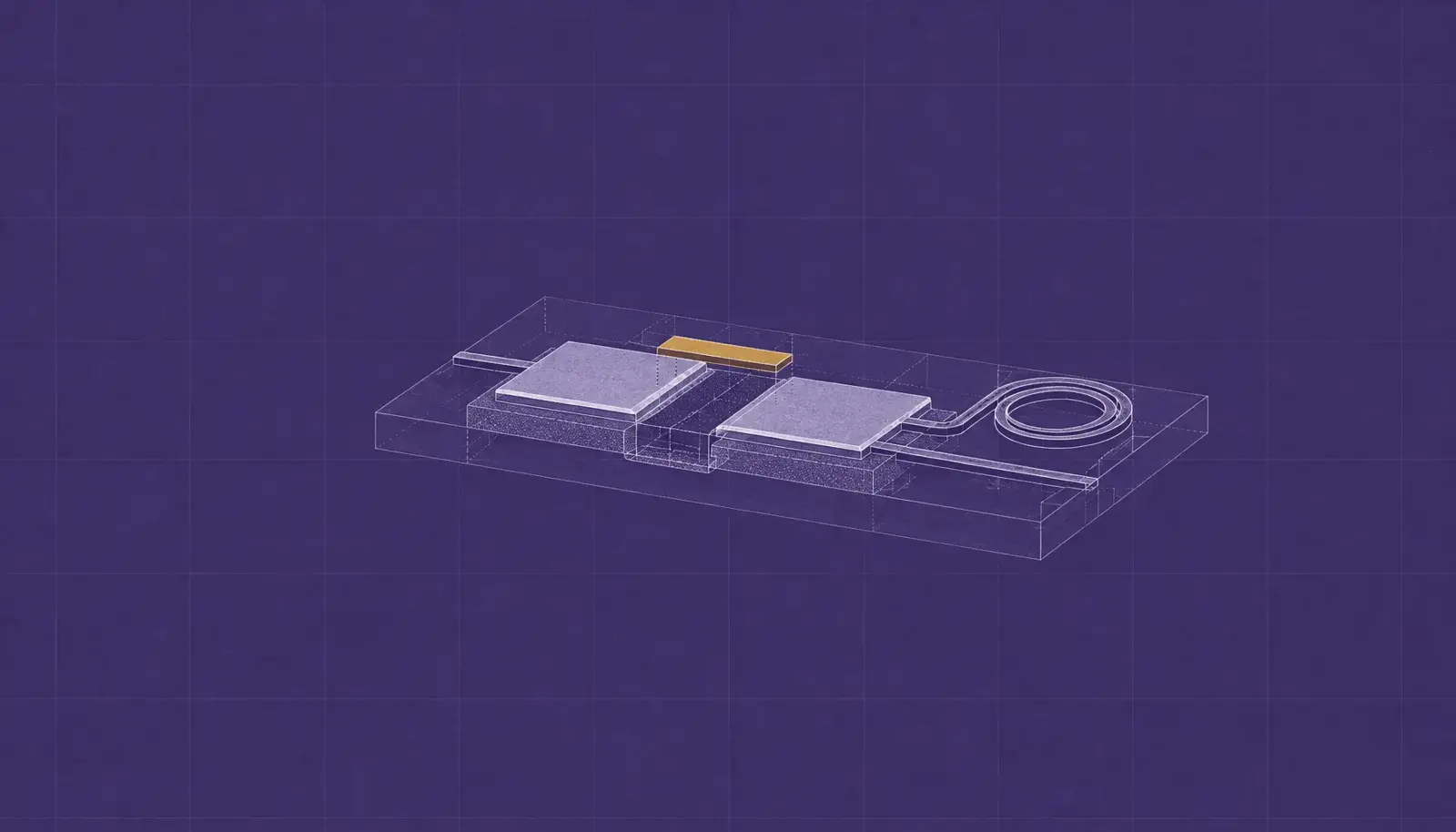
Modes seen across a range of chemical potentials
Highly transmissive Andreev modes appeared in a Josephson junction built on a topological insulator, according to a University of Cologne team whose findings were published in Science Advances on October 30, 2026. The observations match predicted behavior for electrons moving along the material’s conducting surface, but they do not yet establish that the junction has entered a topological superconducting phase.
Andreev modes form when electrons and holes interact at a boundary involving a superconductor. In the Cologne experiment, the team probed the junction’s states through tunnel contacts while controlling the superconducting phase difference with a magnetic-flux loop. The modes persisted across a wide range of chemical potentials, supporting the interpretation that they arise from the topological insulator’s surface states.
“Within our experimental resolution, they could indicate a gap closing and reopening,” write Jakob Schluck, Ella Nikodem, Anton Montag, Alexander Ziesen, Mahasweta Bagchi, Fabian Hassler and Yoichi Ando in the paper’s abstract. The authors describe that possible gap change as an indication, not a confirmed transition.
A magnetic field reveals where the modes gather
The researchers also applied a magnetic field and observed highly transmissive modes concentrated in particular regions of the junction. Their locations match theoretical predictions for Josephson vortices in the topological surface state, according to the paper. That spatial pattern adds evidence for the role of the surface electrons, while leaving open whether the system hosts the protected states sought for topological quantum computing.
A topological insulator is insulating through its interior but conducts electricity at its surface. When a conventional superconductor is placed in contact with that surface, superconductivity can extend into it through the proximity effect. The 2008 proposal by Liang Fu and Charles Kane predicted that this combination could produce topological superconductivity and, under appropriate conditions, Majorana zero modes—states studied as possible building blocks for topological qubits.
The gap transition remains unconfirmed
The central caveat is experimental resolution. The Cologne results are consistent with modes that could signal the predicted closing and reopening of an energy gap as the phase difference changes, but the University of Cologne says more precise measurements are needed to verify that change. Without that evidence, the study supports the proposed physics in the junction but does not demonstrate a topological phase transition or a working qubit.
Jakob Schluck said the next step is to improve the experiment’s energy and time resolution to test for the transition. The project joins experimental work at the University of Cologne with theoretical simulations from Fabian Hassler’s group at RWTH Aachen University. Both teams belong to the Matter and Light for Quantum Computing cluster, which also includes researchers in Bonn and at Forschungszentrum Jülich.
From spectroscopy to a quantum bit
The result addresses an early materials-and-device question: whether a topological-insulator junction displays the distinctive Andreev physics predicted for its surface states. It does not settle the harder engineering questions of how to create, identify and control Majorana modes reliably enough for computation. For now, the concrete advance is narrower: tunnel spectroscopy has detected highly transmissive modes across a broad chemical-potential range and found their magnetic-field-induced localization in line with the Josephson-vortex picture.
The next measurement must determine whether the energy gap actually closes and reopens. Until that signature is resolved, the experiment remains evidence for the underlying junction physics—not confirmation of topological protection in a qubit.
Sources
Related stories
- NIST Team Reads a Superconducting Qubit at 99.2% with Millimeter Waves
- Duke Trapped Ions Cross a Programmable Vacuum-Amplification Threshold
- Quantum Dots Outpace Laser Pulses in an MDI-QKD Model
- South Korea Plans Quantum Link for 614.7-PFLOP Hangang
- Time-Domain Multiplexing Reaches 0.960 GKP Fidelity with One Source